At nine in the morning, someone at Graphite would lose their account. Filters, tokens, and uploaded GIFs disappeared. A script picked the unlucky employee, who then had to sign up for the company’s own product again. Greg Foster described the experiment in 2024, and it reveals Graphite’s working habits.
- Graphite turns dependent code changes into smaller, reviewable stacks.
- Its business grew from an internal tool, then expanded into AI review.
- The Cursor connection now brings code generation into the review workflow.
The problem was familiarity. Employees used Graphite constantly, but almost never experienced it as newcomers. Login bugs could hide in the entrance while everyone admired the furniture. Repeating onboarding made that neglected experience impossible to ignore. Foster reported catching tens of bugs. The price was a little daily irritation, spread across the team.
Graphite’s larger business follows a similar instinct: look at the part of software development people have learned to tolerate. Often, that part is waiting.
01 / The tool that interrupted the plan
Merrill Lutsky, Greg Foster, and Tomas Reimers founded the company in 2020. Their early work concerned mobile developer tooling. Homebrew investor Hunter Walk later recalled a mobile quality-assurance and release-management product already deployed with customers. The founders could have kept pushing it. Instead, they stopped that effort and changed direction.
While working on the original idea, they had built themselves a code review tool. Previous jobs had exposed them to sophisticated internal development systems; startup life had brought them back to less comfortable arrangements. Their own workaround began attracting outside interest. It was an awkward compliment: people wanted the thing backstage.
The team set a pivot test: recruit 20 engineers by August’s end. They got 40, then committed to code review in September 2021. A small experiment had supplied a reason to abandon a larger plan.

02 / The queue is part of the work
A pull request is a proposed code change offered for review. Suppose a developer needs to alter a data model, build an API on top, and add a screen using that API. Those changes depend on one another. Put everything into one enormous request and the reviewer inherits a reading assignment. Submit each separately and wait after every step, and progress becomes a succession of pauses.
Stacking offers another arrangement. Build the API change on the data-model change, then the screen on the API. Reviewers get smaller pieces; the author continues working. Graphite’s command-line interface and VS Code extension manage those relationships and the branch updates that otherwise require tiresome Git maintenance.
Illustration of the workflow, not measured timing.
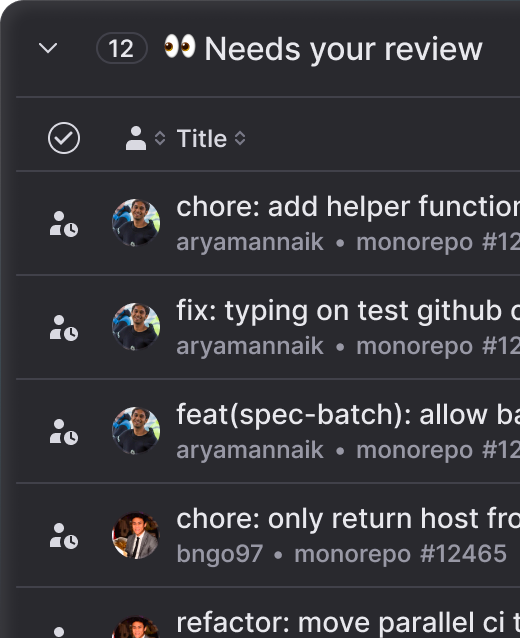
Graphite builds on Git and syncs with GitHub: an engineer can try Graphite without demanding that every colleague immediately adopt the same interface. A pull-request inbox organizes attention; a stack-aware merge queue respects dependencies when changes land. Insights supplies review metrics. The expertise lies in connecting these pieces, where an elegant local trick can otherwise become an organizational nuisance.
03 / A number with a denominator
At Ramp, engineer Rodda John already wanted small, stacked changes. His homemade scripts still left him spending time wrestling with rebases. Graphite’s customer story reports a 74% decrease in median time between merged pull requests after adoption, with roughly one to two hours saved per engineer each week.
“Not all time is created equal.”Rodda John, engineer at Ramp
The denominator deserves attention. Time between merges is a workflow measure, not proof that every feature takes 74% less time to build. Asana’s case study reports 21% more code shipped and 17% more pull requests merged in the first 30 days, compared with the preceding month. Both are company-published customer results, rather than controlled experiments.
Ramp case study
Asana case study
The useful takeaway is a measurement habit: examine review delays, request size, and merge intervals before purchasing productivity by the seat. Shopify, Snowflake, Figma, and Perplexity also appear among Graphite’s named users. The audience is software teams with enough collaboration for these delays to matter.
04 / More code needs more readers
AI made the waiting problem harder to overlook. When code arrives faster, review capacity becomes more conspicuous. Graphite added an AI reviewer, launched the Diamond brand in March 2025, and folded Diamond and Chat into Graphite Agent that October. Developers could ask questions and act on suggested fixes within the review experience.
Alternatives include native GitHub review, manual Git workflows, and dedicated AI reviewers such as CodeRabbit, Greptile, and Qodo. Graphite’s pitch combines the reviewer with the machinery around it: stacking, an inbox, chat, and merging. Teams shopping for a bot should decide whether that wider workflow is useful to them.
Subscriptions fund the product. The current annual-billing prices are $20 per user per month for Starter and $40 for Team; Hobby is free for personal projects, and Enterprise is quoted separately. Ten Team seats therefore cost $4,800 annually, before taxes. Team includes unlimited AI reviews and chat plus the merge queue. Adoption also costs time: people must learn to split work and handle dependencies thoughtfully.
05 / Cursor comes through the same door
Graphite announced a $20 million Series A in May 2022 and a $52 million Series B led by Accel in March 2025. That December, it announced an agreement to join Cursor. Lutsky said an acquisition had not been the plan; integrating code creation with review made the combination attractive. The announced agreement initially remained subject to closing conditions.
The connection became concrete in March 2026. Cursor Cloud Agents arrived inside Graphite, letting users prompt agents, inspect their pull requests, and request changes from the browser. Access requires a paid Cursor plan. April’s Code Tours added guided walkthroughs beside code changes, pulling together descriptions, conversations, and stack context.
06 / Copy the experiment, carefully
A team can start with one dependent feature, smaller requests, and a baseline for review time. Graphite is most relevant when waiting and branch maintenance consume meaningful effort. A solo project with little review has less to gain. Faster merging also needs dependable tests and people who understand what they approve.
The account-deletion experiment has limits, too: Foster acknowledged that employees rejoining an existing organization skipped first-time organization setup. Deletion would be costly where accounts contain irreplaceable work. The portable idea is to revisit an experience your team rarely sees. Graphite found a company in one such blind spot. Your own might be sitting quietly in a queue.
Follow the work
Explore Graphite, its plans and product journal. Watch the product tour (an older CLI walkthrough) or visit its YouTube channel.