The nutrition business has a fondness for the grand exit. Sugar is banished. Carbohydrates are served papers. An entire cupboard is escorted from the premises before breakfast. Praveena Kumar prefers an entrance. Put something useful on the plate, she suggests, then give it enough time and room to become ordinary. Her phrase is “slowly crowding out”: healthier foods arrive first, and the less helpful ones gradually lose their lease.
It is not a slogan designed for a dramatic before-and-after photograph. It is a working theory about people. Information can be delivered in an afternoon; habit has its own calendar. Kumar has spent more than 18 years in dietetics learning the distance between the two. She is a registered dietitian with MarinHealth Medical Network's Women's Heart Health Program, an Ayurvedic wellness practitioner, a yoga teacher, a yoga therapist, and the owner of an independent Bay Area practice called Nourish.
Four professional identities could make for a crowded business card. In her work, they form a sequence. Food leads to behavior. Behavior calls for attention. Attention lives in a body that moves and breathes. The important fact is not that Kumar has collected multiple vocabularies, but that she has spent a career making them converse without pretending they are identical.
Chapter one
The question before the practice
Long before “integrative” became an adjective attached to clinics, groceries and expensive weekends, Kumar turned the meeting of traditions into a research question. At San Francisco State University, where she earned a master's degree in nutrition, her 2006 thesis examined the prevalence of Ayurvedic medicine use among Asian Indians in California. The subject was not abstract. Ayurveda was culturally familiar to many people in the community, while the American clinical system often knew little about what happened outside its own rooms.
The thesis became a peer-reviewed study in 2008. Kumar and her co-authors interviewed 64 Asian Indians living in Northern California. Ninety-five percent knew of Ayurveda, 78 percent knew about Ayurvedic products or treatments, and roughly 59 percent had used or were using them. Then came the number that made the study more than a survey of familiarity: only 18 percent of the users had told their Western physicians.
A communication gap can look like empty space. In practice it is crowded with assumptions. One clinician may not ask; one patient may expect dismissal; one tradition may use categories the other does not recognize. Kumar's later career can be read as a patient answer to that early finding. She works where translation is not decorative. It determines whether advice is heard, whether context survives, and whether the person receiving it can do anything useful next.
The working life
Evidence in one hand, context in the other
When the study appeared, Kumar was affiliated with the Dietetics Department at Alta Bates Medical Center in Berkeley. She would go on to spend more than 13 years working as a clinical dietitian in acute-care and outpatient settings. Hospitals reward precision. A recommendation must account for the person in front of you, not an imaginary reader with unlimited time, money and enthusiasm. The lesson is wonderfully inconvenient for anyone selling universal rules: people are specific.
At MarinHealth, Kumar now provides individualized dietary recommendations and support within a women's cardiovascular program. Her own practice broadens the frame. Nourish brings together nutrition, plant-centered cooking, mindfulness, Ayurveda and movement. It is easy to mash such things into a fashionable puree. Kumar's training suggests a more deliberate arrangement. She graduated as an Ayurvedic Wellness Practitioner from Kerala Ayurveda Academy, completed yoga teacher and yoga therapy training with Dr. Ganesh Mohan, and continued studying yoga philosophy with A.G. Mohan and Indra Mohan of Svastha Yoga and Ayurveda in Chennai.
The work is a bridge, not a blender.
and measurement
and tradition
an ordinary day
The distinction matters. A bridge keeps both banks visible. Clinical dietetics asks what the evidence supports. Traditional practice can ask how food, routine and attention are understood by the person sitting across the table. Yoga introduces a way of noticing the body rather than treating it as a machine that has misplaced its manual. The aim is not to declare every idea equivalent. It is to keep a useful conversation open, specific and honest.
The small verb
Addition beats the purge
In a 2023 essay about developing a positive relationship with food, Kumar laid out a sequence that is almost suspiciously reasonable. Understand why a change matters. Look for reliable guidance. Set goals that are specific and achievable. Make incremental adjustments. Find support. Review what is working when life, as it tends to do, complicates the plan.
Then comes her most revealing sentence: “I've found that slowly crowding out the less healthy with healthier foods works better for a lot of people.” The verb is the story. Crowd out does not demand a ceremonial farewell. It assumes appetite, pleasure and routine are facts, not character defects. It gives the new choice a job beyond being virtuous: the new choice must also occupy space.
This is not passivity. Gradual change still asks for decisions, repetition and the occasional dull triumph of doing today what one also did yesterday. Kumar recommends goals with dates and measures. But she resists confusing severity with seriousness. A plan does not become sound simply because it makes dinner miserable.
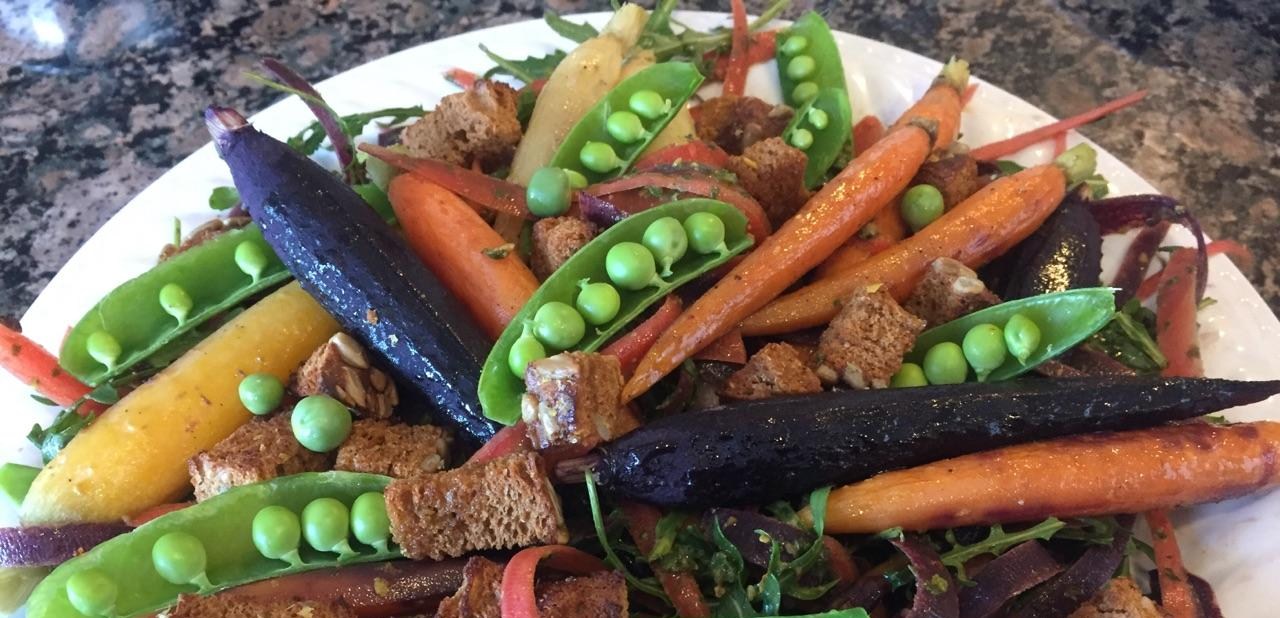
Her photographs of food make the point more cheerfully than a prohibition list could. Peas sit in their split pods, carrots retain their improbable colors, toasted bread and leaves refuse beige respectability. Nothing appears to be apologizing for itself. The plate is presented as abundance. There are worse ways to persuade a habit to move.
A career in four dates
The long route to something simple
A master's thesis at San Francisco State University asks how Ayurveda is being used among Asian Indians in California.
The research becomes a journal article, with Kumar identified in the Dietetics Department at Alta Bates Medical Center.
Kumar enters the national provider registry as an individual registered dietitian in California.
Her essay on a positive relationship with food turns years of practice into a plain argument for motivation, reliable information and gradual change.
The dates describe a career, but they also trace one recurring concern. The 2006 researcher wanted to know what people were doing beyond the clinician's view. The hospital dietitian learned what precision and individual circumstances demand. The teacher learned that an explanation must survive the room in which it is given. The practice owner gave these lessons a home.
Kumar's public affiliations stretch across the same territory: the Commission on Dietetic Registration, the Physicians Committee for Responsible Medicine, the National Ayurvedic Medical Association, Yoga Alliance and the International Association of Yoga Therapists. They are not a ladder toward a single grand title. They are more like coordinates, marking a professional position between systems that do not always share a map.
What remains
No trumpet, just Tuesday
The most appealing thing about Kumar's method is also what makes it difficult to package: it leaves room for time. A habit may take weeks to settle. A goal may need revision. Support is not an accessory but part of the mechanism. Progress can look less like revelation and more like groceries bought again.
There is a kind of confidence in refusing spectacle. It says the person does not need to become a different person before making a useful choice. The kitchen need not be purified. The old vocabulary need not be discarded. One can add a vegetable, ask a better question, tell a clinician about a traditional practice, or notice the body before issuing it another command.
Kumar closes her published advice with encouragement: “Above all, don't get discouraged.” It is the sort of sentence that can sound soft until one considers the alternative. Discouragement is efficient. It can end a plan in an instant. Encouragement is slower and requires maintenance. Perhaps that is why it belongs so neatly in her work.
The loud diet promises an escape from ordinary life. Kumar's quieter proposition is that ordinary life is the only place a change can prove itself. Not during the cleanse, the launch or the perfectly arranged Monday. On Tuesday. With the cupboard still imperfect and the person still entirely human. Add something good. Let it take up room. See what, over time, no longer fits.