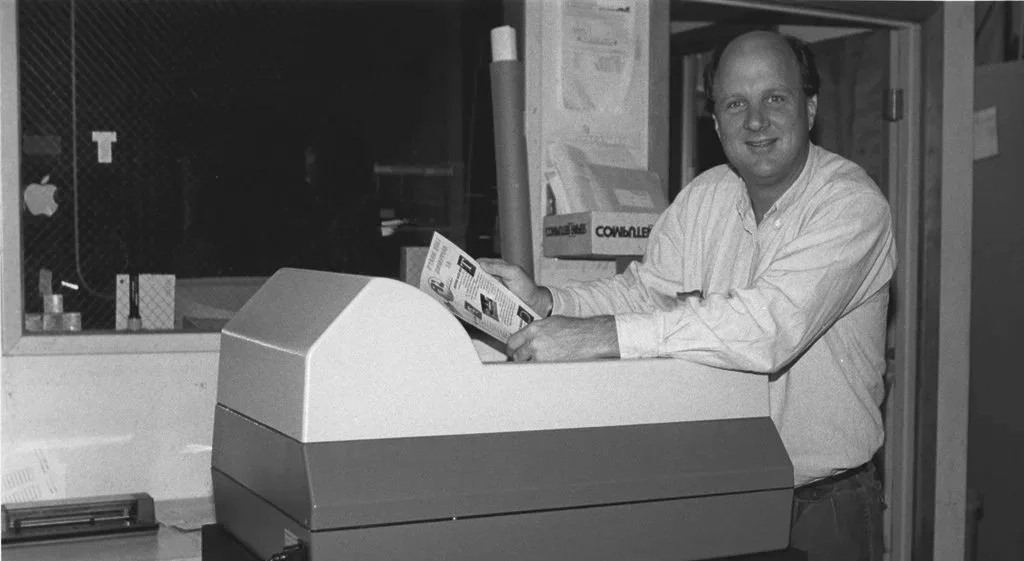
There is a photograph from 1977 of a man at work in a Menlo Park color lab. The room is small, the machinery serious, and the future has not yet arrived to explain that photographs will soon leave film behind. The man is Jim Peck. The business he started in that garage became JP Digital Imaging. What followed is less a story about printing than a lesson in how a company escapes the shrinking definition of its own name.
A color lab makes pictures. Today, JP Digital makes places. It prints wallcoverings that bend around a building’s interruptions, fabricates dimensional letters that become lobby landmarks, cuts privacy film for glass, produces tactile signs that satisfy accessibility rules, and sends installers to make the whole thing line up. The company’s customers are not people buying ten glossy prints. They are architects, contractors, facilities managers, and brand teams whose plans must survive contact with drywall.
The image escaped its frame
The company says advancing technology pushed its transformation from professional color lab to environmental-graphics specialist. That phrasing sounds tidy. The actual shift is more profound. Digital photography made image production easier and cheaper. JP Digital responded by following the image into the complicated world around it - onto glass, wood, acoustic felt, acrylic, vehicles, floors, and exterior monuments.
That move changed the job. A file can be duplicated perfectly. A building cannot. Walls bow. Beams interrupt patterns. vents appear where the rendering promised uninterrupted sky. Materials behave differently under sunlight, cleaning chemicals, or thousands of passing hands. A sign may need braille, a permit, illumination, or a mounting system that the architect approves before anyone switches on a router.
“We understand plans, submittals, phasing, and closeouts - and we move at the pace your project requires.”JP Digital Imaging
This is JP Digital’s useful distinction. It is a printer that learned the language of construction. The company reviews bid documents and finish schedules, measures sites, produces shop drawings, prepares proofs and samples, fabricates the work, and installs it. Its sales pitch to architects and general contractors is pleasingly blunt: “One Sub for Every Surface.” The product is not only the finished sign. It is the absence of five awkward handoffs.
A price tag appears in the hospital
Custom fabrication companies rarely publish a menu. The honest answer to “What does it cost?” is that the wall, substrate, code requirements, access, schedule, and installation determine the price. But public work occasionally lifts the curtain. In June 2025, San Mateo County approved JP Digital’s proposal for a wayfinding-signage upgrade at San Mateo Medical Center: $364,577.09, with authority for changes that could bring the maximum to $401,034.
The medical center’s old wayfinding was described as unintuitive, contributing to confusion and stress. That makes the contract an unusually clear statement of the problem JP Digital solves. Signage is a physical interface. When it works, a worried visitor reaches radiology without asking three strangers. When it fails, the failure is felt before it is admired.
The county received one proposal and judged it acceptable. That fact should temper any sweeping conclusion about market price. Still, it gives a real order of magnitude for a campus-wide institutional job - and shows why the business is not comparable to ordering a banner online.
The first failure is usually translation
Consider JP Digital’s work on Google’s Humboldt campus in Sunnyvale. Some wallcoverings stretched roughly twenty feet wide. They had to accommodate I-beams, HVAC elements, door openings, and changing wall heights. A beautiful PDF could not solve that puzzle. Field verification and careful panel planning could.
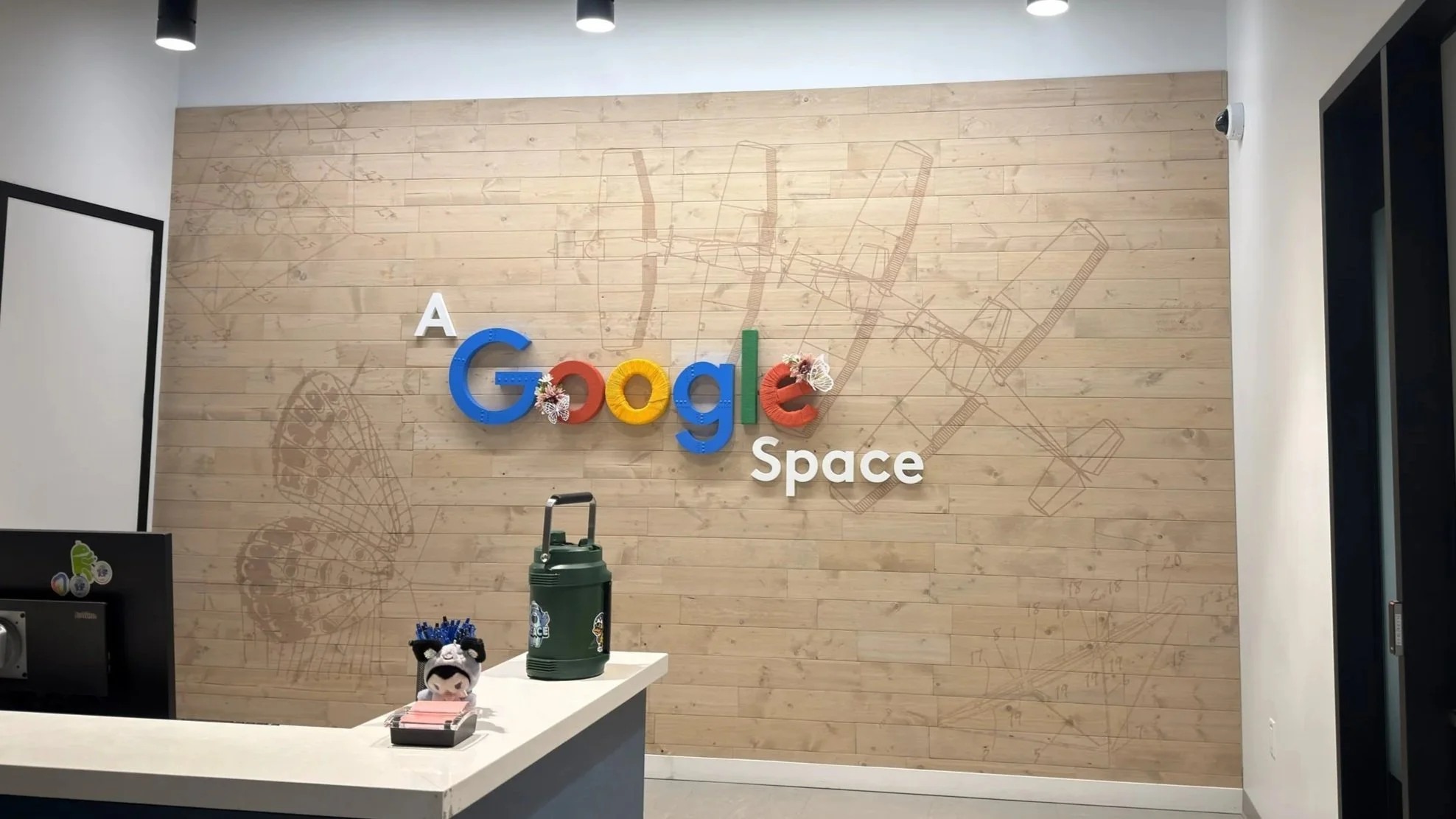
This is where environmental graphics differ from graphic design. The first thing to fail is often the translation between disciplines: a color changes on the chosen material; a seam lands through a face; an installer discovers that the site and drawing disagree. JP Digital’s workflow tries to make those failures happen while the work is still a sample, a proof, or a shop drawing - when the correction is annoying rather than ruinous.
Its current equipment makes that loop broader. A swissQprint Nyala 4 flatbed printer can put high-resolution graphics directly onto rigid and specialty substrates. CNC routing turns sheets into dimensional components. But the technology is not the differentiation by itself; other fabricators can buy machines. The advantage is connecting the machine to measurement, materials knowledge, project management, and installation.
What the children refused
The most revealing JP Digital project may be the Stad Center at UCSF Benioff Children’s Hospitals. During research, young patients rejected “little kid” décor. They did not want primary colors, repetitive cartoons, or more blank clinical walls. In one memorable detail, children associated penguins with pain because another clinic had used them too often.
NBBJ designed four Northern California environments - forest, grassland, beach, and bay - with layered silhouettes, interactive animals, printed wall protection, and ceiling graphics. JP Digital served as the physical fabricator, working with Dome Construction and the design team to turn the concept into PETG graphics, 3M materials, layered Corian, and dimensional details. The project received a 2025 SEGD Global Design Honor Award.
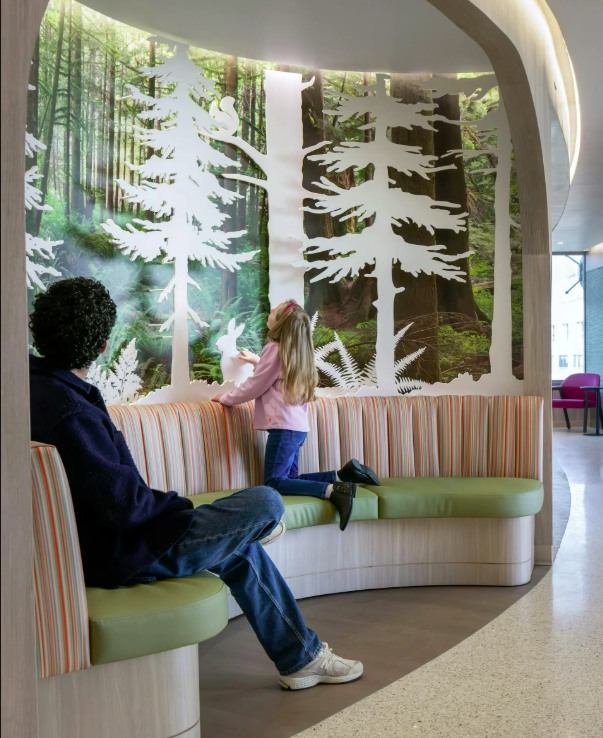
The project explains who JP Digital is when it is most useful. It did not invent the care model or lead the architecture. It made an ambitious design physically credible. The finished environment had to feel imaginative without becoming childish, invite touch without becoming fragile, and provide variety without becoming incoherent. This is not commodity output. It is precise collaboration.
A business built in the expensive middle
JP Digital earns project revenue from custom design support, fabrication, printing, project management, and installation. Its market sits between creative studios that specify an experience and construction teams that must deliver a building. Its competitors range from local sign shops and wide-format printers to wallcovering installers, exhibit builders, and national environmental-graphics firms.
Its integrated model works best when the job contains costly ambiguity: multiple materials, code requirements, awkward surfaces, phased construction, or many locations. It is less persuasive for a standardized commodity print, a project where the buyer wants to coordinate every trade separately, or a site that cannot be surveyed properly. Nor is fabrication a substitute for brand strategy. The model begins to earn its keep after there is a real spatial problem to solve.
There is another constraint hiding inside custom work: cash arrives on a different schedule from materials and labor. In a testimonial for Ardent Financing, Peck said a bank declined to fund a large contract and outside working capital enabled the company to complete it. No amount or project was identified. The anecdote is useful because it reveals the unglamorous machinery beneath impressive interiors. Growth can fail at the gap between winning the order and paying to make it.
The bits worth stealing
The transferable lesson is not “buy a larger printer.” It is to move toward the part of the customer’s problem that remains stubborn after your original product becomes easier to copy. JP Digital did that by adding responsibility: more surfaces, more coordination, more field conditions, more ownership of the final fit.
Bundle adjacent jobs when the customer’s real pain is coordinating specialists.
Sample the material, seam, color, and mount before producing the whole room.
Learn the client’s documents, deadlines, codes, and closeout rituals.
Explain cleaning, sunlight, traffic, repair, and replacement before talking spectacle.
The company describes its mission as creating spaces that connect people through design, precision, and innovation. The more practical version may be even better: make the imaginative thing survive the ordinary day.
Nearly fifty years after the garage, JP Digital still makes images. They simply have weight now. They occupy corridors. They hide a crab behind a movable rock, point a patient toward an appointment, wrap around an I-beam, and wait for someone with a level to make sure the idea is straight.