Pratip Biswas has shared an office-assembly moment with the sort of enthusiasm usually reserved for a product launch. His team was getting hands-on with its own space, and the founder of Unified Infotech turned the occasion into a small argument for collaboration. Even a software company occasionally needs to put something together that cannot be fixed with an update.
It is a useful place to begin with Biswas. The public version of a technology founder often arrives wrapped in forecasts. His own writing keeps returning to more immediate obligations: listen to the team, understand the client, choose the tools carefully, and give the customer a reason to return. The ambition is international. The questions are often pleasantly down to earth.
The brief before the blueprint
Biswas founded Unified Infotech in 2010. He now leads it as CEO, with a public professional base in New York and a business that also operates in Kolkata. The company builds custom software, websites and mobile applications, alongside consulting and related engineering services. Its clients include startups and established businesses with rather different needs and tolerances for uncertainty.
His explanation of the founding idea begins with consulting. He wanted a technology services company that could improve how businesses operated through software made for their requirements. That places a particular responsibility on the opening conversation. Before an engineer can settle how to build something, somebody must understand why it deserves to exist.
The idea sounds modest beside the vocabulary available to a technology executive. It is also demanding. Consulting means asking enough questions to discover when the requested feature and the underlying problem have parted company. A beautiful screen can be an expensive way to preserve a bad process. The client is entitled to expect a little curiosity before receiving the estimate.
In his development interviews, Biswas ties platform selection to business objectives, required functionality and budget. Scope and complexity affect the schedule. There is no universal allocation of effort between the visible interface and the machinery behind it. A tidy answer would be convenient for a sales brochure; a project has the discourtesy of being specific.
objectives
functionality
budget
Then choose the technology
Design has been part of that pitch for years. In a 2019 company announcement about a Clutch ranking, Biswas described the goal of making interfaces that engage people and support commercial results. The language connected appearance with the reason a business commissions a site. A page can receive compliments and still leave its visitor wondering what to do next.
That concern gives his later customer-experience writing a history. The work begins with someone on the other side of the screen trying to make progress. A design decision should help that person understand the offer, find the relevant information or complete the next step. For a founder whose company sells both design and engineering, the connection matters: the attractive part and the functional part have to keep the same promise.
A business that has to earn the next brief
For a founder selling expertise, the relationship continues after the demonstration. The customer eventually has to use the work. Staff have to learn it. Another system may need to connect to it. The next conversation can be considerably less flattering than the first, which is one reason repeat work deserves attention.
In the company’s March 2020 interview account, Unified reported 90 percent repeat collaboration and said 70 percent of new business came through referrals. Those figures describe that period and the company’s own account of its business. They are useful here because they show the kind of evidence Biswas’s company put forward: customers returning and customers introducing somebody else.
A referral carries a small social risk for the person making it. Recommending a supplier attaches your judgment to someone else’s delivery. For a services founder, that makes the introduction a meaningful business asset. It has to survive the experience of the person who receives it.
Biswas also wrote about B2B customer loyalty in 2020, considering why relationships between businesses require attention to the particular buyer. It fits the recurring emphasis in his public work. A client arrives with a set of practical circumstances. Treating every brief as an opportunity to deliver the same answer would be a peculiar way to sell customization.
The boss takes a seat with the team
His leadership writing supplies a companion idea. In a January 2021 essay, he argued that leaders benefit from having learned to follow. He examined ego, judgment, commitment, communication, honesty and the courage to challenge a strategy respectfully. The corner office, in this view, should have a working door.
“Removal of ego is the first step towards becoming a better boss.”
Pratip Biswas · 2021 leadership essay
The advice has a practical application in software. A developer may know something the manager has missed. A designer may see a problem before it becomes a support ticket. A client may describe the difficulty badly and still be entirely right that the difficulty exists. Rank offers no reliable protection against overlooking the obvious.
His essay asks leaders to keep communication open and take the experience of colleagues seriously. It is advice he has chosen to publish, rather than a claim about every meeting he runs. Read beside his consulting approach, it suggests a consistent intellectual preference: useful information should be able to reach the person making the decision.
The office-assembly post offers a lighter expression of that theme. He presented the team’s practical work as another occasion to collaborate. The appeal is easy to understand. A shared task gives everyone something concrete to discuss, and the results can be inspected without opening a slide deck.
Two cities, one working conversation
New York and Kolkata are central to the company’s public identity. One brings it into the conversation with American clients; the other is home to its Indian delivery operation. For Biswas, the professional story crosses both places. His public profiles locate him in New York, while his company’s history and industry connections reach into West Bengal.
One early documented connection comes from February 2015. He participated in a Bengal Chamber roundtable on collaboration in IT business and managing global competition. The gathering brought together technology entrepreneurs and industry representatives, including Indus Net Technologies founder Abhishek Rungta and NASSCOM’s eastern regional representative Nirupam Chaudhuri.
That setting adds texture to the later international profile. A software business grows among other businesses: potential collaborators, competitors, organizations trying to make a region more visible. The Chamber discussion concerned the prospects of midsize IT companies. It places Biswas in a specific business community, years before the later award announcements.
His networking has also had a more informal register. Ahead of London Tech Week in June 2025, he publicly invited fellow attendees to meet for coffee or a conversation. The invitation was straightforward. Even an industry devoted to digital connection still finds uses for a table and two cups.
- 2010Founds Unified Infotech
- 2015Joins Bengal Chamber IT roundtable
- 2021Publishes his essay on leadership and followership
- 2025Company announces its first Inc. 5000 placement
- 2026Publishes a CMO guide to AI in customer experience
A trophy, and the work outside the frame
Several public milestones arrived in 2025. Biswas appeared in a CIO Insider company spotlight interview. Unified announced its first placement on the Inc. 5000 list in August. In September, he accepted a digital transformation award for the company at the Entrepreneur Awards in New Delhi.
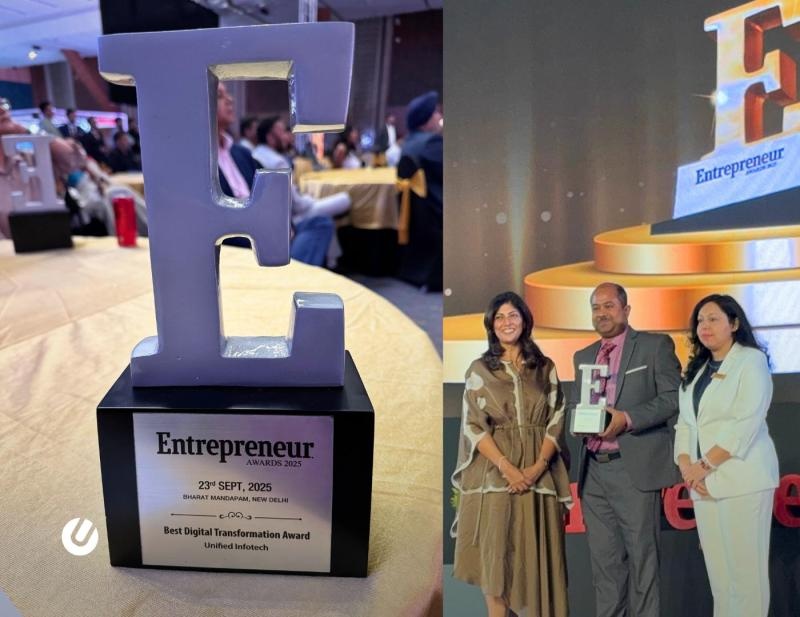
The photograph gives the recognition a pleasingly physical form: a substantial letter E, an engraved base, people on a stage. An award is much easier to photograph than a well-handled requirements meeting. That does give the trophy a certain editorial advantage.
The interviews around this period return to the work behind the recognition. Biswas described a translation-company project that brought project management, documents, delivery, billing and customer feedback into a connected system. The example makes his consulting pitch tangible. Several ordinary operations had to work together before the business could feel the benefit.
His stated roadmap includes international partnerships, developing talent, modernizing older systems and expanding capabilities in emerging technology. These are plans with consequences for the organization as well as its catalogue of services. New capabilities need people who can apply them, and clients need a reason to pay for the application.
“At Unified Infotech, we measure success by the impact our solutions create for clients.”
Pratip Biswas · August 2025 company announcement
AI gets a job description
Biswas’s interest in AI predates the recent rush to put a conversational interface on everything. In October 2020, he wrote about artificial intelligence in web design. His argument gave automation a supporting role: taking on routine work could leave designers with more room for creative decisions. Human judgment retained a place in the process.
By January 2026, his attention had moved to a fuller customer experience. His guide for marketing leaders begins with the journeys visitors need to complete and asks how AI should help. A website has to guide someone toward a decision, answer a question or resolve a difficulty. The conversation window is one part of that experience.
The guide proposes choosing a few valuable journeys, establishing measurement, organizing dependable knowledge and providing a route to human assistance. Its staged rollout gives teams time to observe failures and improve the experience. This is a more exacting brief than making a demo appear conversational. A fluent answer still needs somewhere useful to lead.
Across these writings, a recognizable question persists: what job is the technology doing for the person using it? For the founder who began a consulting-led software company in 2010, AI offers another occasion to ask it. The tools have changed. The customer still has something to get done, and Biswas’s argument gives that unfinished task the first appointment.