The enterprise technology industry has never met a noun it could not improve with a cloud, a platform, or a transformation. Prakash Kolhe has spent more than twenty-five years living with what happens after the noun reaches the meeting room. Systems must connect. Data must reconcile. Someone must answer when a clever demonstration encounters an old process, a nervous client, and a deadline with no sense of humour.
That long exposure to consequence explains the appealing plainness of Kolhe's current message. The founder and CEO of Cymetrix works in Salesforce consulting, data platforms, marketing automation, analytics, and enterprise AI. Yet his most useful idea is almost defiantly unflashy: automation and intelligence are not synonyms. A machine can execute a rule at astonishing speed while making no better decision than the rule permitted.
The distinction is small enough to fit on a slide and large enough to rearrange a technology budget. If the goal is a better decision, the work begins below the shiny layer. Customer information has to be joined. Permissions have to be clear. The record has to be clean enough to trust. The output needs an owner, a measure, and a reason to exist. Only then does speed become more than expensive motion.
A career built one layer at a time
Kolhe's career reads like a tour through the machinery of enterprise software. He began at HCL Technologies in 1998 as a project lead. In 2003 he moved to Quark as director of research and development. Three years later he joined Bank of America as a vice president, working on retail banking technology delivery in India. He returned to HCL in 2010 as a general manager responsible for client services in financial services, then moved to Virtusa in 2012 as a director with business development responsibilities across the Asia-Pacific region.
Each chapter added a different kind of context. Project delivery taught the discipline of shipping. R&D supplied the product lens. Banking placed software inside a business where reliability, process, and customer trust are practical requirements. Client services turned technology into a relationship. Business development added markets, timing, and the delicate art of making a promise that the delivery team can still respect on Monday morning.
Kolhe also earned a Master of Engineering from Visvesvaraya National Institute of Technology and an MBA from IBS Hyderabad. The pairing suits the arc: understand the system, then understand the organisation asking for it. He was active in the Computer Society of India's Mumbai Chapter, another link between the technical work and the professional community around it.
In 2018, Kolhe became CEO of Cymetrix. He was already a founding member, and his appointment put him in charge of growth and organisational change while the company worked across the United States and India. Cymetrix's brief widened over time from Salesforce implementation and CRM work to a broader combination of data, analytics, automation, cloud integration, and AI.
The intelligence underneath the automation
Kolhe's recent writing and talks concentrate on a familiar corporate desire: make each customer interaction timely, relevant, and measurable. Marketing teams, he observes, can build elaborate campaigns and calendars. Customers never see the calendar. They see a message that matters or one that does not. Decision-led marketing shifts attention from executing a planned sequence to choosing the next useful action in context.
That context requires memory. A CRM may know the sales conversation. A service platform knows the complaint. A website knows the visit. A transaction system knows the purchase. Left apart, they describe several incomplete people. Joined carefully, they can form the customer record that Kolhe treats as the foundation for useful AI.
This is why his vocabulary returns so often to integration, Data Cloud, customer 360, and governance while the industry is busy admiring autonomous agents. An agent can work all night. Whether that is a benefit depends on what it knows, which actions it may take, and who notices when its confidence exceeds its wisdom.
The warning is not a retreat from AI. Cymetrix is building directly in the category, including Salesforce Agentforce, data platforms, and automation. It is a demand that the new layer earn its authority. Kolhe has written about preventing hallucinations, compared enterprise data platforms, discussed agent architecture, and spoken about AI across the marketing funnel. His argument stays consistent: the model is one participant in a system, not a visiting oracle with excellent branding.
Start with one useful decision
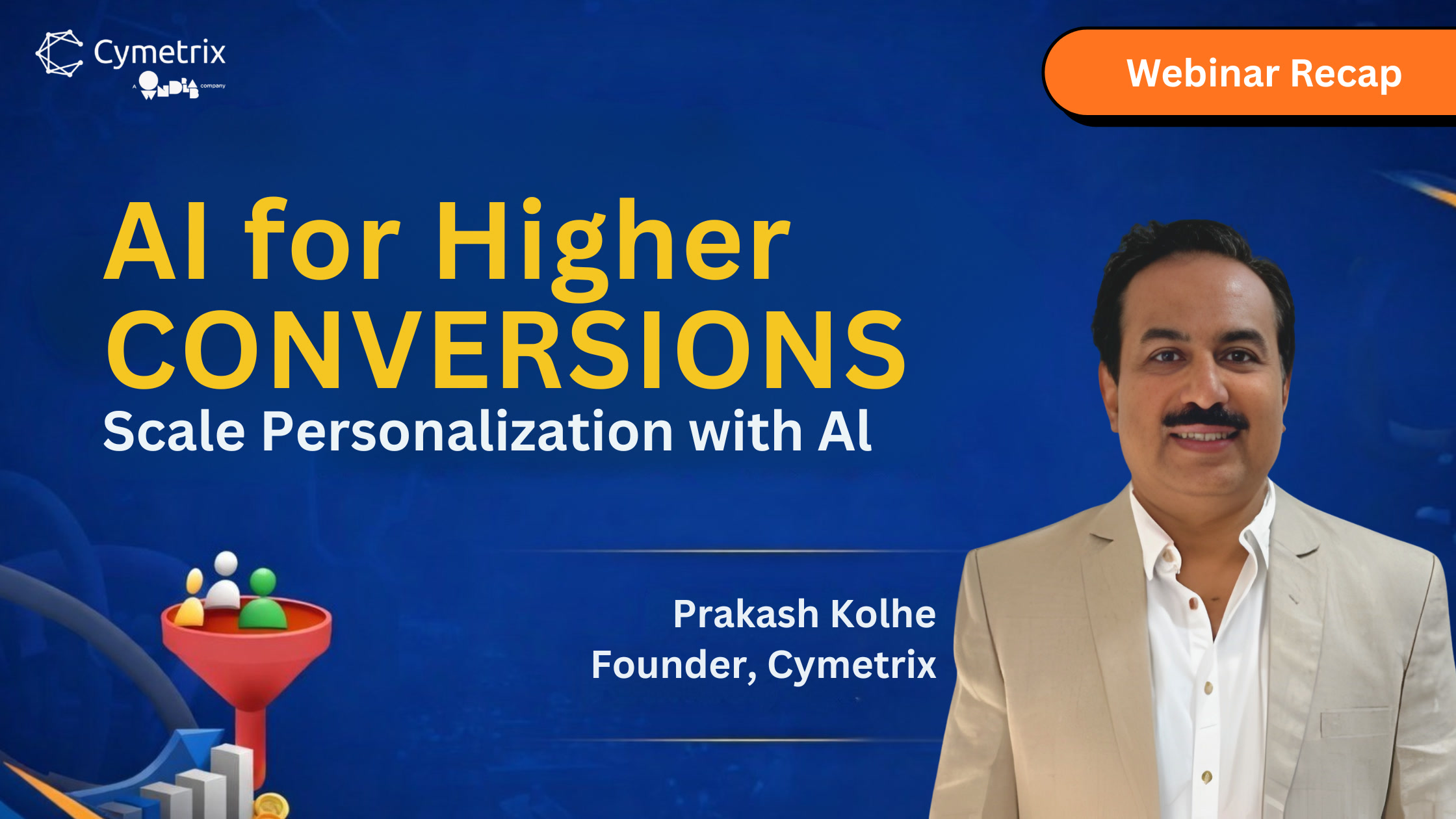
The most revealing part of Kolhe's 2026 webinar arrived when the conversation turned to smaller companies. The full enterprise stack can be expensive. Data platforms, CRM, marketing tools, and specialised AI products accumulate cost and complexity quickly. His advice was to resist the grand entrance.
Begin with the customer data already available. Choose a CRM and a marketing tool that fit the budget. Test one channel, perhaps email. Learn whether the decision improves. Add another layer when the first one produces enough value and understanding to deserve company. It is the enterprise equivalent of refusing to buy a ballroom before learning whether anyone wants to dance.
This incrementalism is not a lack of ambition. It is a way of protecting ambition from architecture. Large transformation programmes often begin as diagrams in which every arrow is necessary and every box appears ready. Reality enters later carrying duplicate records, missing fields, old integrations, and a finance team. Kolhe's sequence allows reality into the room at the beginning.
The same pragmatism shapes his view of people. He does not frame AI as the elimination of the marketer. Automation can remove manual tasks, generate variants, watch signals, and act continuously. Human creativity still supplies judgment, intent, and the standards that make a message worth sending. The tool can multiply an idea. It cannot rescue a pointless one from its purpose.
The operator's advantage
Kolhe's public persona is more operator than futurist. His examples concern funnels, data quality, integrations, customer records, campaign performance, and return on investment. Even when he discusses agentic enterprises, the verbs are practical: connect, govern, measure, train, control. There is little romance in a golden customer record, except to the person who has spent a quarter discovering that three departments disagree about the same account.
That operator's view may be his useful contribution to the present moment. Enterprise AI does not suffer from a shortage of possibility. It suffers from the distance between possibility and a dependable workflow. Kolhe has worked on both sides of that distance: inside large organisations buying and delivering technology, and inside a consulting company expected to make the promise function.
Cymetrix now sits within the Wondrlab group, giving Kolhe another set of connections across technology, data, and marketing. Recent activity has included Salesforce events in Mumbai and Chicago, a 2026 webinar on AI-driven personalisation, and a steady stream of articles on Data Cloud, Agentforce, integration, and marketing automation. The subject changes. The operating question does not: what information is available, what decision follows, and can the result be trusted?
There is something reassuring about a technology leader making the case for better plumbing. The future will still contain agents, predictions, personalised journeys, and interfaces that speak with unnerving fluency. It will also contain databases that need cleaning, systems that need joining, and humans who must decide what the machine is allowed to do. Kolhe's career has prepared him for both versions. He simply insists they are the same version.
A test the technology can answer
Strip away the product names and Kolhe's playbook becomes a compact set of questions. What decision are we trying to improve? Which data makes that decision possible? Is the data accurate, permitted, and current? Where will the action happen? How will a person intervene? What result will justify the cost? These questions are not as dazzling as a live demonstration. They are much harder for a weak project to survive.
They also return responsibility to the organisation. A vendor can supply a model, an agent builder, or a data platform. It cannot decide what the company values, which mistakes are acceptable, or when convenience becomes intrusion. Those choices sit with operators. Kolhe's emphasis on governance is therefore not only technical housekeeping. It is the point where a business states the terms on which automation may represent it.
For founders and executives, the lesson is wonderfully stealable. Choose a narrow decision with visible consequences. Assemble only the data it needs. Place a human checkpoint where the cost of error rises. Measure the outcome over enough time to learn something honest. Then decide whether to expand. The approach lacks fireworks, but fireworks have never integrated a CRM.