The first surprise about Poppy Flowers is that its origin story begins underground. Cameron Hardesty was working in the Obama White House, in communications rather than horticulture, when she began volunteering in the White House Flower Shop. The basement room offered a parallel education: stems, color, mechanics, deadlines. She later joined UrbanStems and spent four years learning how e-commerce, merchandising, and global sourcing could be applied to flowers. Then she planned her own wedding and ran into a stubborn exception. Nearly everything else could be researched, compared, and changed online. Wedding flowers still arrived through long email chains, unclear minimums, and proposals that could take weeks.
Hardesty knew the supply side well enough to order from farms and assemble a local team. She has said that knowledge saved her roughly $18,000. Most couples cannot be expected to have relationships with growers in Colombia or Ecuador, much less know which local designer can receive boxes, condition stems, build an arch, and reach a venue before the photographer. Poppy, founded in 2019, packages that fluency into a service.
A flower shop with a control panel
To a couple, Poppy behaves like a national full-service florist. The process starts with a short style quiz built around mood, palette, and feeling, rather than a test of botanical vocabulary. That produces a proposal the couple can inspect and adjust. Add a centerpiece, change the bouquet mix, reconsider the ceremony installation: the price responds with the plan. A floral consultant remains available, but the customer does not have to send 20 messages just to discover what one change costs.
The offer covers personal flowers, ceremony pieces, reception arrangements, delivery, and setup. Poppy publicly advertises a $1,750 minimum and a $249 deposit, with contracts that remain flexible until 60 days before the event. Those numbers matter because the company is not competing only on taste. It is selling legibility to people making an expensive purchase they may never make again.
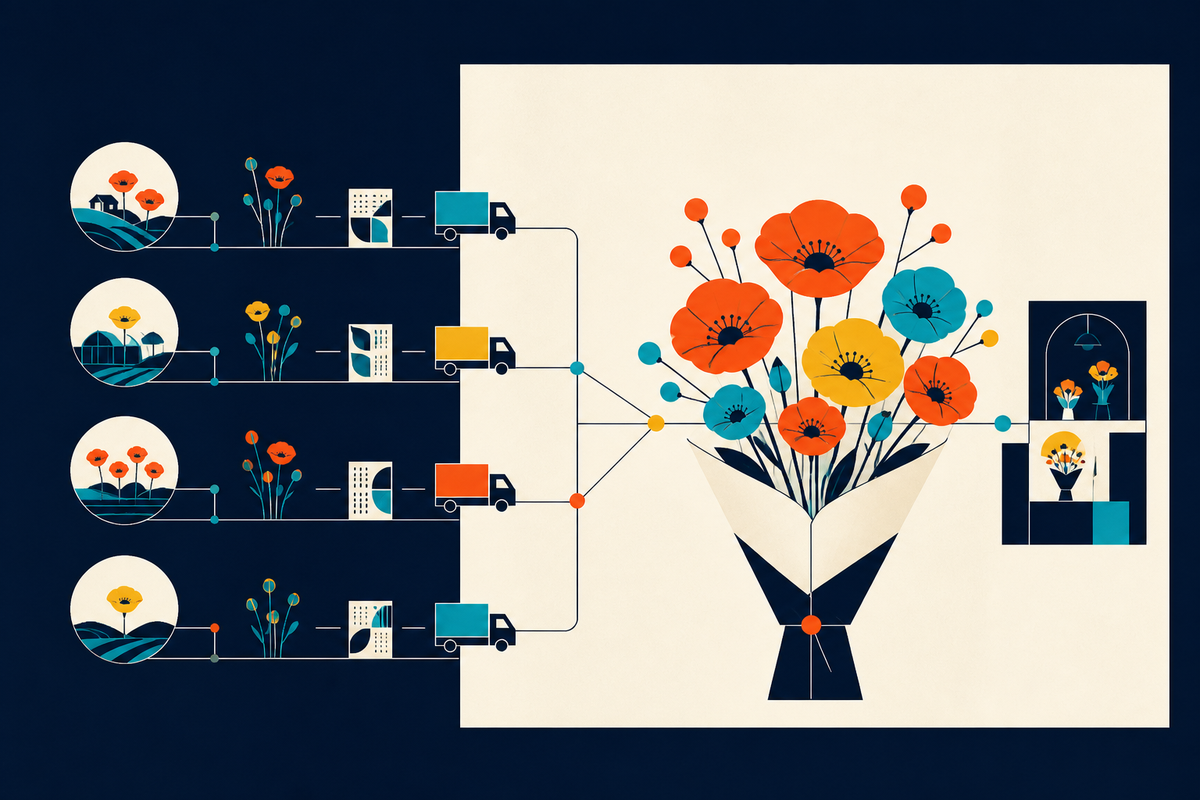
A traditional studio usually owns the whole job: it attracts the lead, translates inspiration, prices every vessel and stem, chases the decision, buys the flowers, schedules labor, designs the pieces, and manages the venue handoff. Poppy separates that bundle. Its central team handles marketing, sales, proposals, payments, procurement, communication, and much of the logistics. Local designers accept projects, receive recipes and run-of-show details, take delivery of flowers and hard goods, and do the creative, physical work.
The marketplace is managed, not merely matched
Calling Poppy a marketplace is accurate but incomplete. A lightweight marketplace introduces a buyer and seller, then steps aside. Poppy stays in the middle. It specifies the recipe, coordinates farm-direct product, sends hard goods, supports the designer, and owns the customer experience. Its partner materials describe detailed design guides, logistical instructions, and on-demand operations support. That is more cumbersome than a directory, but it is also the source of consistency.
For designers, that creates a different kind of gig. They can take work that fits their geography, calendar, and capacity without carrying the entire cost of acquiring and closing a client. Poppy has highlighted a retired special-education teacher who entered the network after arranging flowers for her son's wedding and later completed her 100th Poppy event. Other members are established studio owners filling gaps in their books. The network is not women-only, but the occupation is overwhelmingly female, and the company's pitch emphasizes flexible creative income.
There is a tradeoff. A designer working within a shared system accepts a defined recipe and customer brief rather than selling only her own signature aesthetic. A couple, meanwhile, collaborates remotely and may not meet the week-of designer during the early sales process. Standardization earns its keep only if the handoffs are good. In wedding work, a bad handoff is not a minor software bug. It is visible in every photograph.
Its customer lives in the missing middle
Poppy's natural customer is neither a committed DIY arranger nor the buyer commissioning a singular floral world from a famous studio. It is the couple who wants real customization and day-of installation, has a firm budget, and would rather begin with a concrete proposal than wait for a consultation to reveal whether the idea is affordable.
The wedding-flower choice is a spectrum
Wedding planners are another important audience. A planner needs a florist who responds, scopes clearly, and arrives with the right labor. Poppy's central system can make that repeatable across cities. The supply side matters just as much: independent designers get qualified jobs without spending evenings on sales calls and revisions. Farmers gain a coordinated buyer. The company's advantage, if it holds, is not any single arrangement. It is the density of those relationships plus the data produced by thousands of proposals and weddings.
Perishability is the boss
Software can make a proposal instant. It cannot negotiate with a peony that opened too early. Flowers are living inventory: seasonal, delicate, color-variable, and moving through a cold chain toward a deadline with no extension. Poppy says it sources from Rainforest Alliance and Fair Trade certified farms, many in South America, as well as other growers. Stems are selected against the design recipe, shipped to a local professional, conditioned, arranged, transported again, and installed in a narrow venue window.
This is why the company's logistics expertise matters more than its e-commerce surface suggests. It must forecast demand, substitute when nature declines to honor a mood board, package hard goods, coordinate freelance labor, and preserve enough margin for both the platform and designer. The operation resembles event production, procurement software, and perishable distribution wearing a very attractive boutonniere.
The pandemic detour that became a product
Poppy prepared for a national wedding launch in early 2020, which history greeted by cancelling weddings. Growers were discarding flowers while consumers were stuck at home. The company responded with Poppy at Home, boxes of curated stems meant to be arranged by the recipient. The kits remain available as one-time purchases and subscriptions, generally beginning around $95 to $105 for named palettes.
The pivot did more than produce emergency revenue. It exercised the direct-from-farm supply chain, introduced customers to the brand, and gave Poppy a product outside the wedding calendar. It also clarified the two poles of the company: sometimes the customer wants to play florist; sometimes the customer wants to wake up, get married, and never think about a centerpiece delivery.
Funding the invisible work
Investors have repeatedly financed the operating layer. Poppy announced a $1.65 million seed round in 2021. In late 2023 it raised a $6.5 million Series A led by Michigan Capital Network, after facilitating more than 3,000 weddings across 52 cities. A $2.66 million extension followed in November 2025, with Michigan Capital Network again leading and Virginia Venture Partners, IDEA Fund Partners, Wakestream Ventures, and Front Porch Ventures participating.
The latest capital was assigned to AI and data tools, B2B relationships, and leadership in product, engineering, and operations. The useful boundary is explicit: automate paperwork and prediction, not the designer's eye or hands. A model might accelerate a proposal, surface likely substitutions, or forecast demand. It cannot wire a trailing amaranthus stem into an arch during a crosswind.
Where Poppy fits now
The competitive field is fragmented. Local florists offer proximity, taste, and deep venue knowledge. DIY wholesalers compete on raw material cost. Marketplaces such as BloomNation help shoppers find independent shops. Consumer brands including UrbanStems, The Bouqs, Farmgirl Flowers, 1-800-Flowers, and FTD have trained people to buy bouquets online, but everyday gifting is a different operational problem from installing a wedding.
Poppy sits across those categories: consumer service, e-commerce, managed marketplace, and logistics company. Its public figures illustrate the reach. By late 2025, reporting put the network above 1,100 designers and the customer count above 6,000 couples. In 2026, Poppy's own reviews page said more than 10,000 couples had chosen the service and displayed a 4.7-star weighted rating across more than 450 public marketplace reviews. The company also refreshed its Real Weddings gallery so prospective customers could filter hundreds of events by budget, palette, location, and season. A portfolio became a planning database.
That last change captures the larger idea. Wedding florals will always contain uncertainty because nature, taste, and live events do. Poppy is not trying to abolish the uncertainty of flowers. It is trying to remove uncertainty from everything around them: what is included, what it costs, who is responsible, and what happens next. The business is the promise that custom need not mean mysterious.
Keep exploring
See the planning experience, browse real work, or hear Hardesty discuss the future of the floral industry.