The mother in Orange County knew which summer camp deserved a second look. She knew which salon could manage a rushed afternoon, which indoor playground was worth the drive, and which merchant could survive a crowd of coupon holders. Plum District built a business around that knowledge. Its salespeople were mothers in the neighborhoods they covered. Its customers were other mothers. The vouchers were merely the paperwork.
The short version
- Plum District sold discounted family products, services and local experiences through email, a website and later an iPhone app.
- By late 2011 it reported nearly one million subscribers, more than 10,000 deals and 300 local consultants across 27 US markets.
- The local network proved costly. After layoffs and market closures in 2012, the company leaned toward national offers.
- Coupon Lawn says it bought the website in 2020; the original domain now points to its coupon business.
The premise sounds quaint until you remember the state of local shopping in 2010. A deal site could put a half-price voucher in an inbox, but it could not tell a parent whether the place was worth spending Saturday there. Plum District tried to close that gap with people. Founder Megan Gardner, who had been approached by investors interested in the daily-deal boom, said she would take the job only if the strategy changed. Her chosen audience was mothers: people buying for themselves, children and households, and talking to one another about those purchases.
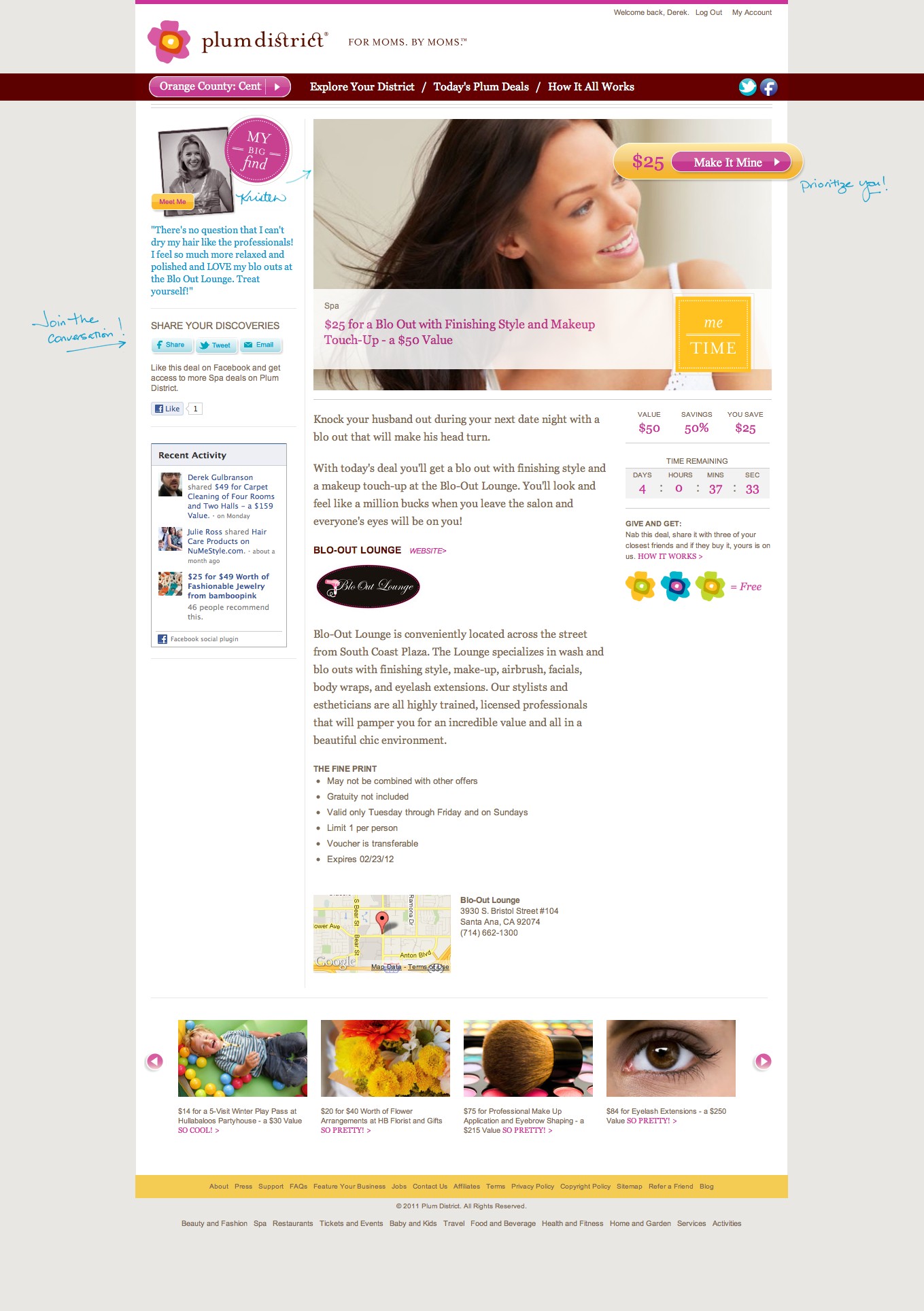
That changed both sides of the sale. A consultant knew the merchant; another mother recognized her judgment. The site offered local outings, children's activities, beauty services, restaurants and national products. Members received offers in their inboxes and bought discounted vouchers. Merchants got promotion and, ideally, customers who would return at full price. A school fundraiser could even pay a PTA $3 for each new signup through its referral link. The coupon was also a recruiting tool.
The neighborhood was the sales floor
Gardner called the field sellers “District Consultants.” Some had run PTAs or soccer leagues; some had backgrounds in marketing and sales. They found merchants, negotiated offers and brought local taste to a format usually sold from a call center. In a 2011 interview, Gardner put her objection plainly: “Early on I knew a call center approach wouldn’t work for making deals.” Her answer was to hire people who already understood the town.
The payment structure was ordinary enough to reveal the hard part. Gardner gave the example of a customer paying $50 for $100 worth of summer camp. The $50 was split between the merchant and Plum District, and the consultant took a percentage of Plum District's portion. Shoppers did not pay to join; they paid when they bought an offer. A merchant was, in effect, paying for marketing out of the voucher proceeds. How much that customer would spend later was the important unknown.
It was a clever way to make a crowded product feel specific. Groupon could sell a cheap massage in almost any city. Plum District could say a local mother had picked it. DoodleDeals and CafeMom's mom.com also chased parents, while Zulily focused on discounted goods for families. Plum District's distinct bet was the human distribution network: local mothers supplying both inventory and credibility.
One million inboxes, hundreds of front doors
Capital arrived quickly. Plum District raised $8.5 million in January 2011 from Kleiner Perkins and General Catalyst. That December, it announced a $20 million Series C led by General Catalyst, with Kleiner Perkins, Comcast Ventures and Duke University participating. Disclosed financing totaled about $30.6 million. The money bought expansion, but expansion here meant far more than adding a city to a dropdown menu. Each new district needed a list of subscribers, a roster of merchants and a trained local seller.
Company figures reported in December 2011. Plum District also reported nearly one million subscribers at the time.
The company bought DoodleDeals for a stronger New York presence and distribution relationships, and Chatterfly for a mobile loyalty system. Those were two related hopes. DoodleDeals could help fill the top of the funnel; Chatterfly might persuade a first-time bargain hunter to come back. It also helped local merchants imagine something beyond a single burst of discounted traffic. A reported 75 percent of subscribers had shared a deal by email or social media, which made word of mouth look like a product feature.
In August 2012 the iPhone app arrived. It let members browse, buy with one click, redeem offers and keep track of unused vouchers. The company said it had 1.3 million members, up from roughly one million the previous December. Chatterfly's fuller loyalty features remained in development. For a shopper, the app made a discount easier to carry; for Plum District, it offered another chance to stay present after the first sale.
Then the map got smaller
That same August, reporting described layoffs of regional sales managers and corporate staff, and the closure of at least 13 of the 27 markets Plum District had once covered. Gardner confirmed a restructuring of the local sales model and said some people had moved to a national sales team. The company disputed reports of a cash crisis. The visible change was unmistakable: the neighborhood-first machine was losing neighborhoods.
That is the price of its best idea. The company could make a local offer feel trustworthy, but every additional market demanded fresh human work. A national retailer, by comparison, could supply an offer across many inboxes at once. The change in direction did not prove the audience choice was wrong. It showed that an audience insight and a sales system have to survive the same arithmetic. Deep discounts leave only so much to divide among the merchant, the platform and the person who found the deal.
The more immediate weakness sat with merchants. A packed appointment book on coupon day was useful only if the discounted visitors returned or spent enough to cover the margin lost. This was a problem across daily deals, not a uniquely Plum District failure. Its local consultants were supposed to improve the fit between offer and customer. If that fit did not generate repeat business, personal curation made an expensive introduction.
Gardner left the CEO role in 2013, and longtime executive Susan Kim took over. The company acquired Spotivate, a startup that helped parents find local experiences such as camps and lessons. Before the deal, Plum District had distributed Spotivate content; Kim said the test lifted email open rates by 50 percent and doubled click-through rates. Those were encouraging engagement numbers, although they were not proof of profitable sales. The acquisition suggested a shift from pure discounts toward helping families decide what to do.
What survived the deal
Coupon Lawn says it acquired Plum District's website in July 2020 and merged the sites. Visiting Plum District's old address today leads to Coupon Lawn. The brand name is still attached to saving money, but the original company of district consultants and neighborhood vouchers belongs to another era of the web.
There is a lesson here for anyone building a niche marketplace. Narrow the audience until you can name its ordinary Tuesday, then find sellers who understand that day better than an algorithm does. Test one district's merchant economics before celebrating another district's subscriber count. Ask whether the first discounted visit brings a second full-price one. Plum District answered the first question brilliantly. The others became harder as the map grew.
A mother looking for a good summer camp in Orange County needed a useful recommendation more than a giant coupon directory. Plum District saw that before many of its rivals did. The part that proved difficult was turning that recommendation into a repeatable business. The neighborhood knew what it liked. The spreadsheet had its own opinion.