Dan Tocchini had spent part of his working life making websites. He had also sold diamonds to small jewelers, carrying the stones from shop to shop. The trade left him with an unromantic question: why was it still so much trouble for a business to make a decent place for itself on the web? A jeweler could take a fine photograph. A musician could write a sharp biography. Turning those materials into a site meant picking a template, nudging boxes, cropping photos, checking mobile screens and repeating the whole routine whenever the content changed.
The Grid proposed a pleasing inversion. The owner would bring the material; the software would do the arranging. In 2014, when most site builders advertised how easy they made editing, The Grid advertised how little editing one might need. It called the result a website that designed itself. There was a certain insolence to it, the kind good product pitches need. Why hire a machine to imitate a designer's toolbox if the machine could take the fiddly work off the desk entirely?
- The Grid analyzed text and images, then generated a hosted website with automatic layout, colors and photo crops.
- It sold a $96-a-year founding membership in 2014 and announced $7.7 million in seed and Series A funding that year.
- Access rolled out slowly; a public version arrived in 2016. Reviewers found the generated results hard to tailor.
- The company's site later said V2 sites were archived and promised a V3, without a public release date.
First, the seductive part
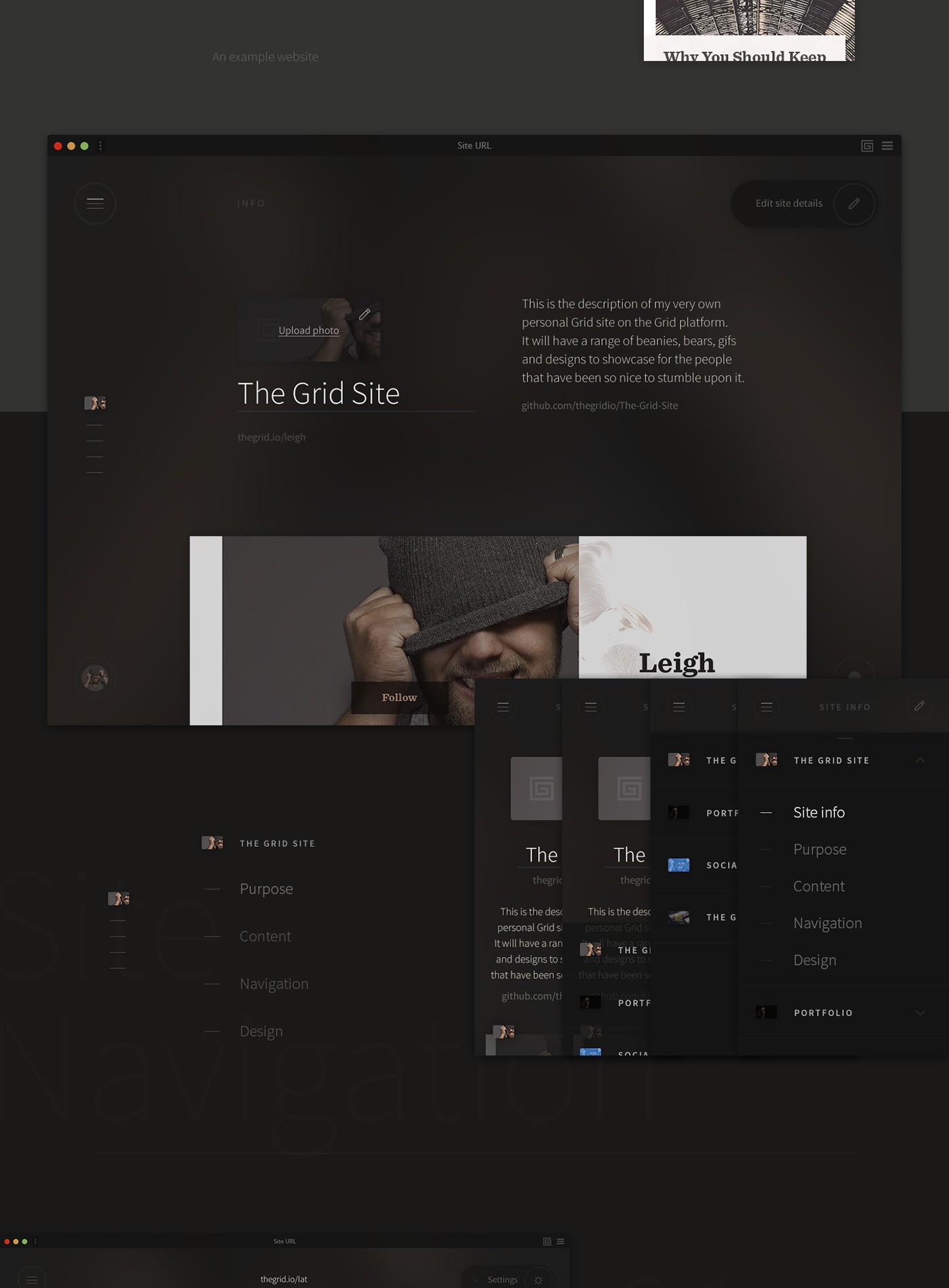
The customer The Grid had in mind was broad: the independent shop, the band, the blogger, the person with images and words but little appetite for CSS. Sign up, bring a domain and content, choose a direction, and let the system compose. Its software examined images for faces, color and contrast so a crop would keep the subject in frame and type would remain legible. It used layout rules and constraint solving to place content, then served the finished site. The design was meant to change with the material instead of forcing every new post into a rigid template.
This was a real distinction from Squarespace, Wix, Weebly and WordPress as they stood then. Their editors offered more direct control; The Grid offered fewer little decisions. That made the service a wager on a particular kind of customer fatigue. People might want a website, but they did not necessarily want a second job as its art director.
The pitch was supported by a deeper platform. The Grid's developer documentation described a REST API for content management, users, notifications and design systems, with OAuth2 authentication. Its public GitHub organization includes a finite-domain constraint solver and image-related code. This was more than a landing-page trick. The team was trying to make publishing itself programmable.
The bill arrived before the website
In October 2014, The Grid opened a founding-member campaign. The early price was $96 a year, initially covering up to seven sites and unlimited contributors. A later price of $25 a month was discussed. That is what it cost to buy the promise; the eventual cost in waiting was less easily quoted. The company aimed at a spring 2015 launch and raised $3.1 million in seed funding, followed by a $4.6 million Series A led by Jerry Yang's AME Cloud Ventures. The presale and the financing made the idea look inevitable. Neither could make the production schedule obey.
Limited beta access began in 2015, while the advertised spring date passed. Access expanded through 2016, and contemporary reporting places the public version in September of that year. A long queue can be exciting when the product is a mystery. It becomes a different kind of queue after customers have paid and planned around the arrival. The Grid's early failure was a calendar failure: the company's invitation reached far more people than its working product could serve on time.
Molly met the person with a logo
The Grid personified its AI designer as Molly. She could select colors, crop a photograph and assemble a page. The name made the machinery seem companionable, though the machinery had an awkward social habit: it could make decisions a customer did not like. A business owner might want a particular shade of blue, a particular image placement or a headline with a deliberate break. Automated design saved the work of choosing, but it also made some choices hard to change.
Early hands-on accounts show the tension. A 2015 demonstration impressed The Next Web, which also saw occasional strange font and color pairings and noted that users could lose a combination they liked while moving the style controls. A later CMSWire review found the dashboard incomplete and the editing options too narrow for many business uses. WIRED described mixed reviews and users frustrated by similar-looking results. The criticism had a common center: the product solved the blank-page problem, then struggled with the ordinary request to make the result unmistakably mine.
“AI” WAS THE EASY PART.The Grid, on its later V2 archive page
That line reads like a joke whose author paid for the punchline. The technology could perform image analysis and layout solving; the more difficult system included onboarding, taste, revision, dependable hosting and customer communication. The Grid's own notice apologized for neglecting responsiveness. It said V2 sites had been placed in an archived state, promised a content backup tool for users and said registration would reopen with V3. The page still offers no date for that return. For someone whose business lives at a domain, an archived website is not merely a product update. It is a closed front door.
A useful idea with an inconvenient human attached
The Grid's original question remains good. Most people publishing online do not wish to debate margins, breakpoints or the exact position of a caption. Automating the boring first draft can be a gift. The part worth copying is the content-first workflow: ask for the words and media a person already has, use software to make a credible first arrangement, and keep that arrangement responsive as content changes.
The other lesson is where to stop deciding on the customer's behalf. A useful automatic designer needs reversible choices, visible controls for brand essentials and an export path before anyone trusts it with a lasting home on the web. The bargain works best for small sites with flexible branding, frequent updates and owners who value speed over pixel-level command. It works poorly when the site must follow a strict style guide, support unusual interaction or guarantee continuity through a platform change. Those conditions do not make automation foolish. They define the point at which a good assistant must hand back the pen.
The Grid saw the future early enough to charge admission. Its real contribution may be a less glamorous specification for that future: a good first result, an easy second choice, and a door that stays open.