5M+ patients measured45+ countries reachedQuickSee reads a prescription in ~10 secondsFirst handheld autorefractor used in space - Polaris DawnWinner, 2022 SPIE Prism AwardSpun out of the Madrid-MIT M+Vision fellowship20+ IRB clinical studies5M+ patients measured45+ countries reachedQuickSee reads a prescription in ~10 secondsFirst handheld autorefractor used in space - Polaris DawnWinner, 2022 SPIE Prism AwardSpun out of the Madrid-MIT M+Vision fellowship20+ IRB clinical studies
A technician holds the whole eye exam in two hands. No dark room, no dial-in lenses - the number arrives in about the time it takes to read this sentence.
Medical Devices · Cambridge, MA
PlenOptika
The company that shrank a room-sized eye exam into something you can carry into a village, a van, or - as it turns out - orbit.
EST. 2014HQ: CAMBRIDGE, MA~25 EMPLOYEESPRODUCT: QUICKSEE
5M+
Patients Measured
45+
Countries
~10s
Per Refraction
1,400km
Altitude In Space
The Pitch
A billion people can't see clearly. The fix is glasses.
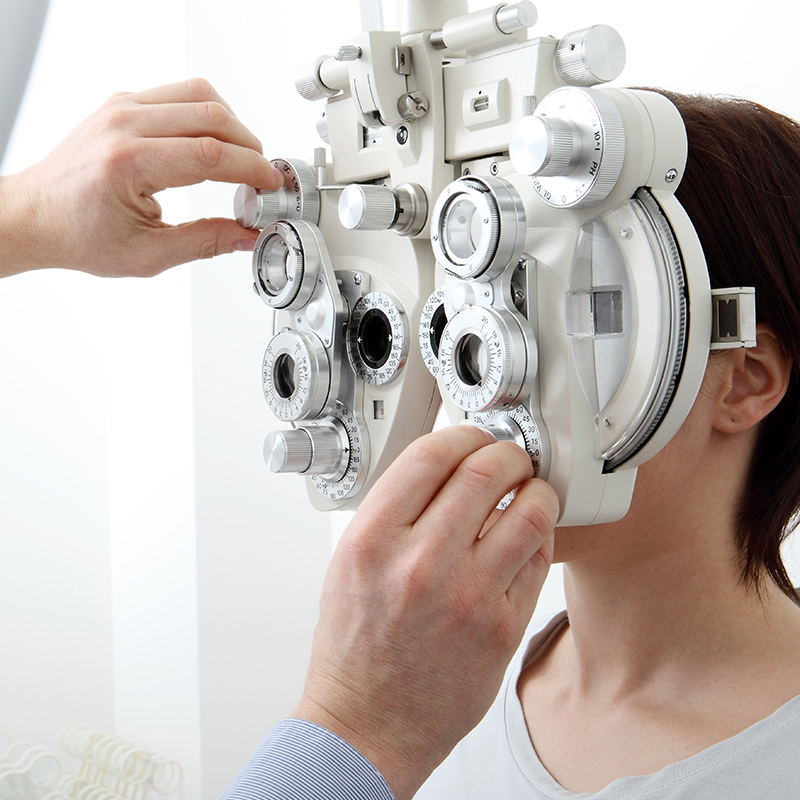
Here is a strange fact about the modern economy: the single most common unmet health need on Earth is also one of the cheapest to solve. More than a billion people have uncorrected refractive error - they need glasses and don't have them - and the reason usually isn't the glasses. It's the measurement. To write a correct eyeglass prescription you have traditionally needed a trained optometrist, a dark room, and an autorefractor the size of a small photocopier that costs tens of thousands of dollars. That machine does not travel to a rural clinic. It does not fit in a backpack. It mostly sits in cities, in countries that already have plenty of eye doctors.
PlenOptika's whole thesis is that the bottleneck is the hardware, so you should fix the hardware. Its device, QuickSee, is a handheld autorefractor roughly the shape of a pair of binoculars. A technician - not necessarily an ophthalmologist - points it at a patient, the patient looks through it at a distant target, and in about ten seconds it produces an objective reading of the eye's refractive error. It is calibration-free, battery-powered, and priced at a fraction of the tabletop machines it competes with. The clever part is what's inside: affordable optical components paired with machine-learning algorithms that interpret the wavefront of light bouncing back out of the eye. The expensive physics got cheaper; the software made up the difference.
“QuickSee Free Pro is more than just an autorefractor - it's a modern platform for advanced refraction analysis.
Shivang R. Dave, PhD · Co-founder & CEO
Origins
Four fellows, one unglamorous problem
PlenOptika did not start as a company. It started as a research question. In 2011, four fellows in the Madrid-MIT M+Vision Consortium - a fellowship built to point smart people at big health problems - looked at the global burden of disease and picked something almost no one was fighting over. Not cancer, not a moonshot drug. Uncorrected vision. It affects more people than almost anything, causes an estimated $400 billion in annual economic loss, and the intervention is well understood. What was missing was access.
The four - Shivang R. Dave (entrepreneurship, global health, bioengineering), Eduardo Lage (electrical and medical-device engineering), and Nicholas Durr and Daryl Lim (optics) - had a convenient distribution of skills. They built a handheld, binocular-shaped prototype and called it QuickSee. In 2014 they turned the project into PlenOptika. Along the way the company was mentored by the MIT Venture Mentoring Service, incubated for four years in Harvard's Innovation Launch Lab, and later moved to Boston University's Photonics Center - a fairly Boston way to grow a hardware company.
SD
Shivang R. Dave
Co-founder & CEO
ND
Nicholas Durr
Co-founder · Optics
DL
Daryl Lim
Co-founder · Optics
EL
Eduardo Lage
Co-founder · Engineering
The Business
Who buys a portable eye exam
The company sells to a wider set of customers than you might expect for a medical device. There are the obvious ones - optometrists and ophthalmologists who want a fast objective starting point before they refine a prescription. There are opticians and retailers, for whom a ten-second reading is a way to serve more people without adding a doctor. And then there is the group the founders clearly built for first: NGOs, mission-based programs, and mobile clinics running vision screenings in places that have never had an autorefractor at all. PlenOptika even runs a grant program that puts devices into faith-based nonprofit clinics, from Texas to Uganda. It is a B2B hardware business with a software layer on top and a philanthropic seam running through the middle.
That mix explains some of the design decisions that look unusual from the outside. A machine meant to stay in a city clinic can afford to be heavy, finicky, and calibration-dependent, because a technician will babysit it. A machine meant to ride in a van to a screening event cannot. So PlenOptika optimized for the harder environment and let the easy one come along for free - the clinic gets a device that happens to also work in the field, and the field gets a device that happens to also meet clinic-grade accuracy. On the money side, the company has stayed comparatively lean: a team of around 25, seed-stage funding, and a research pedigree that pulled in grant support from the National Eye Institute and recognition from MassVentures. This is not a company that raised a fortune and went looking for a problem. It found the problem first and kept the burn low.
What It Does
A refractor that became a platform
The early insight was accuracy in a portable box. The recent one is that a device connected to software is worth more than a device alone. QuickSee Free Pro now pairs the handheld with a cross-platform Companion App that turns raw measurements into something clinicians and patients can actually read.
Hardware
QuickSee Free
The handheld, calibration-free autorefractor. Wavefront aberrometry in roughly ten seconds, designed for field use where tabletop machines can't go.
Hardware+
QuickSee Free Pro
Adds keratometry - corneal curvature measurement - alongside autorefraction, widening what a single portable device can capture in one pass.
Software
Companion App
Runs on Android, Windows and macOS. AI analysis, wavefront maps, Zernike coefficients, point-spread graphs, visual-acuity simulation, and stored patient reports.
Why It Matters
The math of not being able to see
The case for a portable, technician-friendly refractor is basically a distribution problem. Traditional autorefraction concentrates capability where doctors already are. PlenOptika's approach spreads it outward - to clinics, retailers, mobile units, and NGO programs. The figures below are the company's own reported reach; treat them as the scale of the deployment, not a lab benchmark.
QuickSee reach, by PlenOptika's own reporting
// figures as stated by the company
Patients measured5,000,000+
Countries reached45+
IRB clinical studies20+
Seconds per exam~10
Field Report · Low Earth Orbit
The autorefractor that went to space
In September 2024, SpaceX's Polaris Dawn crew flew to roughly 1,400 kilometers - the farthest any crewed non-lunar mission has gone. Among their instruments was a QuickSee Free, which became the first handheld wavefront-aberrometry and autorefraction device used in space.
The reason is a condition called Spaceflight Associated Neuro-Ocular Syndrome (SANS): microgravity subtly reshapes astronauts' eyes and shifts their vision. The crew paired smart contact lenses that tracked ocular pressure with QuickSee readings to catch those changes. A device built for a clinic in Uganda turned out to be exactly the right size for a spacecraft - which is the whole point of building things that fit in one hand.
The Record
A wide résumé for a small company
2011
M+Vision fellowship
Four fellows in the Madrid-MIT consortium choose uncorrected refractive error and build the first QuickSee prototype.
2014
PlenOptika founded
The research project becomes a company, mentored by MIT VMS and incubated at Harvard's Innovation Launch Lab.
2019
Beazley Designs of the Year
QuickSee selected for the Design Museum's flagship design exhibition in London.
2021
Grants & peer-reviewed proof
Launches device grants for mission- and faith-based nonprofit clinics; studies in ophthalmology journals report large gains in prescription access.
2022
SPIE Prism Award
The optics-and-photonics community names QuickSee a winner of its top product award.
2024
Polaris Dawn
QuickSee Free becomes the first handheld autorefractor used in space.
2025
Mobile refraction platform
Updated Companion App turns QuickSee Free Pro into a cross-platform refraction-analysis system with AI reporting.
“Our founding mission is to increase access to excellent vision care to everyone in need.