Breaking
SHIVANG DAVE co-founds PlenOptika, the eye-exam-in-your-pocket company 7 MILLION+ people given vision correction across 60+ countries QUICKSEE reads a full prescription in roughly 10 seconds 2024 Meaningful Business 100 honoree SILMO D'OR 2023 winner, Material & Equipment UW DIAMOND AWARD for translating research into impact
PlenOptika - Cambridge, Massachusetts

Shivang Dave

He took the eye exam off the optometrist's wall and folded it into something you hold like a pair of opera glasses.

Co-Founder & CEO, PlenOptika
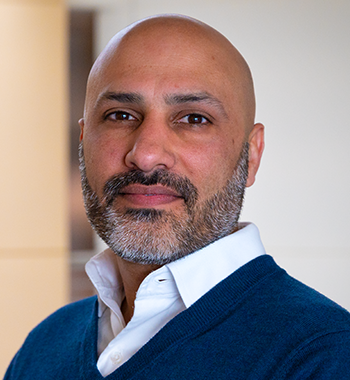
Portrait of Shivang Dave, co-founder and CEO of PlenOptika
Shivang R. Dave - the binocular man of better sight
The Work Today

A clinical-quality eye exam that fits in one hand

PlenOptika builds QuickSee. Point it, hold steady, and in about ten seconds it returns the same eyeglass prescription a trained optometrist would reach for inside a room of expensive, bolted-down machines.

That ten seconds is the whole argument. Roughly a billion people on earth can't see clearly for one boring, fixable reason: nobody ever measured their eyes. The machine that does the measuring, the autorefractor, traditionally costs as much as a car and needs a clinic, a power outlet, and a specialist to run it. Dave's company turned that into a battery-powered device a community health worker can carry into a village, a refugee camp, or a school hallway.

As CEO, Dave has steered PlenOptika from a four-person research huddle into an international company with products in distribution on multiple continents. The scoreboard he cares about is not revenue. It is people who can suddenly read a chalkboard, thread a needle, or keep their job because someone finally handed them the right glasses.
~10s
to a full prescription
7M+
people given vision correction
60+
countries reached
Unless researchers can take their innovations out of the university and bring them to market, they do not have the impact that they're supposed to.
- Shivang Dave
Origin

It started with a kid who was not shielded from the hard parts

He grew up in Sacramento, the American-born son of an East Indian family, and went back to India often as a child. His parents made a deliberate choice on those trips. They did not hurry him past the poverty and the inequality. They let him look.

Something landed early. By five or six he had already decided, in the unembarrassed way only a small child can, that his job was to make things better. Most kids announce they want to be astronauts. This one wanted to fix the gap between how the world is and how it could be.

Two teachers nudged the trajectory. An eighth-grade history teacher named Mr. Green talked about Berkeley until Dave wanted to go there. Years later, a college physics professor, Bob Jacobson, told him to pick the graduate school that fit him rather than the one with the loudest name, and offered a line Dave kept: nothing is fixed in stone.

At UC Berkeley he started on the pre-med track, the obvious road for someone who wanted to help people heal. Then he discovered bioengineering and never looked back. Medicine treats one patient at a time. Engineering can treat a million.

In 2003, still early in his training, he helped build wearable bio-monitoring technology to watch over patients remotely in Oakland. The thread was already visible: take the expensive thing locked in the hospital and let it travel to the person who needs it.

He went on to a PhD in bioengineering and nanotechnology at the University of Washington in Seattle, working across synthetic chemistry, nanotechnology, and biomedical imaging. A serious scientist's resume. What it lacked, so far, was a product.

The Turn

Madrid, a stethoscope, and the problem nobody wanted

In 2011 Dave joined the inaugural class of the Madrid-MIT M+Vision Consortium, a fellowship built on a strange premise. Before you invent anything, go spend two and a half months in a Madrid hospital shadowing doctors. Watch. Take notes. Find a problem worth a career.

His team, four researchers who half-jokingly called themselves "Team Eye," landed on uncorrected refractive error. Unglamorous. Enormous. It sits in the top ten of the Global Burden of Disease list, and the fix has existed since the 13th century. The bottleneck was never the glasses. It was the measurement.

So they prototyped a handheld, binocular-shaped device using wavefront aberrometry, the same optical physics used to tune telescopes and laser eye surgery, and pointed it at the human eye. Fast. Accurate. Almost no training required. They named it QuickSee.

The co-founders

Team Eye

Nicholas Durr, Daryl Lim, Eduardo Lage, and Shivang Dave - four M+Vision fellows who turned a hospital observation into a company in 2014.

The physics

Wavefront aberrometry

The same wave-measuring optics behind laser eye surgery, shrunk into a portable, calibration-free device anyone can be trained to use.

How QuickSee Works

From "look here" to a printed prescription

1

Hold & look

The patient looks into a device shaped like binoculars. No chin rest, no dark room.

2

Measure the wavefront

Light bounces back off the retina; sensors read how the eye bends it.

3

Crunch the math

Algorithms convert wavefront data into Zernike coefficients and a refraction.

4

Get the Rx

In roughly 10 seconds, a full eyeglass prescription - ready to fill.

By The Numbers

Proof, not promises

PlenOptika did not ask the world to take its word for it. The device went through clinical trials across five countries before it went anywhere near a market.

Reach
7M+ people
Countries
60+
Trial nations
5
Exam time
~10 sec

Trials run in the US, Spain, India and China. Clearance obtained, then scale.

The Long Road

A career measured in milestones, not job titles

2003
Helps build wearable remote-monitoring tech for patients in Oakland.
2011
Earns a PhD in bioengineering and nanotechnology from the University of Washington; joins the first M+Vision fellowship cohort.
2014
Co-founds PlenOptika with three fellow researchers.
2018
QuickSee reaches the market.
2023
QuickSee Free wins the SILMO D'Or prize in Paris.
2024
Named to the Meaningful Business 100; honored with a University of Washington Diamond Award.
Recognition

SILMO D'Or 2023

QuickSee Free took the Material & Equipment prize at the 30th edition of the optical world's marquee awards in Paris.

Recognition

Meaningful Business 100

Selected from 850+ global nominations by judges drawn from Google, the UN, the Rockefeller Foundation and more.

Recognition

Eddie Award

PlenOptika honored by the Mass Innovation Network for QuickSee, billed as the world's most accurate handheld autorefractor.

The Texture

Details that don't fit on a business card

Make clinical-quality eye measurement so portable, affordable and simple that the next billion people can finally get the glasses they were always going to need.
- The PlenOptika mission, in plain terms
global eye carewavefront aberrometryautorefractionmedical devicesbioengineeringsocial impacttranslational medicinevision health
Pass It On

Spread the 10-second eye exam

Good ideas travel. Share the story of the man who shrank the eye clinic into the palm of a hand.

in / LinkedIn X / Twitter f / Facebook Instagram
The Rolodex

Where to find Shivang & PlenOptika