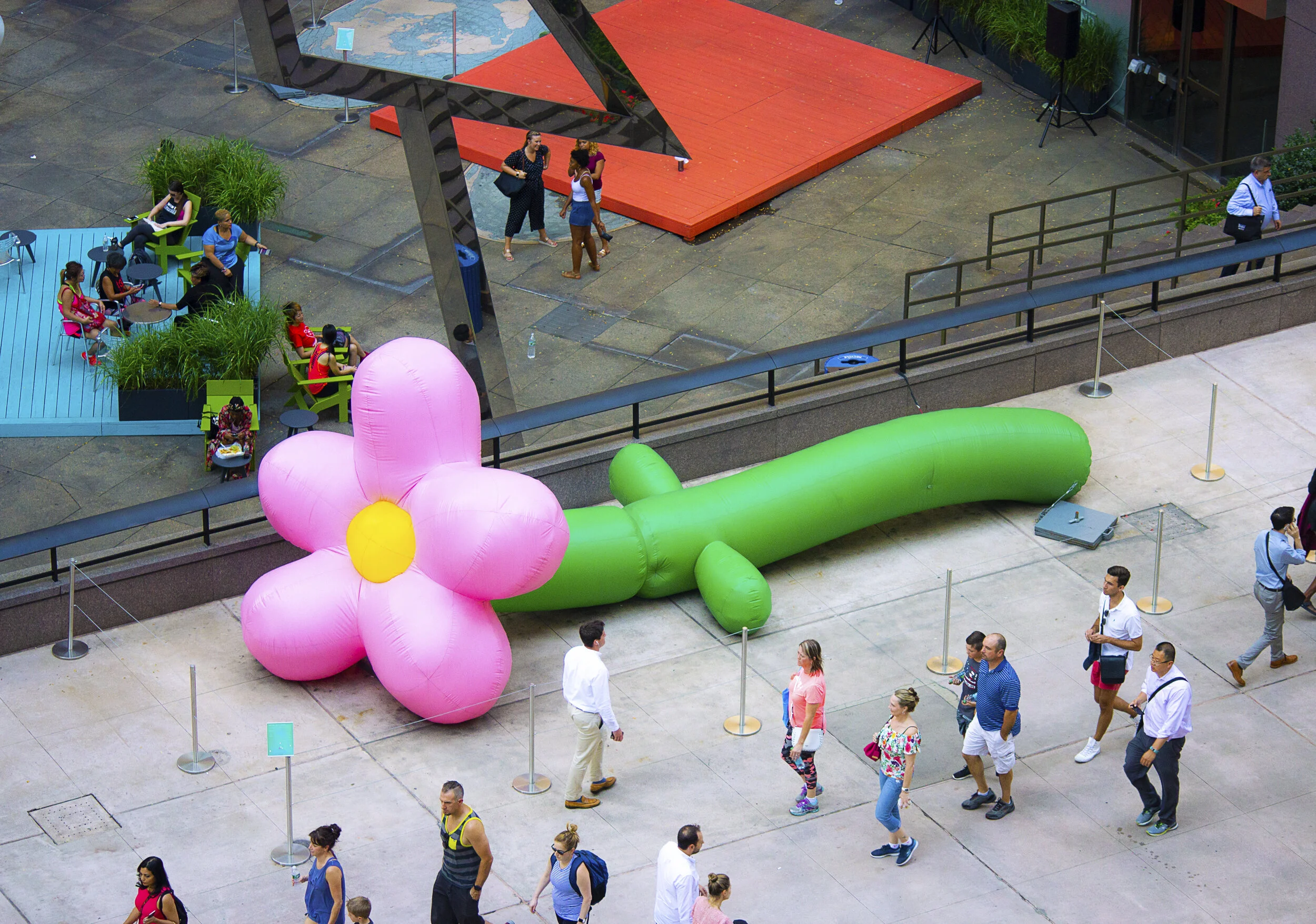
A pink flower lies on a Manhattan plaza, its green stem stretched out beside the lunch crowd. It is too big for a vase and apparently too relaxed for Midtown. Around it, office workers and visitors supply the scale. PLAYLAB, INC., the studio behind it, has found a simple way to interrupt a familiar place: give a familiar thing an unfamiliar body.
The sculpture belongs to Grown Up Flowers, a group of six inflatables installed along Sixth Avenue in 2018. The flowers sat, bent and lounged among buildings that usually make everything beneath them look small. An object associated with decoration had become the main event. You could understand the joke before reading a single word about design.
That kind of immediate legibility runs through an otherwise unruly portfolio. PLAYLAB works on fashion shows, films, campaigns, books, furniture, stores and public art. Its commercial usefulness lies in giving an idea enough physical or visual presence that people notice it, enter it, sit in it or carry it away. The studio sells creative direction and design; the deliverable might require an air pump.
The name nearly didn’t survive
Archie Lee Coates IV and Jeff Franklin met at Virginia Tech. PLAYLAB dates its beginnings to 2004, when the two were students; Coates later identified 2009 as the incorporation year. The distinction suits a practice that began as a place to try things before it became an established business.
In a 2024 interview, Coates remembered the founders escaping the architecture studio to draw ideas on coffee-shop napkins. He learned HTML and built a website. By 2007, they had a tiny Brooklyn studio without heat. The enterprise was taking shape, but its name began to embarrass them. Around 2010, they considered dropping PLAYLAB. A friend persuaded them that the name’s naïveté was something to protect.
Today the phrase “no focus” remains in the company’s description. Read against its output, that means keeping the medium open. A graphic designer might begin by making an image; an architect, by planning a space. PLAYLAB leaves itself room to decide that an idea needs either, both or something else.
“The goal was no goal.”
Archie Lee Coates IV, HYPEBEAST Studio Visits
The line is funny because paying clients still have goals. Their products need a setting, their archives need a story, their stores need a reason to visit. PLAYLAB’s freedom has to become useful to somebody beyond the studio. That is the business hiding inside the joke.
Luxury gets permission to play
Virgil Abloh’s collaboration with PLAYLAB gave that sensibility a conspicuous stage. For Louis Vuitton’s Fall/Winter 2020 show, Heaven on Earth, the studio helped turn the runway into a blue-sky environment. The setting made the presentation feel like entry into an imagined world. Clothes remained the occasion, but the room carried part of the meaning.
Publishing offered another scale of work. PLAYLAB worked on Abloh’s Figures of Speech book, while its broader portfolio extended to Nike campaigns and environments for musicians. The same client relationship could travel across a screen, a printed object and a temporary place. For a brand, that makes a studio valuable before the final format has been decided.
Rimowa’s 2023 SEIT 1898 exhibition presented a different problem: make luggage history worth looking at. The anniversary project, with creative work by PLAYLAB, brought together more than 100 archival cases. Its itinerary included Tokyo, New York and Shanghai. Cases built for particular purposes and objects marked by use gave visitors something more specific than a corporate anniversary number.
These projects place PLAYLAB among independent studios working where brand design meets entertainment and spatial design. The alternatives depend on the assignment: a set designer, a branding practice, a retail architect or a production company. PLAYLAB’s distinction is the breadth of the conversation it can have with a client. That breadth still needs specialists and collaborators when an idea becomes a build.
A clothing store with somewhere to sit
Madhappy makes the proposition tangible. Its Los Angeles flagship, which opened in 2023, combined apparel with a café and places to gather. The roughly 2,800-square-foot store gave the brand’s interest in conversation a physical address. A visitor could do more than inspect a sweatshirt and leave.
The New York store sharpened the challenge. Opened in June 2025, it occupied about 1,400 square feet across two levels. PLAYLAB and CoPa had to fit retail, a café and seating into a compact footprint. That is an ordinary commercial constraint, even when the finished space looks like a particularly cheerful daydream.
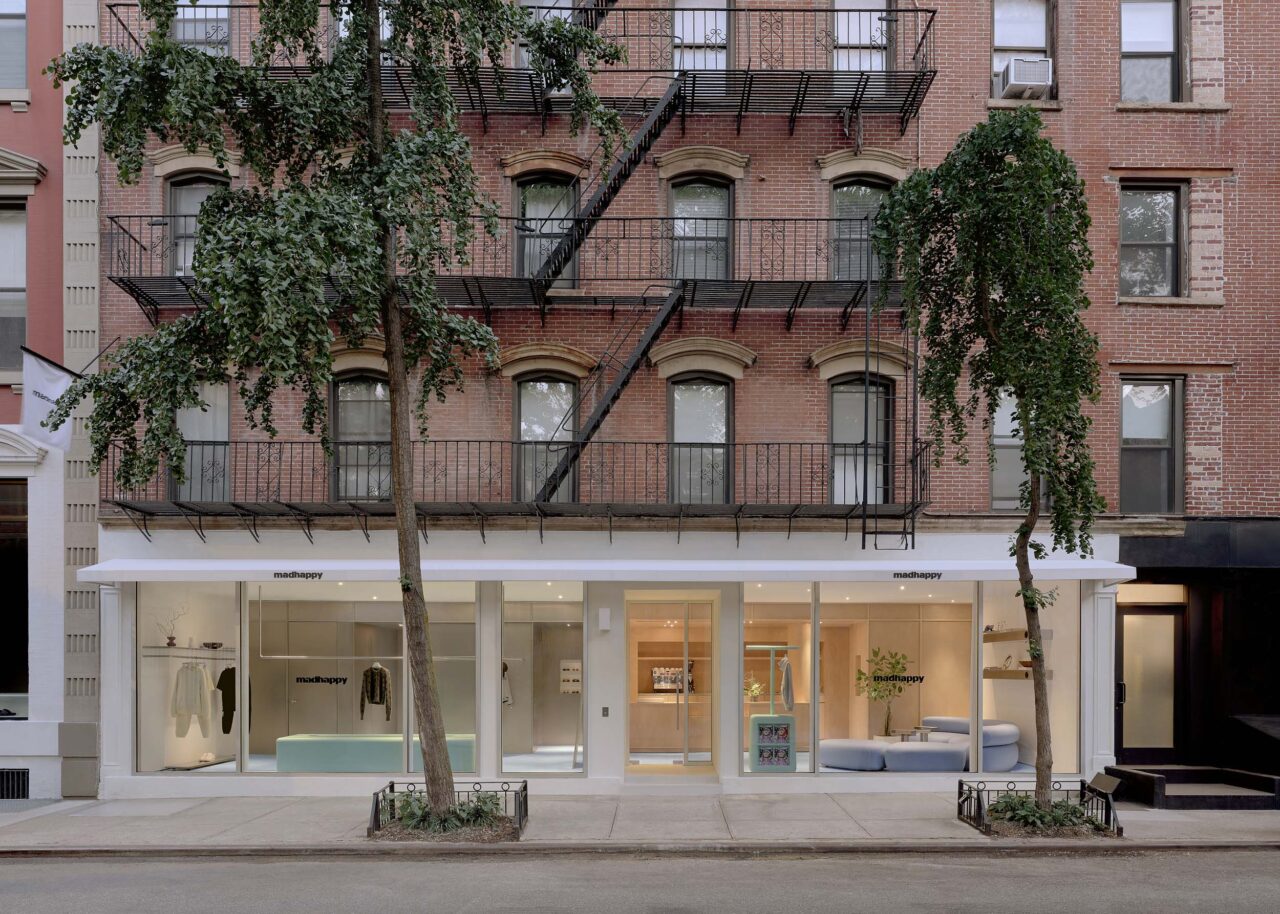
A curved blue sofa offers a soft counterpoint to Douglas fir café paneling and metal retail fixtures. A green resin table incorporates a glass opening that brings light to the floor below. The table, fabricated by Quincy Ellis, was inspired by a table-and-skylight arrangement at the Gala Dalí Castle House-Museum in Spain. Furniture becomes part of the building’s daylight system.
For a prospective client, the useful question is what people should be able to do in a place. Here, seating, food and circulation support a social ambition. Another retailer could copy the decision to make room for lingering. Copying the blue floor would reproduce the appearance while leaving the underlying commercial choice unresolved.
The pool that runs on a different clock
PLAYLAB’s involvement in +POOL stretches the idea of creative work beyond a commission. Developed with Family New York and launched publicly in 2010, the proposal imagined a floating pool that would filter river water for swimming. Its cross-shaped design made a complicated civic ambition easy to recognize.
Recognition could help raise money, but it could not complete the job. A 2013 Kickstarter campaign brought in roughly $273,000 from 3,175 people. A contemporary estimate put the proposed pool at $15 million. Those figures describe early fundraising and an early construction estimate, respectively. Neither represents PLAYLAB’s income or a final project bill.
Announced allocation for +POOL testing and a scaled pool. Project funding, separate from PLAYLAB’s finances.
In 2024, New York State and New York City announced a combined $16 million commitment. The project’s own timeline records filtration tests, permit applications and construction milestones. It is a record of how many separate decisions stand between a persuasive rendering and a public facility.
By July 2026, the prototype’s launch had been pushed to at least 2027 because waterfront flood-protection construction occupied its intended testing site. Earlier obstacles included filtration problems and health reviews. The latest delay came from another legitimate public need competing for the same piece of waterfront.
For this project, an image’s ability to win attention has been far ahead of the timetable for access. The lesson for anyone borrowing PLAYLAB’s ambition is practical: a public idea needs partners who control permissions, infrastructure and operations. Enthusiasm cannot substitute for their work. A design that depends on shared land and water must live with shared priorities.
The portfolio includes wishes
Visit PLAYLAB’s current website and its invitations are unusually direct. It would like to redesign the Westminster Dog Show, make a collection of USM objects and create a book about the Macy’s parade. These pages describe proposals. They are a view into the work the studio wants to do, rather than a list of confirmed commissions.
The Westminster concept extends from wordmarks and wristbands to agility courses and trophies. The USM proposal explores what familiar modular components might become: lamps, games, even an aquarium. The parade book has the tentative title Cloudy With a Chance of Balloons. Its mockups include an accordion timeline, translucent process pages and a puppet-show idea tucked into a slipcase.
There is a useful sales argument here. Show a prospective collaborator enough of an idea that they can imagine joining it. For a small practice, the condition is affordability: speculative work consumes time before anyone agrees to pay. Publishing a wish can invite a conversation; it does not establish demand or a production budget.
A separate, documented relationship with Fondation USM produced Mi-Wi for its 2025 Futures Lab programme. The speculative platform explored self-discovery and purpose in a future shaped by artificial intelligence. It belongs to design research, with a different promise from a software product ready for customers to use.
Keeping the experiment workable
PLAYLAB’s process has a practical spine. Coates has described researching a brief, reducing it to a plain-language idea and developing small, medium and large versions. That gives a client something to discuss when ambition meets time and money. The point is to preserve the idea while finding a feasible expression.
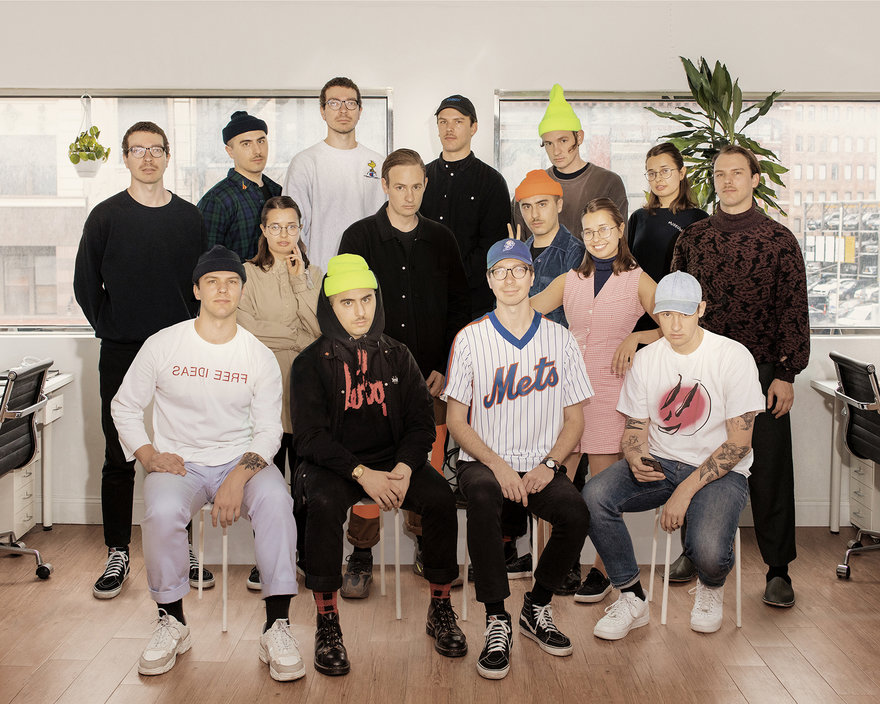
The model fits clients willing to help develop a concept and make decisions as it takes form. A buyer with a fixed specification and no room for exploration may need a narrower service. A retailer allocating space to conversation also has to accept that every chair occupies floor area that could hold merchandise. Play has practical consequences.
In May 2026, PLAYLAB’s The Forest For The Trees installation for Golden Goose brought visitors to Haus Marghera, outside central Venice. Guests painted miniature trees that joined a larger display. Participation changed what the exhibition contained.
It is a fitting image for the studio’s business: create a setting, invite other people in, and give them something concrete to do. A giant flower can start the conversation. Someone still has to decide where it goes.