Five years is a long time between studio albums. It is longer on the internet, where an afternoon can turn a snippet into a religion and a week can turn yesterday's obsession into old furniture. Playboi Carti spent the gap between Whole Lotta Red and Music doing something stranger than disappearing. He remained everywhere without offering the ordinary evidence of presence. A feature surfaced. A billboard appeared. A voice, lower than the one listeners remembered, came through a speaker. The faithful argued over dates. The album stayed absent, which made the idea of it grow unusually large.
Then, on March 14, 2025, the absence ended in excess. Music arrived with 30 tracks, a guest list that ran from Kendrick Lamar and Future to the Weeknd and Lil Uzi Vert, and no interest in behaving like a tidy answer. It opened at No. 1 in the United States with 298,000 equivalent album units. Every original track entered the Billboard Hot 100. Carti became the first rapper to place every song from a 30-plus-track album on that chart at once.
The numbers made a neat headline. Carti's career is less neat. Its logic lives in the sequence of sounds he has been willing to leave behind. The buoyant, open space of his first mixtape gave way to the high, elastic “baby voice” that made syllables wobble like synthesizer notes. Whole Lotta Red pushed toward clipped phrases, blown speakers and punk theater. On Music, a rough low register often walks in first, a voice with gravel in its pockets. He does not simply change flows. He changes narrators.
A skateboard at basketball practice
Jordan Terrell Carter grew up around Atlanta and Riverdale with two ambitions tugging at the same sleeve. Basketball gave him travel, practice and a route away from trouble. Style gave him another way to move. As a teenager, he showed up to practice carrying a skateboard. The references he named later were revealing: Allen Iverson and Terry Kennedy, a basketball star whose clothes rewrote the league's visual rules and a skateboarder who made grace look casual.
A dispute with his coach ended the basketball plan. Recording expanded to fill the space. He skipped enough school that graduation became a last-minute cliffhanger, finishing nine assignments while seated with younger students. His family did not know whether he would graduate, so they were not waiting at the ceremony. It is the sort of adolescent detail that would be too tidy if invented: the future cult figure quietly doing make-up work against a clock.
He first recorded as Sir Cartier. An early video placed a 14-year-old Carter in South Atlanta parking lots and strip malls, already looking directly into the camera. By 2013 he had met Ethereal, a producer in the Awful Records orbit. Awful was an Atlanta laboratory for low-budget oddness. Its members let home recording, warped textures and personality do the work that polish could not. Carter became the young member of the circle. One of his first tracks with Ethereal, “YUNGXANHOE,” used the PlayStation 2 startup sound. The sample lasted a few seconds; the instinct lasted much longer. Familiar technology could become atmosphere.
At 18, he left Atlanta for New York, stopping only briefly in retail. His H&M career lasted four days. He stayed with family and friends, joined the downtown fashion current and met A$AP Bari, who introduced him to A$AP Rocky. At SXSW in 2015, Rocky's attention showed him a larger version of the life he wanted. Carter attached himself to the possibility, then signed with Rocky's AWGE imprint and Interscope the following year.
“Sometimes I still can't believe it.”Playboi Carti, on working beside A$AP Rocky
The voice escapes the sentence
“Broke Boi,” released in 2015, announced Carti through economy. His lines were short, the space around them luxurious. Pi'erre Bourne later gave that economy a vivid setting: springy drums, bright loops and melodies that felt borrowed from a game nobody had finished designing. Their work on the 2017 mixtape Playboi Carti produced “Magnolia,” a song whose repeated New York refrain traveled much farther than a descriptive verse would have. The mixtape reached No. 12. Die Lit followed in 2018 and debuted at No. 3 with little of the explanatory press that usually surrounds a major-label arrival.
Carti had found a way to make language serve rhythm without pretending the two jobs were identical. A vowel could stretch. A consonant could land like a hi-hat. Ad-libs supplied motion, not commentary. By the time the “baby voice” became a recognizable device, listeners could identify him before parsing a word. The trick was not high pitch by itself. It was the choice to treat timbre as structure.
Three voices, one restless instrument
Whole Lotta Red changed the instrument again. Released on Christmas Day 2020, it replaced much of the earlier levitation with abrasive synths, terse chants and the pacing of a set designed for bodies in motion. Its early reception was divided. Its later life was more consequential. The album reached No. 1, fed the emerging rage sound and supplied younger rappers with a vocabulary of distortion and theater. Carti's bet was that a difficult first night mattered less than a durable afterlife.
Scarcity becomes stagecraft
The long wait for Music was frustrating because Carti's restraint never looked accidental. He has long been protective of presentation. He posts sparingly, interviews rarely and allows low-quality fragments to circulate in the space where a conventional campaign would place a calendar. The audience responds by becoming its own publicity department. It enhances snippets, decodes typography, invents release dates and turns disappointment into another form of participation.
There is wit in the arrangement. A rapper built by SoundCloud learned to make the internet work hardest when he gave it the least. Yet scarcity alone would be a cheap trick. What kept the gaps alive was the possibility that the next voice would not resemble the previous one. During those five years, features on Travis Scott's “FE!N,” the Weeknd's “Timeless” and the chart-topping “Carnival” revealed a deeper rasp. The cameos were dispatches from an album still out of frame.
“It's gotta be something I never heard before.”Playboi Carti, describing what he seeks in a beat
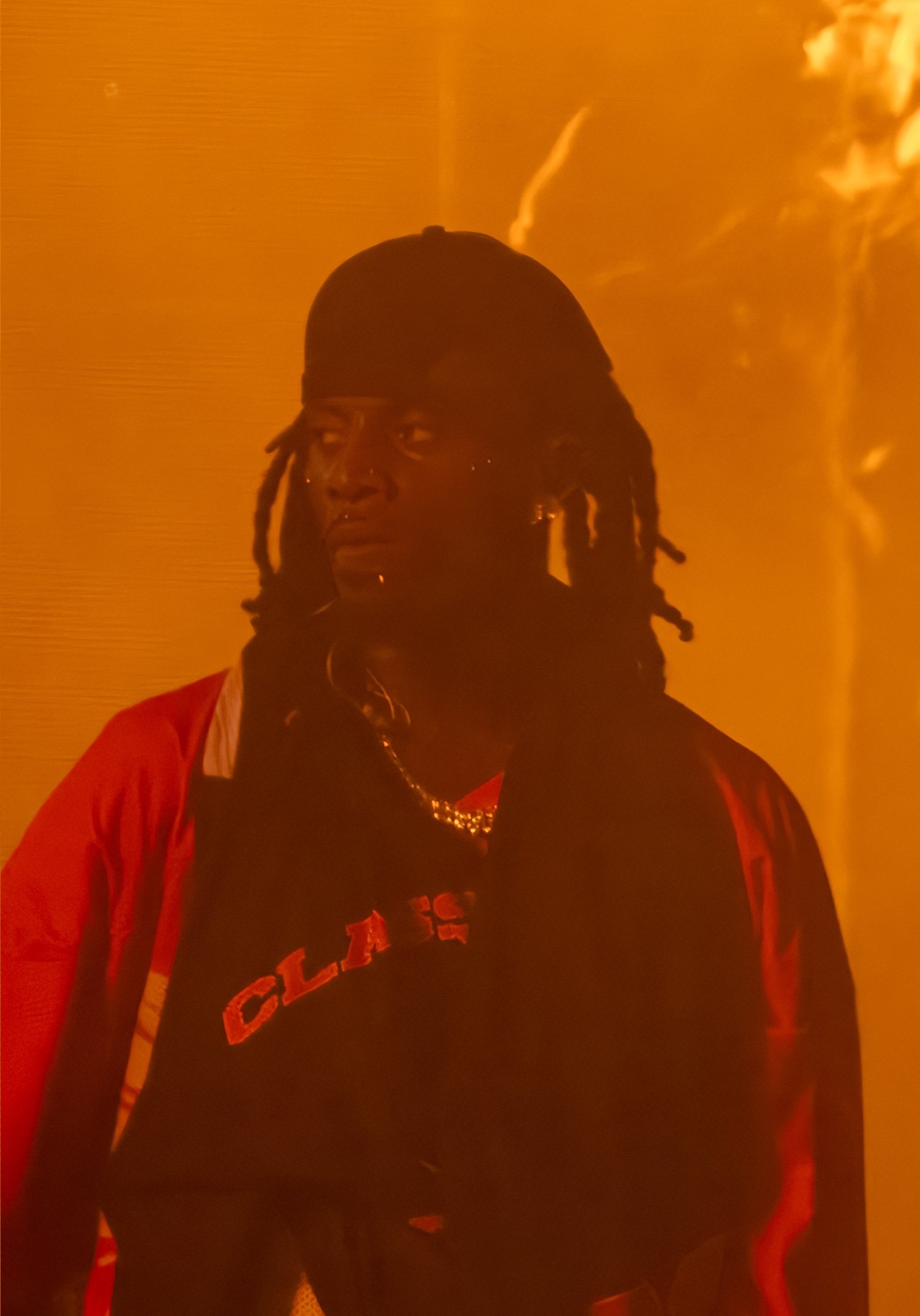
Onstage, all this withholding reverses. Carti's shows use smoke, harsh light, guitar textures and an audience that knows when to supply the words. The minimal writing becomes maximal architecture. A repeated phrase gives thousands of people a single lever to pull. At Clout Festival in 2024, the image was reduced almost to heraldry: a dark figure cut by red light, voice sent into a crowd already primed to answer.
That live scale also explains why Carti's influence is better measured in behavior than in imitation alone. He helped move rap performance toward the pacing of punk and metal without simply borrowing a band. The scream, the pause and the entrance became production tools. By 2025 he could support the Weeknd in stadiums, then take his own Opium roster through arenas on the Antagonist Tour.
The little brother builds a house
Carti's early story is full of older guides: his brother introducing him to Gucci Mane, Ethereal opening the Awful Records circle, Rocky modeling a union of music and fashion, Pi'erre Bourne helping locate the right negative space. In 2019, Carti founded Opium and changed his position in the picture. Ken Carson, Destroy Lonely and Homixide Gang developed distinct records inside a shared atmosphere of dark graphics, overloaded synths and volatile live energy.
A label can turn taste into infrastructure. Opium gave Carti's aesthetic a roster, release pipeline and touring bill. It also created a useful tension. The artist who built desire by limiting access became responsible for helping other artists remain visible. The apprentice had to learn curation. When Carti appeared on Ken Carson's xperiment in July 2026, the old direction of influence folded back on itself: the label founder entered a younger artist's album as a guest.
“Broke Boi” carries a spare Atlanta style beyond the local underground.
The self-titled mixtape and “Magnolia” translate repetition into mainstream motion.
Whole Lotta Red takes abrasion, chant and stage energy to No. 1.
Music ends the five-year album gap with 30 simultaneous Hot 100 entries.
Festival stages and Opium collaborations keep Carti active beyond his own album cycle.
Thirty tracks, still unfinished
Music did not settle the argument about Playboi Carti. A 30-song album is almost designed to prevent consensus. It moves between the low register, flashes of earlier vocal styles, Atlanta references and high-profile guests. Some passages sound constructed for a stadium. Others preserve the lurch of a file posted at an unreasonable hour. The sequencing can feel less like a guided tour than a warehouse with every door open.
But its scale completes a useful inversion. Carti began with loose songs and no full-length project, maintaining interest while observers asked what, exactly, he was doing. A decade later, he answered five years of speculation with more music than anyone could absorb in one sitting. The mystery did not vanish. It simply moved from “When will it arrive?” to “Which Carti is speaking now?”
The old basketball dream survives faintly in the way he works. Not in statistics or sports metaphors, but in the appetite to create a new move once the previous one becomes readable. The skateboard at practice was an early clue. So was the PlayStation startup sample. So was a voice pitched beyond ordinary speech. The point has rarely been to choose one world. It has been to collide several until they make a sound with no settled name.
That leaves Carti in a curious position. He is a chart-topping artist with the habits of an underground rumor, a label founder whose public language often arrives in fragments, and a performer whose smallest phrases demand the largest rooms. The silence will return eventually. It always does. The useful question is not how long it lasts. It is what kind of voice walks out when it breaks.