The most revealing thing about Plaud’s newer wearable recorder is a button. Hold it to start recording. Press it briefly during the conversation to mark a moment worth remembering. In a business devoted to artificial intelligence, the human still gets a small, rather satisfying vote.
That detail explains much of the company’s appeal. A recording can preserve an hour of speech and still leave you with an hour of work. Someone has to find the decision, distinguish a suggestion from a promise, and remember why the room changed its mind. Plaud puts microphones at the beginning of that process and software at the other end.
- Capture: pocket recorders, wearables, and desktop software collect conversations.
- Sort: AI turns audio into transcripts, summaries, and searchable notes.
- Pay: hardware is purchased once; heavier transcription runs on a subscription.
- Check: the recording remains the place to verify what was actually said.
A million dollars before the meeting began
Plaud was founded in 2021. Its first Note campaign on Kickstarter ran in the summer of 2023, with a $5,000 goal. By August 16, 7,564 backers had pledged $1,108,181. Those were crowdfunding pledges for a product, rather than a venture-capital round. The distinction matters: an order and an investment express different kinds of confidence.
The proposal was easy to understand. A slim recorder could attach to a phone, record calls or conversations, and pass the audio to an app for transcription and summaries. Voice recorders were familiar. The promise of doing something useful with their contents was the attraction. A drawer full of audio files is an archive; a searchable answer is something you might use tomorrow.
In June 2026, Plaud announced that it had gone from $1 million to $100 million in annual recurring revenue within two years. That is a company-reported measure, distinct from total annual sales or audited revenue. It nevertheless describes the business Plaud wants readers to see: recurring software reached through a physical object.
“Most AI companies have scaled through software behind a screen. We took a different path.”Nathan Xu, co-founder and CEO, June 2026
The recorder supplies an entrance into conversations that never take place in a video-call window. The subscription supplies a reason to keep coming back. Plaud’s current website reports more than 2.5 million users across over 170 countries. The scale is its own claim; the combination of device and service is visible in the product itself.
The phone already has a microphone
There is an obvious objection to buying a recording gadget: most customers already own one. A phone can capture audio. A laptop can record a meeting. Conferencing software increasingly provides notes. Plaud has to earn its place between those perfectly reasonable alternatives.
Its argument begins with the first few seconds. A dedicated control lets the user start capture without finding an app. A wearable keeps the microphone nearby when someone is moving between conversations. A recorder attached to a phone has a different job from a bot invited to a scheduled call. These differences concern habits and placement as much as AI.
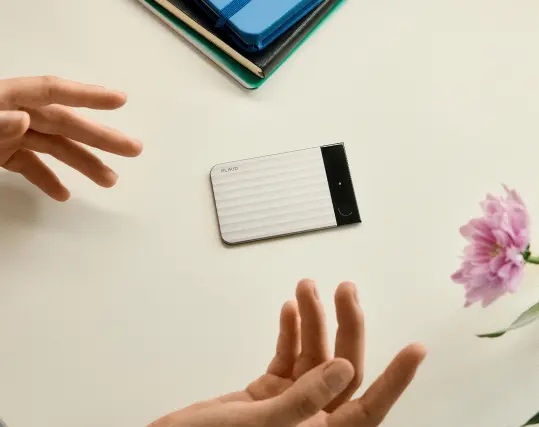
The Note Pro, listed at $189 in the US, makes that argument through fairly concrete engineering. It is 2.99mm thick, has four MEMS microphones and an AMOLED display, and automatically switches between call and in-person recording modes. Plaud specifies pickup up to five meters and up to 50 hours of recording in endurance mode; its enhanced mode is rated for up to 30 hours. Those are operating specifications, not promises that every noisy room will produce a clean transcript.
The $179 NotePin S trades the card shape for something worn as a pin, clip, necklace, or wristband. It is meant for in-person conversations. It lacks the vibration conduction sensor that enables the Note line’s phone-call recording. Choosing between them is therefore a question about where you talk, rather than which one looks more futuristic.
The important moment gets a button
The original NotePin used a pressure-operated control beneath its smooth surface. The S adds a distinct physical button and Press to Highlight. It is a documented design change, and a useful way to examine what the earlier product could not do: accept an explicit highlight from the user during recording.
Imagine a client finally explaining the real objection to a proposal. You can mark that moment without writing a sentence or interrupting the conversation. The software receives a cue about your priorities. It does not have to infer importance solely from which words sounded emphatic.
This is also a more credible account of improvement than a grand tale of failure and redemption. The products show a change in control and capability. The button makes the company’s lesson available to anyone designing an AI tool: give users an inexpensive way to supply context while it is still fresh.

Five free hours, then the arithmetic
Plaud sells hardware and processing separately. The free Starter plan includes 300 transcription minutes each month, equivalent to five hours. Pro provides 1,200 minutes, or 20 hours, for $99.99 a year. Unlimited costs $239.99 annually and carries a limit of 24 hours per day. Monthly payment options also exist. These are US listed prices checked on October 1, 2026.
The useful calculation is personal. If you record one hour every working day, five free hours disappear quickly. If you record an occasional interview, Starter may be enough. The economic question is how much reviewing and rewriting the software removes after you allow time to check its work. Plaud cannot answer that by printing a battery specification.
The output can include speaker-labeled transcripts, summaries shaped by templates, mind maps, and answers through Ask Plaud. Its single-file question mode attaches clickable timestamps to responses. For a journalist checking a quotation, or a consultant verifying an agreed deadline, the route back to the audio matters more than elegant formatting.
- 01Record the conversation
- 02Transcribe and structure
- 03Ask, verify, and export
The notebook wants to join the company
Plaud’s customers include salespeople, executives, consultants, lawyers, educators, and clinicians. The shared problem is documentation after conversation. A sales representative needs the objection and next step. A teacher wants a usable record of discussion. A clinician needs a workflow that fits the organization’s rules, rather than simply another place to put patient information.
Plaud Team, announced in May 2026, extends the individual archive into shared workspaces and centralized administration. Its September Salesforce integration gives sales notes a destination in the CRM. Best Buy’s July retail partnership gives the hardware a place where prospective customers can encounter it in person. One expansion concerns the work after recording; the other concerns the purchase before it.
Desktop capture addresses meetings on a computer without adding a bot to the call. Embedded, the developer offering, lets other companies integrate device pairing and transcription into their own apps. Plaud is spreading the same capture-and-processing idea across different entrances. The stated mission is “Amplify human intelligence.” Its practical task is getting a useful record into the next tool.
Earbuds, and the distance from notes to action
In August 2026, Plaud unveiled One Explorer Edition: earbuds and a recording case, initially limited to 2,000 units worldwide at $249.99. The product page now points visitors to a waitlist after the initial pre-order. The case captures in-person discussions; the earbuds extend capture to calls and online meetings. LTE connectivity supports a move toward real-time agent interaction.
The limited edition is an experiment in a larger responsibility. Producing a draft summary leaves a human to interpret it. Acting on a conversation requires deciding what the speaker intended and which action is authorized. Plaud’s expansion makes that distinction increasingly important. An accurate archive is a useful starting point; it does not settle every question about what should happen next.
A record still needs a reader
Plaud says its AI processing runs in the cloud. Turning off Cloud Sync changes retention, rather than making transcription happen offline. Its security page describes encryption and a default policy against using customer data for training. For organizations with strict requirements, the processing arrangement is part of the buying decision, alongside the microphone and the monthly quota.
The same applies to ordinary conversations: people need to know when they are being recorded. Distance, overlapping voices, and background noise can also weaken the material a summary depends on. A confident sentence deserves checking when a quotation, commitment, or clinical detail matters. The device reduces some clerical work; somebody remains responsible for the record.
The most useful thing to copy from Plaud is the sequence. Make capture easy. Give the output a familiar form. Put it where the next piece of work happens. For users, that means choosing a template before recording, marking the moments that matter, and reviewing the resulting commitments. The little button has a sensible ambition: helping tomorrow’s reader understand what today’s listener cared about.