Fathom is for the person whose best meeting skill is paying attention and whose worst is typing while making eye contact. Coaches hear the hesitation behind an answer. Founders notice the throwaway feature request. Salespeople catch the actual objection instead of polishing a note called “budget?” while the buyer keeps talking. The app captures the call, writes the recap, identifies actions, and gives every sentence a place to be found later.
That sounds like every AI meeting assistant, because the category has converged on the same nouns: transcript, summary, action items, search. Fathom’s case rests on the verbs after those nouns. Clip the exact moment. Ask a question across months of calls. Send the decision to Slack. Put the next step in HubSpot. Draft the follow-up in ChatGPT. The interesting product is not a robotic secretary. It is a pipe from conversation to work.
Who should invite it?
Start with people paid to notice. User researchers need quotes without breaking rapport. Recruiters need a faithful record of a candidate’s examples. Customer-success managers need promises to survive the handoff. Coaches and consultants need to stay inside the conversation. Revenue teams get the broadest kit: deal views, coaching metrics, scorecards, keyword alerts, and CRM field sync.
Solo users with ordinary internal meetings are also a good fit because Fathom does not meter basic recordings and transcripts on the free plan. People who rarely revisit meetings may find the whole category unnecessary. A clear decision log and five disciplined minutes at the end of a call can still beat a warehouse of machine-made minutes.
From Zoom passenger to meeting memory
Richard White founded Fathom in 2020 after years of customer calls at UserVoice. The useful parts of those conversations kept evaporating between the call and the follow-up. Early artificial intelligence was not ready to carry the whole idea, so the team concentrated on less glamorous problems: reliable capture, distribution, and a product people could use without a manual. Fathom entered Y Combinator’s Winter 2021 batch and publicly launched on Product Hunt that December.
The financing tells a tidy adoption story. A $4.7 million seed round arrived in 2022, with backing that included Zoom’s Apps Fund. In September 2024, Fathom announced a $17 million Series A led by Telescope Partners. Two million dollars came through a Wefunder campaign from users. At the time, the company reported 90-fold revenue growth and 20-fold usage growth across two years. Those are company figures, not audited commandments, but users investing in their note-taker is a charmingly literal vote of confidence.
What happens in the room
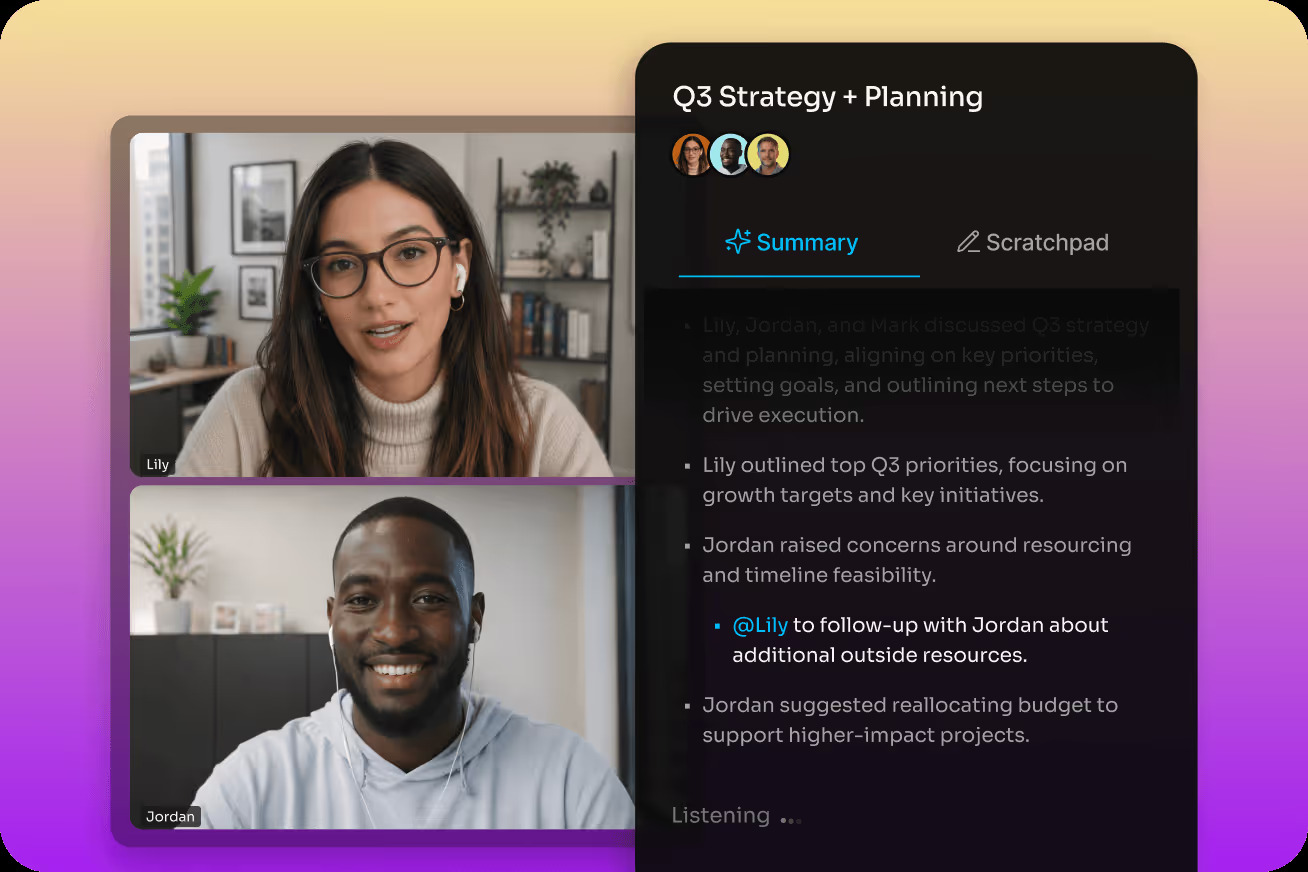
Fathom 3.0 gives Mac users several capture modes. The familiar bot can join a Zoom, Google Meet, or Microsoft Teams call and preserve full audio and video. Bot-free modes can produce a transcript only or keep audio as well; bot-free video for Zoom remains a limited beta. The desktop app adds a live summary, a private scratchpad, and a single post-call workspace. Slack Huddles now count as meetings too.
The choice matters. A visible “Fathom Notetaker” in the participant list is transparent, but it can make a first customer interview feel like a deposition. Reddit discussions and Product Hunt reviews repeatedly flag that social friction. Bot-free recording removes the little avatar, not the duty to disclose. Consent law, company policy, client expectations, and ordinary courtesy still apply.
| Capture mode | You keep | Best used when | Catch |
|---|---|---|---|
| Bot + full video | Video, audio, transcript | Demos, coaching, presentations | A named bot joins the call |
| Bot-free audio | Audio, transcript, summary | Client calls and quick syncs | Mac-first in the 3.0 experience |
| Transcript only | Text, summary, actions | Lower-footprint documentation | No recording to replay |
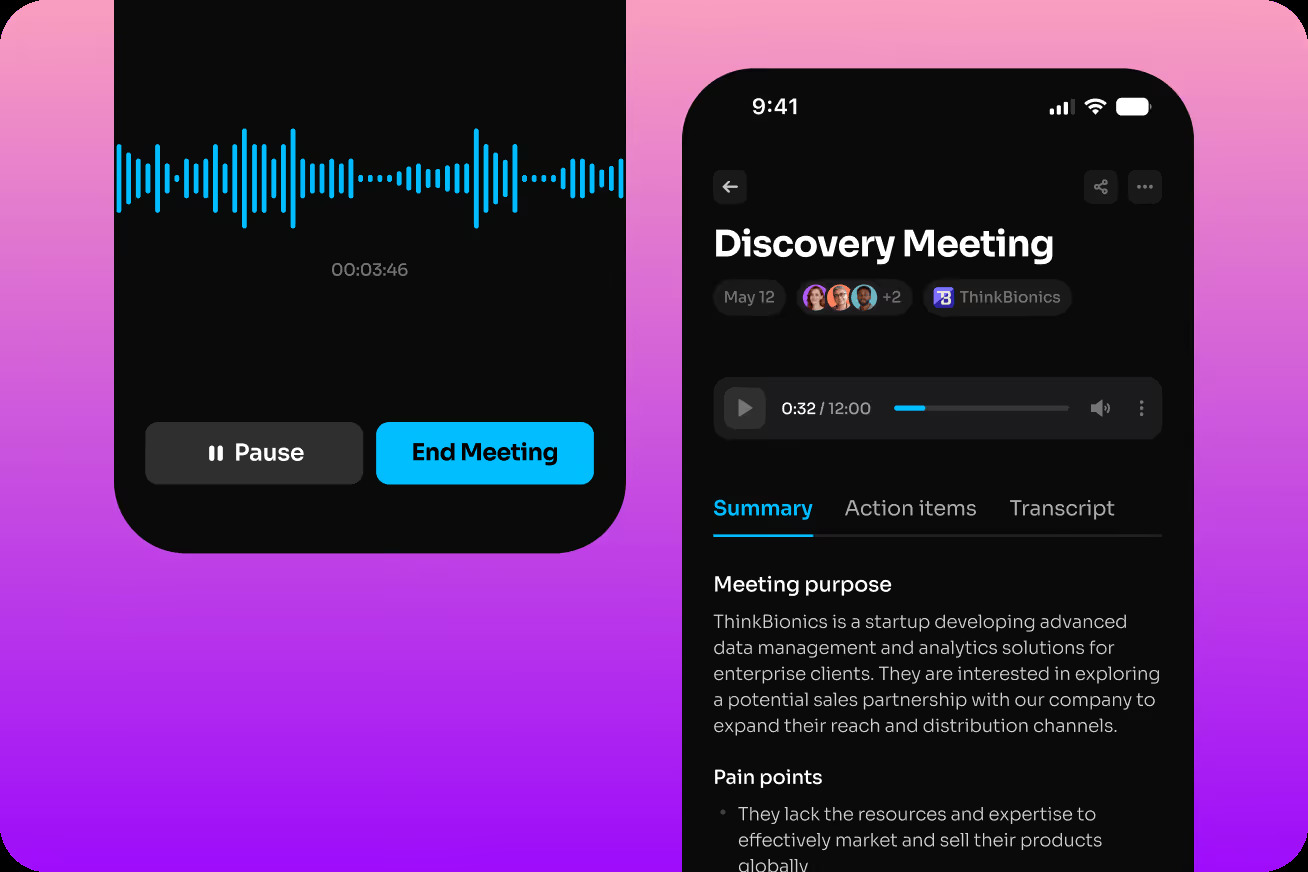
| iOS in person | Mobile recording and notes | Interviews away from a laptop | Designed for in-person use |
The useful bit begins afterward
A clean transcript is table stakes. Fathom earns its keep by turning a meeting into smaller, movable objects. Summaries can follow templates tuned for one-to-ones, demos, discovery, or sales frameworks. Action items arrive with owners. A highlight becomes a short clip rather than a timestamp someone will never open. Teams can collect clips into playlists, comment on calls, and organize customer or deal histories.
Ask Fathom is the more consequential feature. You can interrogate one call or search a permitted library for objections, decisions, feedback, and patterns. Answers cite exact transcript moments, which makes checking the machine less tedious. Account-wide search turns an archive from a record cupboard into something closer to organizational memory. It is especially useful when the sentence you need was spoken by somebody else on a call you never attended.
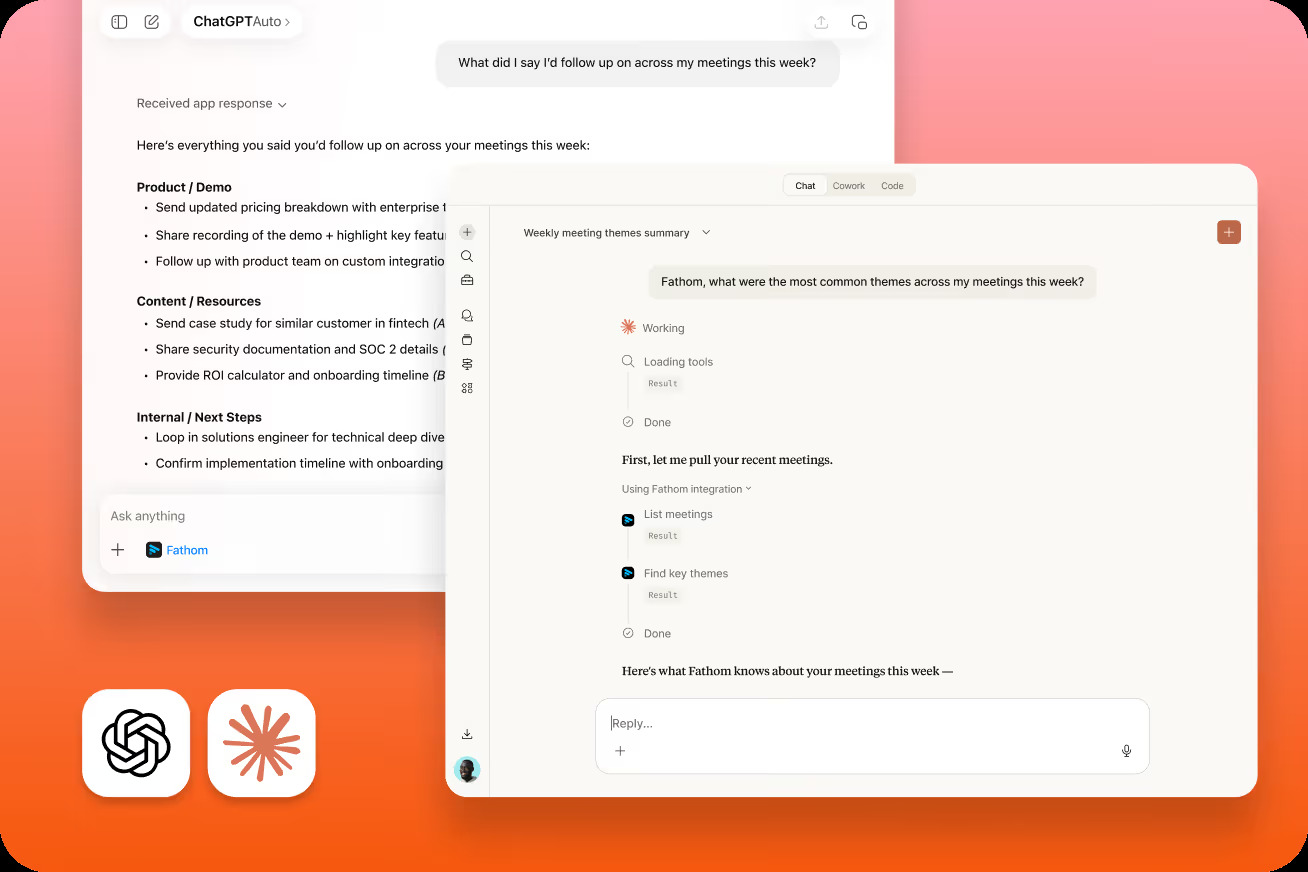
The new MCP connections bring that memory into ChatGPT and Claude. A team can draft a quarterly business review from customer calls, prepare a mutual action plan, or ask which objections recurred this week. Developers get a public API, webhooks, search-style access, and recording downloads. This is the direction to watch: Fathom as a meeting-data layer, not just another destination.
Pricing without the telescope
The free individual plan is unusually usable: unlimited recording, transcription, and storage, with instant summaries, clips, search, and limited access to advanced AI features. Premium costs $20 per month, or $16 per month on annual billing, and removes many AI limits while adding action items, advanced summaries, Ask Fathom, and bot customization.
Team costs $19 per user monthly or $15 on annual billing, with a two-seat minimum. It adds shared search, folders, comments, playlists, and alerts. Business is $34 monthly or $25 annually per user, also with two seats, and adds the heavier revenue machinery: CRM field sync, deal intelligence, coaching, scorecards, and custom summaries. Enterprise pricing is negotiated for SSO, SCIM, retention controls, onboarding, support commitments, and a signed HIPAA business associate agreement. Check the live pricing page before procurement; SaaS tables enjoy moving the furniture.
What reviewers notice after the honeymoon
The praise is strikingly consistent. Product Hunt reviewers like the quick summaries, recording reliability, searchable transcripts, and generous free plan. A career coach described split attention during client calls as “brutal” and said Fathom let her remain present while preserving the metrics and stories needed later. TechCrunch’s Frederic Lardinois found the transcription good and the summaries particularly strong, with useful chapters that adapt to the meeting type.
The complaints are narrower but real. The interface can feel crowded when video, transcript, summary, and chat all compete for one screen. Some users want cleaner pop-out views. Bot visibility can chill an external call, and the newest bot-free desktop experience reached Mac before Windows. Native meeting suites may also be simpler when every participant already lives inside one vendor’s ecosystem.
The privacy conversation before the conversation
Fathom says it is SOC 2 Type II, HIPAA, and GDPR compliant, and that all data is stored in the United States. Its AI subprocessors - named in the help center as Anthropic, OpenAI, and Google - are contractually barred from using customer data to train their models. Fathom does use de-identified customer data to improve its proprietary models, with an opt-out for individuals and an organization setting for team accounts.
Deleted account data is removed from backups after an additional seven days, according to the same documentation. Those are meaningful answers, but a badge cannot make a sensitive call routine. Legal teams should inspect the data processing agreement, retention options, access controls, recording notices, and export destinations. “We have a transcript” is convenient until nobody can explain who can see it.
Choose by behavior, not by feature grid
| If your priority is... | Start with... | Why |
|---|---|---|
| A broad free plan and quick summaries | Fathom | Unlimited basics make a low-risk individual trial |
| Discreet, note-first capture | Granola | Its identity was built around bot-free personal notes |
| Transcript collaboration | Otter | Longstanding real-time transcript workflow |
| Search and automation at team scale | Fireflies.ai | Deep integration and conversation-intelligence focus |
| Shareable customer evidence | Grain | Clips are central to the product |
| Revenue coaching and forecasting | Gong | Broader, heavier sales platform |
The native assistants from Zoom, Microsoft, and Google deserve a trial too. They reduce vendor sprawl and may fit an organization already committed to one suite. Fathom’s advantage is neutrality across meeting platforms and its growing collection of downstream routes. Its disadvantage is becoming one more repository that security, IT, and humans must govern.
A sensible first week
Use a recurring internal meeting, an external conversation with clear consent, and one long call you expect to revisit.
A week later, ask for a decision, owner, objection, and exact quote. Memory products prove themselves after memory fades.
Sync an action to your real CRM or task system. If the workflow still ends in copy-paste, find out why.
Open a recording as a teammate and an external recipient. Confirm what each person can watch, read, copy, and download.
Should you use Fathom?
Yes, if conversation is raw material for your work and you routinely lose details between listening, typing, and following up. The free plan makes the answer easy to test. Pay when advanced summaries, cross-call questions, CRM automation, or team governance replace measurable chores. Skip it if you will not revisit the archive, cannot establish clean recording consent, or already get sufficient notes from your meeting suite.
Fathom began by promising that you would never take notes again. Its better 2026 promise is more modest and more useful: the important sentence will still be there when somebody finally needs it. That could be tomorrow’s action item, next quarter’s product brief, or the customer warning everyone remembers differently. A meeting is expensive. Forgetting it is optional.