Picture a software company with two keyboards at every programming station. Two mice, too. The obvious question is whether anybody can get any work done when both people can move the cursor. Pivotal Labs had an answer: the keyboard is the least interesting part of programming. Most of the work happens before anyone types, in the disagreement about what to build, the tiny correction that saves an hour, and the explanation that turns a colleague into a future maintainer.
This was an unusual thing for a large technology company to sell. Pivotal Software also sold substantial technology: an enterprise platform for running applications, data systems, and tools for development teams. But its consulting arm treated a client's ability to build software as part of the deliverable. A successful engagement was meant to leave behind people who could keep shipping after the consultants left.
The short read
- Pivotal combined a commercial application platform with hands-on software consulting.
- Its Labs teams paired with client developers, designers, and product managers on real work.
- It earned $657.5 million in fiscal 2019 revenue; VMware completed its acquisition that December.
- The Cloud Foundry lineage continues in Broadcom's VMware Tanzu portfolio.
01 / The methodThe client gets a keyboard
Pivotal Labs began before Pivotal Software did. When EMC and VMware assembled the new company in 2013, they brought together the Labs consulting tradition, Cloud Foundry, and data products including Greenplum. The combination sounded like the usual corporate shopping list. In practice it addressed two failures that big organizations knew well: the months it took to release an application, and the awkward handoff once a consultant had built it.
Labs put client staff inside the work. Its own description was blunt: it paired with client developers, product managers, and designers every day. Teams worked in short cycles, tested assumptions, and changed priorities as they learned. The contract did not promise a fixed scope at the outset, because the point was to discover which features deserved to exist. That is a difficult sales pitch to an executive who wants a date and a list. It is easier to appreciate after paying for a perfectly delivered feature nobody uses.
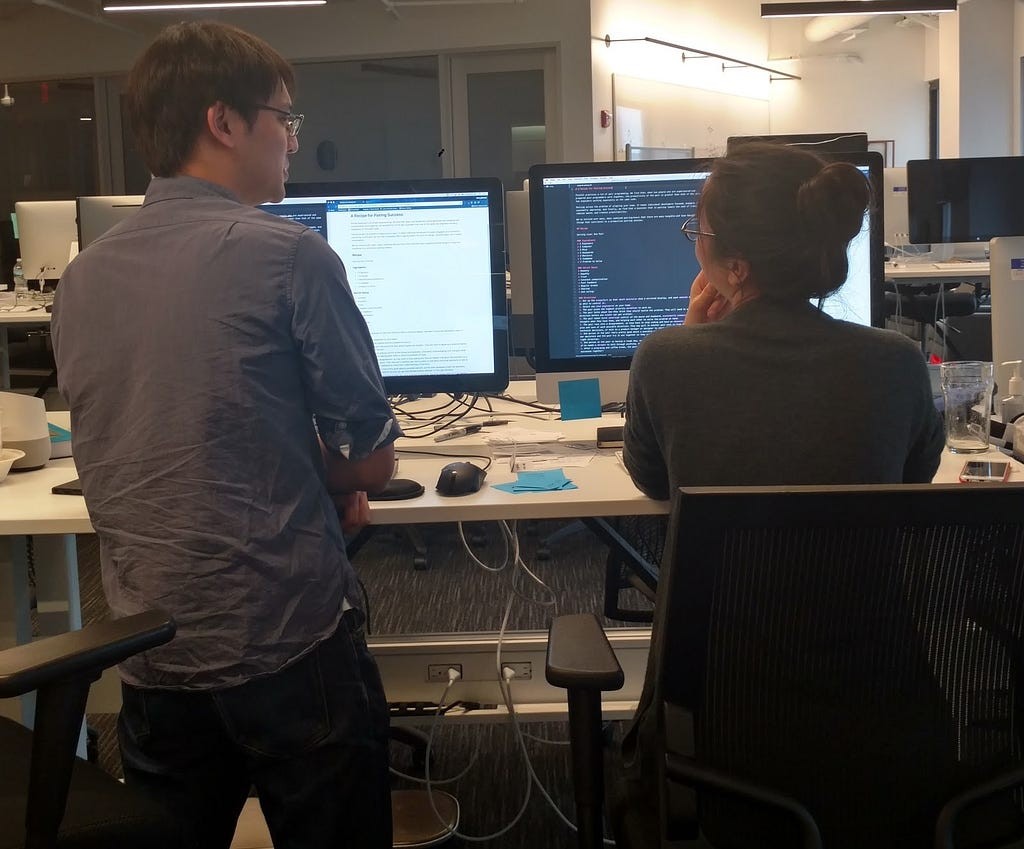
The office routine made the theory visible. Pivotal Labs described a 9-to-6 day with an hour for lunch, a 40-hour week, and a sustainable pace. Pairing demanded attention; exhausted pairs were a poor investment. Engineers rotated partners to spread knowledge through the team. A private genius might finish a task quickly, but a team that understands the whole codebase can change it again tomorrow.
02 / The machineMake deployment ordinary
The other half of the business was Pivotal Cloud Foundry, later called Pivotal Application Service. It packaged the open-source Cloud Foundry approach for enterprise buyers: developers could push applications while a platform team handled much of the machinery underneath. Pivotal sold subscriptions, support, and related services. A customer could run the platform in its own environment or across supported clouds, keeping a consistent path from code to production.
That mattered because large companies do not have one application or one team. They have legacy systems, security reviews, multiple environments, and good reasons to fear Friday releases. Pivotal aimed to make deployment a repeatable service instead of a bespoke negotiation between a developer and an operations department. It also supplied Greenplum for analytics, GemFire for distributed data, and tools such as BOSH for managing complex deployments. Pivotal Tracker, born in Labs, helped teams manage the work itself.
Comcast offered an unusually large demonstration. In 2017 it reported about 2,000 developers deploying 20,000 apps on Pivotal Cloud Foundry, handling roughly 350 million transactions a day. Ford's interest was different but related: in 2016 it invested $182.2 million in Pivotal and planned new software labs to help its teams move faster. Financial firms, healthcare organizations, and other large enterprises also appeared in Pivotal's customer base. The common buyer was an organization for which software had become important, but releasing it remained painfully ceremonial.
03 / The billWhat the transformation cost
There was no simple sticker price for a Pivotal transformation. The company sold enterprise subscriptions, premium support, training, and consulting engagements. Its annual filing defined a counted platform customer as one producing at least $50,000 in annual revenue; that threshold describes its reporting, not a standard price. In fiscal 2019, subscription revenue was $400.9 million and services revenue was $256.6 million. The mix shows how much of the company still depended on people working directly with other people.
For a buyer, the software bill was only one part. Pairing asked client employees to leave their familiar schedule and sit with consultants, to show unfinished work, and to accept frequent feedback. A platform team also had to run the platform and make it trustworthy. If leadership wanted only a faster demo while keeping slow approvals and separate silos, the mechanics could become expensive theater. The method works best when a client can spare real staff, grant a team room to make decisions, and measure what reaches users.
Pivotal's commercial position sat between a managed public-cloud shortcut and the do-it-yourself burden of building an internal platform. Red Hat OpenShift, cloud-provider services, Heroku, and in-house platform groups offered alternative routes. Pivotal's distinction was its insistence that the route to production and the behavior of the people traveling it belonged in the same sale.
04 / The turnGrowth, then gravity
Pivotal went public in April 2018. By the end of its 2019 fiscal year, subscriptions were growing strongly and existing customers were expanding their spending. Its filing reported a 149 percent trailing four-quarter dollar-based net expansion rate. Yet the count of customers meeting its $50,000 threshold moved from 377 in February 2019 to 412 that November, while that expansion rate eased to 135 percent. Those numbers do not prove that the product failed. They do show a business leaning heavily on deeper adoption inside accounts while the task of winning new large accounts remained demanding.
The market was shifting as Kubernetes gathered enterprise attention. Pivotal began bringing Kubernetes into its plans; VMware, already a close partner, wanted an application platform for its emerging Tanzu portfolio. VMware agreed to buy Pivotal in August 2019 and closed the deal on December 30. The company born partly from VMware became part of it again. The name Pivotal largely receded, but the Cloud Foundry product line continued under Tanzu, and Pivotal Labs became part of Tanzu Labs.
The curious legacy is that the easiest part to copy costs almost nothing in licensing. A second keyboard is cheap. The hard purchase is an organization's willingness to let the person who knows the customer sit beside the person who writes the code, then believe what they learn together. Pivotal sold a company-sized version of that argument. The company changed hands. The argument has not gone away.