Consider a software improvement that makes the screen emptier. At Albany Medical Center, Picis and hospital staff spent two years reviewing a perioperative system already in use. They reduced case documentation screens by 57% and documentation fields by 53%. The time required to close a case fell by 37%, according to the results Picis published in October 2021. In a business accustomed to announcing additions, this was a rather persuasive subtraction.
- What it sells: software for the surgical journey, including scheduling, anesthesia records, recovery documentation and patient tracking.
- Who buys: hospitals and health systems; Picis reports more than 400 hospital customers worldwide.
- The useful distinction: specialist workflows plus direct connections to bedside medical devices.
- The lesson to steal: revisit the forms and configurations you already have before asking staff to fill in another field.
01 / SUBTRACTIONThe forms that disappeared
Albany’s project reached across three facilities, 44 operating rooms and eight procedure rooms. The work included documentation screens, surgeon preference cards, stock dictionaries, staff training and security configurations. This was a review of the daily machinery of work, down to the names attached to things on a shelf.
Changes after a two-year optimization project. Vendor-published customer results; bars show percentage reductions, not minutes or clinical outcomes.
The implication is practical: software can collect useful information and still make collecting it unnecessarily laborious. A review that removes duplication deserves a place beside the more glamorous project that installs something new. Albany’s reported figures describe its own experience, rather than a forecast for every hospital buying Picis.
02 / THE HANDOFFA chart with an itinerary
Picis develops clinical information systems for perioperative and critical care. Perioperative is the orderly word for everything surrounding an operation: preparation, anesthesia, surgery and recovery. The company’s central proposition is a continuous patient record across those stages. The patient has enough transitions to make without the information acquiring a separate itinerary.
Preop Manager handles assessment and readiness before surgery. OR Manager covers scheduling, intraoperative documentation, resources and costs. Anesthesia Manager captures the anesthesia record, including data from connected equipment. PACU Manager carries documentation into the post-anesthesia care unit. These are distinct jobs with a common need: the next clinician should be able to use what the previous clinician recorded.
Assessment and readiness
Scheduling, supplies and documentation
Charting and connected device data
Post-anesthesia documentation
OR Manager’s preference cards are a telling detail. Add the surgeon and procedure to the schedule and the corresponding card is selected automatically. The software also records tissues and implants, so staff can retrieve affected patient lists when a recall occurs. Surgical software has to accommodate both the planned case and the awkward question that arrives months afterward.
SmarTrack Next addresses another handoff: telling staff and families where a patient is in the process. Its web-based tracking provides near real-time status updates and configurable communication. Envision Analytics, built with Microsoft Power BI, gives administrators a way to examine operational and clinical data. One tool answers “Where are we?” Another asks “Why do we keep getting stuck here?”
03 / TRANSLATIONThe machines speak different dialects
A hospital’s devices do not necessarily come from one manufacturer. Picis treats that variety as part of the job. Device Hub collects bedside data and sends it to clinical systems using interfaces including HL7, a healthcare data exchange standard. Picis says it supports more than 450 medical devices, including legacy connections. An impressive compatibility count is useful only when the hospital’s particular equipment appears on the list.
That last distinction matters. Managing a device connection and viewing a clinical record are different functions. Picis’s technical description separates them. The buying conversation should do the same: which devices connect, where their data appears, and who checks the resulting record?
“We get a lot better documentation for a lot less effort.”DR. MARY STOCKER, CONSULTANT ANESTHETIST, TORBAY HOSPITAL
TESTIMONIAL PUBLISHED BY PICIS
The competitive choice is broader than paper versus software. Epic offers operating-room scheduling capabilities; Surgical Information Systems sells specialist anesthesia software. Picis’s position rests on its perioperative depth and the ability to fit into an existing hospital environment. The question for a buyer is whether those specialist capabilities justify another system to implement and maintain.
Fraser Health offers a concrete example. In August 2022, Picis announced a project covering 11 acute hospitals and 90 operating rooms in British Columbia, integrating Preop Manager, Anesthesia Manager and PACU Manager with Meditech Client/Server and Expanse. The announced scope shows a specialist working alongside the hospital’s broader EHR. It does not, by itself, establish the project’s eventual results.
04 / THE REPLACEMENTWhen the supplier leaves the room
Sometimes the reason to buy is less philosophical. In a case story published in July 2023, Picis described a large, unnamed Long Island hospital whose perioperative supplier was ending software development and support in North America. The announcement had come in early 2020. A system that had been acceptable acquired an expiry problem.
Picis proposed its suite in March 2020. Device compatibility was one reason the hospital selected it, according to the account. COVID restrictions also changed the sales process: the usual series of face-to-face meetings became a half-day in-person demonstration followed by remote work. What failed first was the incumbent’s continuing support, not a publicly documented clinical failure. The buyer’s calculation changed because continued use had become harder to defend.
The business model reflects that kind of purchase. Picis licenses software to healthcare organizations and offers implementation, training, optimization and support. Its customer relationship extends beyond a download. The price discussion therefore needs to include interfaces, configuration, staff time and ongoing service, as well as the modules themselves.
05 / LONG MEMORYOwnership changed. The specialty endured.
Founded in 1994, Picis has passed through several chapters of healthcare IT. Co-founder and former CEO Todd Cozzens described its early territory as the electronic record for high-acuity care: operating rooms, intensive care and emergency departments. Ingenix, a UnitedHealth Group subsidiary, completed its acquisition in August 2010.
In May 2015, Constellation Software announced an agreement through Harris Computer to acquire Picis clinical applications. Picis now identifies itself as a wholly owned Harris subsidiary. The enduring commercial proposition is specialization: learn a complicated department well enough to help its people document, coordinate and examine their work.
The company also works through regional partners and integrations. Its 2021 Bitscopic partnership brought Picis information into PraedAlert clinical surveillance for VA hospitals. That arrangement extends the usefulness of the record beyond the department that created it, allowing other clinical monitoring activities to draw on perioperative and ICU data.
06 / A MOVING RECORDThe chart gets up and walks
The September 2026 introduction of Prima takes the same argument to a connected tablet. Anesthesia clinicians can access and document information during preoperative and intraoperative workflows, including medications, fluids, physiological variables and notes. Connected devices can supply physiological data, and HL7 integration supports continuity with electronic records.
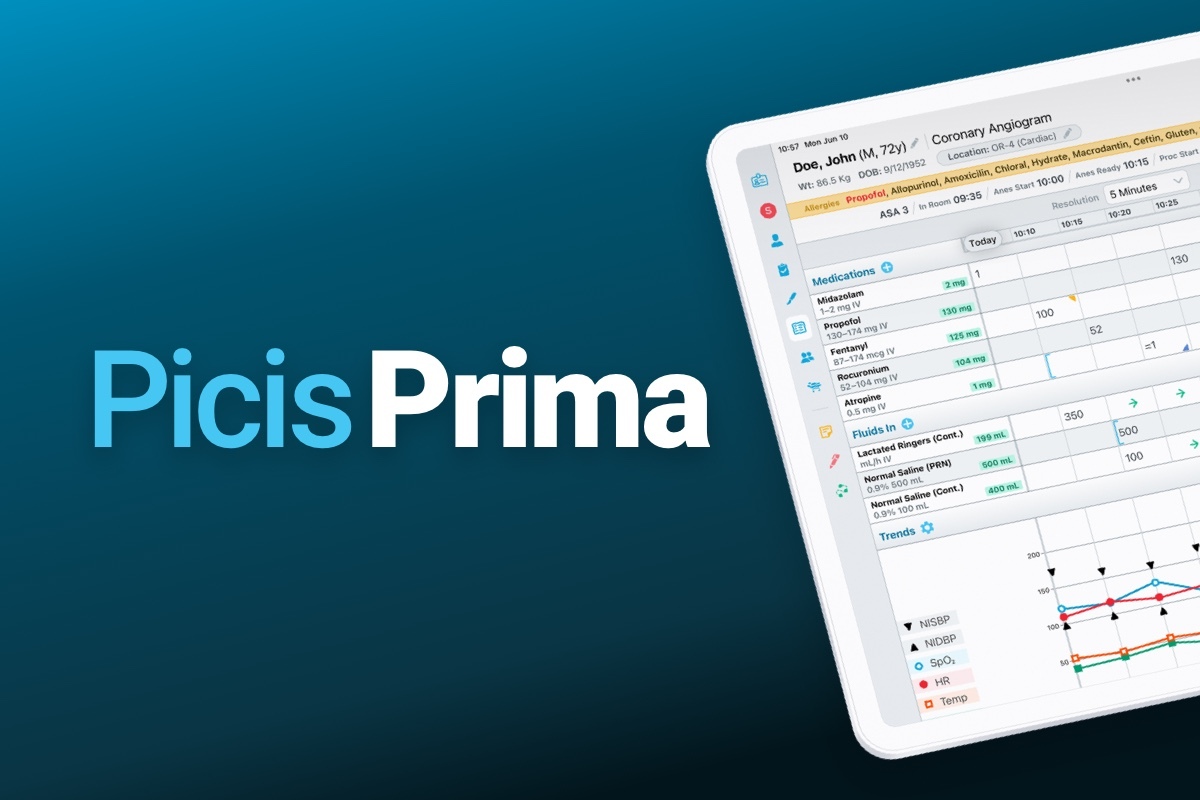
Prima’s product page states a consequential condition: it does not work offline. Documentation and data capture need an active connection to the server and associated services. A tablet can move through a building more easily than a workstation; its usefulness still depends on the infrastructure supporting it. Buyers should test that condition in the rooms where care happens.
There is a transferable idea running from Albany’s missing fields to Prima’s moving chart. Put the record where the work occurs, keep the information connected, and examine every demand placed on the person entering it. The software earns its place when the next necessary action becomes easier. Sometimes that means a new device connection. Sometimes it means a field has finally disappeared.