Before a photograph could leave a phone, it had to survive Philippe Kahn's kitchen. The server sat there in 1997, months before the picture that made it famous. It knew how to receive an image, put it on the web and notify a list of people. This was not yet a neat consumer object. It was infrastructure waiting for its moment.
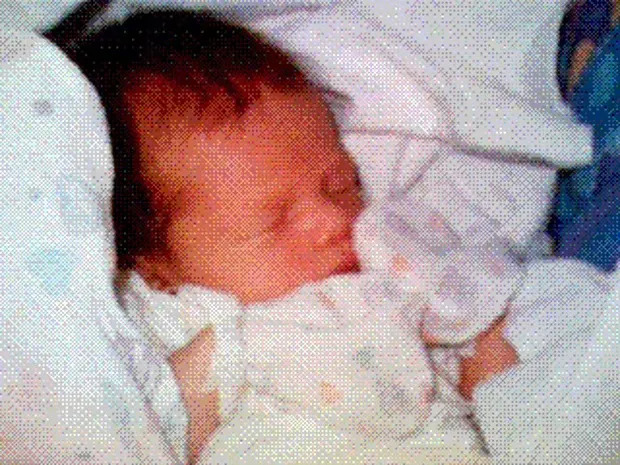
The moment arrived on June 11 in a Northern California maternity ward. Kahn brought a Casio digital camera, a Toshiba laptop and a Motorola StarTAC. He connected the pieces through the phone's 1,200-baud data link and finished the system while his wife, Sonia Lee, waited for their daughter to be born. When Sophie arrived, her picture traveled to the home server and then to nearly 2,000 friends, relatives and colleagues.
We now point, tap and send with the bored fluency of breathing. Kahn's contraption gives that gesture its wires back. A picture did not merely need a lens. It needed a route, an address book and a reason to travel. The camera phone's enduring idea was the completed loop.
The 1997 sharing loop
01 / Practice before productThe curve, the flute and the compiler
Kahn's appetite for systems appeared early. He has said that seeing a normal distribution curve in sixth grade was a revelation. The remark is delightfully specific. Plenty of future founders claim they were born curious. Kahn remembers the graph.
Born in Paris in 1952, he studied mathematics at ETH Zurich in the 1970s. There he met Niklaus Wirth, the designer of Pascal. Kahn says Wirth impressed him immediately; their relationship lasted more than four decades. At the same time, he pursued musicology, composition and classical flute at the Zurich Music Conservatory. His mother had been a professional violinist. Mathematics and music became parallel tracks, both formal enough to be demanding and abstract enough to reward obsession.
He chose science and technology as his profession, but the flute stayed in the daily schedule. This is the quiet key to the noisy career that followed. Kahn does not treat an interest as decoration. He gives it practice hours.
“Seeing a normal distribution curve was a revelation in 6th grade.”Philippe Kahn on an early encounter with mathematics
After his studies, he taught mathematics at the University of Nice. Silicon Valley pulled harder. He arrived alone and without a work permit, making printer cables for a computer shop and earning little. Consulting work followed. So did a meeting with three Danish entrepreneurs. Together they started Borland in 1983.
02 / Make power accessibleThe $49.95 wedge
Software development tools then could feel like institutional furniture: expensive, imposing and meant for somebody with a purchasing department. Turbo Pascal compressed the editor, compiler and runtime into an integrated package that was fast and affordable. It sold for $49.95. More than one million developers eventually used it.
Kahn later described Borland's recurring challenge as competing with companies at least ten times its size. The response was not ornamental strategy. It was a better ratio of capability to friction. Turbo Pascal started quickly, compiled quickly and put professional power within reach of an individual programmer. Sidekick, Turbo C++, Prolog and Paradox extended the same restless catalogue.
By the mid-1990s, Borland employed roughly 4,000 people and generated more than half a billion dollars in annual revenue. Growth did not produce agreement. Diverging views with the board led Kahn and Lee to form Starfish Software in 1994. He left Borland the next year and turned toward wireless synchronization. Motorola acquired Starfish in 1998.
The sequence established a rhythm: build a tool, watch it spread, then move to the next missing connection. With Starfish, information moved between devices. With LightSurf, founded after the hospital prototype, photographs moved across public networks. In Kahn's career, the nouns change. The verb is usually move.
03 / Close the loopA photograph with somewhere to go
Kahn had started building the picture-sharing server in late 1996. Low-power imaging sensors, stronger processors and emerging cellular infrastructure suggested a new arrangement. The hardware alone was not the thesis. Instant media sharing over a public network was.
The distinction has grown more useful with time. A component can be clever and still leave the user carrying the workflow. Kahn joined capture, transmission, publishing and notification. The photograph appeared online and the audience received a link. Comments began returning. He called the service PictureMail and the behavior “point, shoot, share instantly.”
LightSurf turned the prototype into a commercial platform licensed to handset makers and wireless carriers. VeriSign bought the company in 2005 in a stock deal valued at about $270 million. By then, the pocket camera was becoming normal. The awkward pile of devices had vanished into the gesture it predicted.
“If it weren't for the last moment, nothing would get done.”Kahn on finishing the camera-phone setup in time
There is comedy in this maxim, but not carelessness. The server had been under construction for months. The final deadline worked because so much unglamorous preparation already existed. Kahn did not summon a network from thin air between contractions. He completed the final mile when life supplied a reason no demo day could match.
Borland launches Turbo Pascal and lowers the barrier to professional development tools.
Kahn and Sonia Lee start Starfish Software, focused on synchronization.
PictureMail sends Sophie's photograph over a public cellular network.
Motorola acquires Starfish; LightSurf begins commercializing picture sharing.
VeriSign acquires LightSurf; Fullpower becomes Kahn's next operating chapter.
04 / Read the conditionsThe Pacific as a second workshop
Kahn came to sailing late. After Borland went public, he ordered a Baltic 43 and learned enough from the salesman to get away from the dock. On weekends he crossed Monterey Bay and returned, not always elegantly but reliably. The beginner soon built Pegasus Racing into a serious program.
Pegasus took line honors in the Transpac races of 2001 and 2003. In 2009, Kahn and Mark “Crusty” Christensen won the doublehanded division from Los Angeles to Hawaii and cut more than two days from the previous doublehanded race record. Kahn has completed 15 big-boat races from California to Hawaii, three with only two sailors aboard.
Offshore sailing rewards systems and punishes theater. Weather, fatigue, weight and equipment keep their own counsel. Kahn came to prefer doublehanding because it restored adventure and reduced the logistics of moving a large crew around the world. Later he simplified again. From his home by Santa Cruz Harbor, he could roll out a dinghy and reach the water in five minutes.
Turbo Pascal shortened the trip from idea to running code. PictureMail shortened the trip from moment to audience. A boat beside the harbor shortened the trip from wanting to sail to reading the wind.
The smaller setup did not mean smaller interest. It meant more time sailing. He could choose a foiling catamaran, Laser or Moore 24, meet the local conditions and learn against younger sailors. The grand campaign gave way to frequency. A five-minute launch beat an airport itinerary.
05 / Keep the beginnerHundreds of patents, no finish line
Kahn has founded four technology companies: Borland, Starfish, LightSurf and Fullpower-AI, where he remains co-founder and CEO. His official biography lists more than 235 issued patents; a 2025 ETH Zurich profile counted more than 350 patent filings over his career. Asked to choose a favorite, he compared them to children and declined the ranking.
The numbers matter less than the posture they reveal. He continues to work, practice flute and sail. In a 2022 conversation, he said he no longer needed to work but loved what he did and could not help it. This does not sound like a mission statement polished in a conference room. It sounds like a condition.
That mixture of disciplines also protects him from becoming a monument to his earlier work. A compiler can become a museum object. A daily scale cannot. A race trophy records one finish; the breeze presents a fresh problem every afternoon. Kahn keeps choosing activities that erase yesterday's certainty and return him to the useful awkwardness of a beginner.
The temptation with Kahn is to freeze him at the maternity ward, soldering iron nearby, history waiting in a bassinet. It is a perfect anecdote and therefore an incomplete portrait. The longer story runs through a classroom, a conservatory, a cable shop, a compiler, four companies and the open Pacific.
Each setting asks a version of the same question: what stands between intention and action? Price. Wires. Distance. Logistics. Kahn's work repeatedly removes one obstacle and then listens for the next. The camera in your pocket was one answer. The habit of looking for friction was the real career.