Eric Yuan’s first argument for video calling was a train journey. As a university student in China, he lived ten hours away from his girlfriend. Visiting her meant spending a substantial part of the visit getting there. He imagined a device that would let them see each other without the journey. Romance has financed worse research departments.
The girlfriend became his wife. The idea took considerably longer to find its business model. Between that student daydream and Zoom’s founding in 2011 came mathematics, engineering, a move across the Pacific, and years spent building somebody else’s communications software. This is an unusually patient origin story for a product whose appeal rests on how little patience it requires.
Yuan was born in Tai’an, in China’s Shandong province, in 1970. His parents were geological engineers. He studied applied mathematics at Shandong University of Science and Technology, then earned a master’s degree at China University of Mining and Technology. The educational route was technical; the problem that interested him was intimate. Someone he wanted to see was inconveniently elsewhere.
In 1995, while attending a training program in Japan, he heard Bill Gates speak. The possibilities of the internet helped turn Silicon Valley from a distant idea into a destination. Getting there was another exercise in waiting. His American visa application was rejected eight times before he succeeded. He arrived in 1997, with limited English and a job at Webex.
The familiar inspirational version ends at the airport. Yuan’s career becomes more interesting after it. He had reached the place he wanted to work, but he still needed to discover what he wanted to build. The next fourteen years would give him an education in both the machinery of online meetings and the frustrations of the people attending them.
- 1997Joins Webex
- 2011Founds Zoom
- 2019Nasdaq IPO
- 2026ZoomMate launches
A crowded market, with room for one less headache
At Webex, Yuan was an early engineer. He rose through engineering leadership, then became a corporate vice president at Cisco after its 2007 acquisition of the business. He was working inside a company that already understood online meetings, with customers, distribution, and a product people recognized. Leaving meant surrendering several advantages at once.
By 2011, he wanted to build a new approach to video communications. His proposal did not win support inside Cisco. He left and started Zoom. For prospective investors, the difficulty was obvious: video conferencing already existed. An experienced executive proposing another version could sound like a restaurateur announcing that he had discovered lunch.
Yuan’s bet depended on the difference between a category existing and a customer enjoying it. A meeting product could possess the necessary features and still make joining a call a chore. That left room for a company willing to treat the ordinary experience of getting connected as the main event. The technical work mattered because it could disappear from the user’s attention.
He later described the fundraising resistance to a Stanford audience. Investors who liked his background still doubted his choice of business. The objections were useful evidence of how the market looked from outside. Yuan had spent years looking from inside, where a dissatisfied customer was more persuasive than a tidy map of the competition.
Zoom went public on April 18, 2019. Its shares rose about 72 percent on their first trading day. The event supplied a satisfying ending to the story of the engineer who persisted. It also supplied a misleading one. A listing rewards what a company has built; it cannot settle what the founder will have to learn next.
The customer who had already left
In Zoom’s early years, Yuan personally emailed customers who canceled. A cancellation is a particularly useful kind of feedback: the person has already voted. There is less need to interpret a survey score when the answer has arrived through the billing system. Asking why can still produce a conversation, provided someone is willing to listen.
The habit helps explain his recurring interest in happiness. In a 2018 interview, he described a question he asked himself each morning: “Do I feel happy?” His explanation was practical. His own dissatisfaction could affect his colleagues and family. When something was going wrong, he wanted to understand it and act on it.
As a management philosophy, happiness can sound suspiciously easy to print on a mug. Yuan connected it to decisions about the product and the working environment. Employees who were treated well would be better placed to serve customers. The idea gave a human test to engineering decisions: what did this change feel like to the person using it?
There was a domestic version of that test, too. Yuan recalled criticizing his son over a disappointing exam result. His son explained that he had worked hard and cared seriously about basketball. Yuan reconsidered and apologized. The anecdote is small, which is part of its appeal. A founder accustomed to directing a company had encountered someone with a quite reasonable competing agenda.
Basketball runs through Yuan’s life beyond that conversation. He follows the sport, and NBA player Andre Iguodala became a Zoom investor. Yuan has also held public conversations with Chris Paul. These connections give the familiar executive biography a different texture: there are people in his orbit whose work is measured by a scoreboard rather than a quarterly call.
Do I feel happy?
Eric Yuan’s morning question, 2018
When a useful tool becomes a public room
In early 2020, Zoom’s audience changed with extraordinary speed. The company reported roughly 10 million daily meeting participants at its December 2019 peak and more than 200 million in March 2020. Those figures count participation in meetings, including repeat attendance. They do not mean that 200 million distinct people had accounts.
The distinction matters because even the correctly labeled numbers describe a difficult engineering and management problem. Zoom was suddenly serving a broader public, including people without an employer’s IT department to configure the experience. A product designed mainly for organizations was being asked to behave like a public meeting place.
Privacy and security shortcomings brought criticism. On April 1, Yuan published an apology and announced a 90-day pause on feature development so engineering resources could focus on safety, privacy, and security. The decision temporarily reversed the usual product-company appetite for additions. Existing users needed confidence in the room before anyone offered them another piece of furniture.
The episode complicates the attractive story of a founder who listens. A company can listen carefully to one kind of customer and still fail to anticipate another. Zoom’s wider reach changed the meaning of a good experience. Joining easily was one requirement; understanding and controlling what happened inside the meeting was another.
In 2023 came a different reckoning. Zoom announced about 1,300 job cuts, approximately 15 percent of its workforce. Yuan acknowledged mistakes in assessing sustainable growth. His base salary for fiscal 2024 was reduced by 98 percent to $10,000, and he gave up his fiscal 2023 corporate bonus. Those were specific personal consequences. For departing employees, the larger consequence remained the loss of a job.
The contrast with his emphasis on employee happiness is unavoidable. Keeping that ambition in the story requires keeping these decisions beside it. A founder’s principles become more revealing when the business makes them hard to honor. Yuan’s record includes the reassuring customer email and the painful company announcement.
Daily meeting participants, free and paid. Repeat attendance counts. December figure is the reported maximum; March figure exceeded 200 million. Bar lengths use 10 and 200 million.
A meeting invitation for your other self
Yuan’s next ambition carries a certain comic risk for the founder of a meeting company. In a June 2024 interview with Decoder, he discussed a future in which AI-powered digital twins could attend meetings on a person’s behalf. Having helped make it easier to be present, he was considering how software might spare people some of that presence.
Treat that as a proposed future, rather than a description of what every Zoom user can do today. A digital representative raises questions that a video connection does not answer by itself. What can it decide? When must it ask the person it represents? How does everyone else know what kind of participant has joined? Better imitation alone cannot settle permission or responsibility.
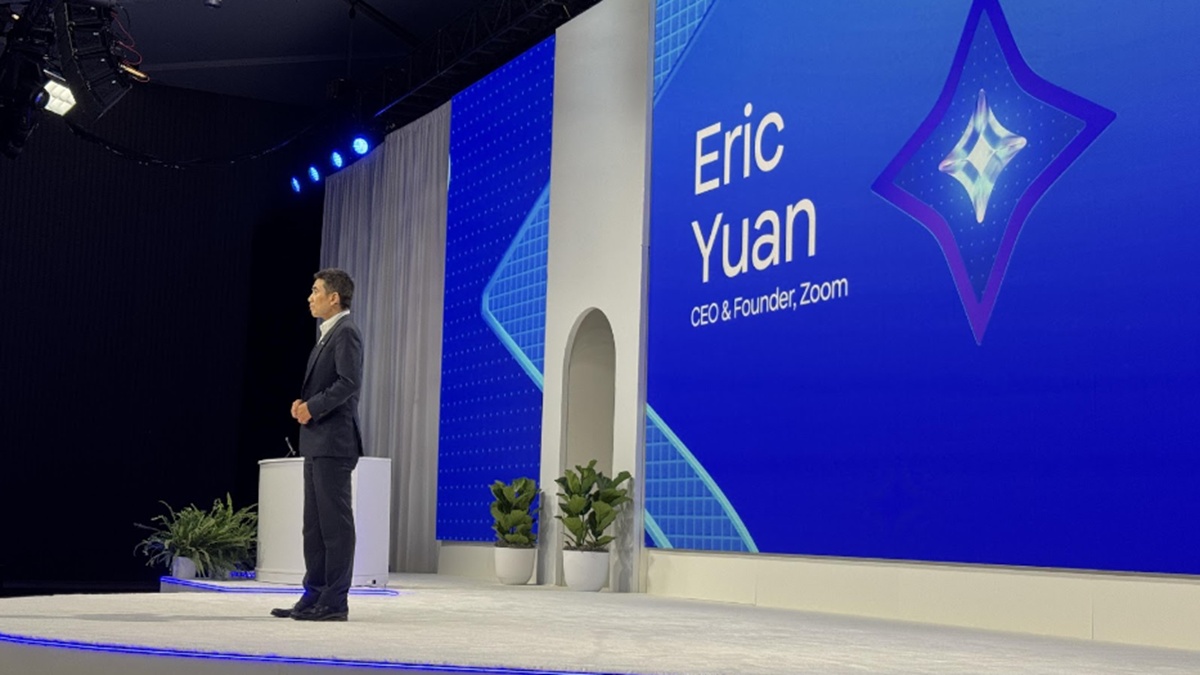
The more immediate business direction is already visible. Zoom launched ZoomMate on June 1, 2026, describing software that uses conversational context to search connected systems, produce documents and presentations, and carry out workflows. The advertised progression is from discussing work to getting the follow-up done. A meeting summary has limited charm if someone must spend the afternoon reconstructing the tasks it contains.
That puts Yuan back near his original concern: the time surrounding an interaction. The student’s problem included the journey to see someone. The worker’s problem includes finding the right information, recording the decisions, and moving them into other tools. Whether the newer products actually reduce that burden will depend on their performance in ordinary working days.
He remains Zoom’s founder and chief executive, and serves on the boards of Intuit and ServiceNow. His company biography now also lists membership in the National Academy of Engineering. The engineer who once struggled to persuade investors that meetings needed improvement has a rather different challenge: persuading customers that the expanding product will keep life simple.
There is a useful measure available, and it predates the stock listing, the conference stage, and the AI vocabulary. Someone wants to see another person. Work stands between the intention and the conversation. Yuan built a career by trying to remove some of that work. The next chapter will be judged in the minutes people get back, and in what they choose to do with them.
Keep the conversation going
More from Yuan and the people who have spoken with him.