Before there was a perfume business, there was a mailing list. Philippe Benacin and Jean Madar, students at ESSEC, approached roughly 300 companies offering market research. One answered: a clothing company interested in launching a fragrance. Most of the recipients contributed nothing to perfume history. Their silence did, however, leave the two students with a rather clear next appointment.
The assignment opened a door into a trade neither had set out to conquer. Benacin would eventually help put names such as Montblanc, Jimmy Choo and Coach onto perfume counters around the world. His entry was considerably less theatrical: someone needed a study, the students needed work, and an industry became interesting once they got close enough to ask questions.
Born in Tunis in 1959 and a graduate of ESSEC in 1983, Benacin built his working life in Paris. Today he is chairman and chief executive of Interparfums SA, as well as president and vice chairman of the US parent, Interparfums, Inc. The arrangement leaves him unusually fluent in two languages of luxury: the imaginative language of a brand and the contractual language that lets someone else bottle it.
The long apprenticeship
Interparfums dates its beginnings to 1982. The early business sold mass-market fragrances, including in South America and the Middle East. Benacin has described the first decade as slow going. He and Madar learned by meeting people across the perfume trade, assembling an education that their business-school credentials had not supplied. The prestige names came later.
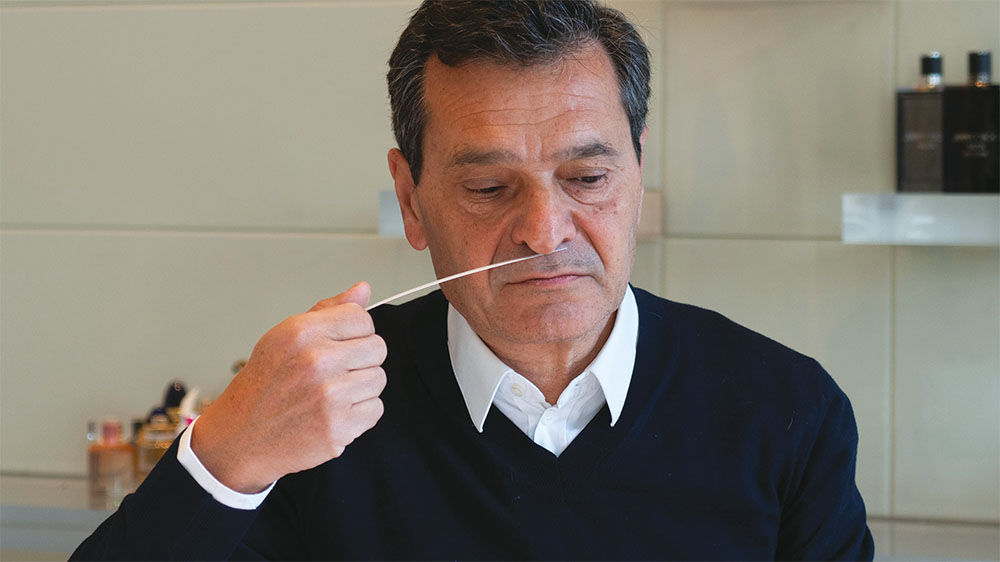
His original enthusiasm was music. Fragrance appreciation developed through encounters and repetition. Gérard Delcour gave him his first perfume, Oscar de la Renta pour Lui, remembered as a leather scent. He liked it before he had the vocabulary to explain why. That is an appealingly ordinary beginning for someone whose eventual job would involve deciding which smells deserved a worldwide launch.
The company moved toward selective perfumery with Régine, whose nightlife world offered an identity that could travel beyond a nightclub door. In 1993 came Burberry. Interparfums gained the right to create, produce and distribute its perfumes worldwide. A British fashion house supplied a recognisable history; Benacin and his colleagues had to give that history another sensory form.
The sequence matters. A brand could contribute more than a label to stick on a finished bottle. Its clothes, customers and associations provided the beginnings of a brief. Benacin found a business in making those associations legible on a perfume counter, where the customer might encounter a fashion house through a fragrance long before buying its coat.
The business begins
A turn toward luxury
A name of their own
A licence comes with an ending
The same arrangement carried a vulnerability. In July 2012, Interparfums announced that discussions with Burberry over a new operating model had ended without agreement. Burberry would buy back the licence rights for €181 million. The relationship that had helped establish the French company in luxury was coming to a close.
The payment gave Interparfums resources, but it also made the central bargain of licensing visible. Years of work can build a valuable fragrance business whose name belongs to somebody else. Creative success does not remove the contract. A customer sees a bottle; the people behind it also see an expiry date.
By January 2014, Benacin was discussing the next launches: Balmain and Karl Lagerfeld, plus new men’s lines for Montblanc and Jimmy Choo. The French company had recorded €251.5 million in 2013 sales excluding Burberry, up 19.3% on the comparable business. Rebuilding meant giving the other names more work to do.
There is a useful lack of romance in that response. The next chapter required advertising, marketing and a willingness to accept the costs of launches before knowing their reception. Benacin expected those efforts to weigh on the following year’s operating margin. A new fragrance can promise pleasure immediately; the accounts generally insist on a longer conversation.
“Les prises de décisions sont faites en équipe”
Philippe Benacin, 2023
“Decisions are made as a team.” Translation from French.
The machinery behind a first impression
Benacin’s enterprise operates across the full journey from concept to distribution. Marketing teams begin with the brand’s identity and draw up a brief. Perfumers develop compositions. Bottles, caps, pumps, cartons and metal parts arrive through a network that can involve as many as 100 subcontractors. Concentrate must become a finished product, then reach the right shop.
Interparfums describes a development journey of about 18 months. Inventory, transport, traceability and country-specific campaigns all sit behind the few seconds in which someone tests a scent. The expensive-looking object on the counter is also an exercise in coordination. A missing pump can be rather more persuasive than a beautiful advertising concept.
Benacin has described evaluating proposals with his teams, sometimes receiving as many as 50 fragrance submissions. He steps in to settle a choice when agreement proves elusive. His account gives considerable room to collective judgment. Someone must choose, but the process first gives different people the chance to disagree.
That teamwork has institutional memory. Marie-Astrid Berruyer joined Interparfums in 2011 to work on Burberry fragrances and later took responsibility for other brands. Pierre Desaulles arrived in 2003, worked in marketing for 15 years and went on to lead the American distribution subsidiary. These careers suggest how knowledge survives a change of licence: people carry what they learned into the next project.
- 01Brand identity
+ creative brief - 02Composition
+ bottle design - 03Production
+ coordination - 04Distribution
+ launch
Paris, available by the bottle
In 2021, Interparfums bought its headquarters at 10 rue de Solférino. The building had been the Socialist Party’s home. A new owner might have stopped at renovating the offices. Benacin saw a name with the makings of another business. By 2025, Solférino Paris had become a collection of ten fragrances.
This time the team began without an existing fashion brand. Benacin described an internally driven project, with three or four people leading its development. The building supplied visual material: black-and-white flooring, mouldings and the architecture of its entrance. Those details travelled into the boutique and packaging. The office was doing an unusual second job as a creative brief.
The geographical idea was deliberately accessible. In February 2026, Benacin described a Paris viewed affectionately by international visitors. He was comfortable with its postcard quality. Perfume names evoked the Seine, the Palais Royal and the Quai Voltaire. The city offered places a customer could remember, imagine visiting or simply enjoy saying.
He also discussed extending that map to other neighbourhoods, including the Marais. There is room here for a familiar tension: a business built on making brands recognisable now has to decide how much discovery its own brand can contain. The initial Paris needs to invite people in. Later bottles can take them down another street.
The move has a practical purpose alongside the pleasure of invention. In July 2025, Benacin explained that owning fragrances could give part of the business greater permanence, since licences have programmed lifespans. Solférino was particularly important for its image. A company accustomed to interpreting other names was learning what customers might make of one it had introduced itself.
A worldwide business, one market at a time
The map extends well beyond Paris. Discussing Asia in 2014, Benacin said Interparfums had been working in China and the wider region since the late 1980s and early 1990s. He rejected a single formula for the Asian consumer, describing the need to combine brands, products and marketing differently in individual markets. Recognition travels unevenly.
That observation puts a limit on the apparent simplicity of the licensing idea. A famous name can open a conversation, but it does not guarantee the same response everywhere. Distribution and local familiarity determine whether a brand’s story reaches someone already interested in hearing it. International growth requires a succession of specific judgments.
The newer portfolio creates more such decisions. In 2025, Interparfums acquired the Goutal brand, launched Solférino and signed a worldwide fragrance licence with Longchamp. Ownership, invention and licensing now sit beside one another. Benacin can pursue unfamiliar territory while keeping several different kinds of agreement in the same business.
He works within a partnership that has lasted since the beginning. Madar oversees the strategic direction of the US parent from New York; Benacin directs the French group from Paris. The two cities are useful reminders that the enterprise has several moving parts. The bottles may share a distributor or a balance sheet while carrying very different names.
The next launch has a calendar
The recent numbers bring the story back to earth. Interparfums SA reported 2025 sales of about €899 million at current exchange rates and €918 million at constant exchange rates. Its operating margin was 19.5%. The distinction between the two sales figures matters: currency movements can change the reported size of a business even when the bottles have already been sold.
The first half of 2026 was more difficult. Sales were €414 million at current exchange rates, down 7.3%, or €431 million at constant rates, down 3.7%. September’s results put the operating margin at 21.1%. Coach and Jimmy Choo, alongside markets including the United States and China, helped support the period. The career continues through uneven trading conditions, rather than ending neatly at the launch of a new house.
Benacin’s stated outlook remains tied to projects several seasons ahead. Preparations in 2026 support a broader launch programme in 2027 and 2028. His colleagues have described increased investment and associated spending as part of that work. What appears in a shop next year has already occupied someone’s desk for quite some time.
There is something fitting about a founder who arrived through a research assignment still spending his days interpreting what a name could mean. Burberry offered one answer. Montblanc and Coach offered others. Solférino now asks him to choose the name, furnish its world and wait for strangers to decide whether they would like to wear it. Four decades into the business, the next appointment is still worth taking.