The trick at the perfume counter is that the name on the bottle and the company behind the bottle are often different. Jimmy Choo makes shoes. Montblanc makes pens and leather goods. Coach makes bags. Yet each can become a smell, a piece of glass and a gift box shipped from New York to Seoul. Interparfums is one of the companies paid to perform that translation. Its own name stays backstage while the fashion house gets the spotlight.
The arrangement sounds simple: license a famous name, put it on a fragrance and sell it. The reality is closer to running a small movie studio. Interparfums develops large new fragrance families it calls “blockbusters,” then follows them with seasonal editions and line extensions known as “flankers.” Each release needs a scent, a bottle, a carton, a campaign, regulatory clearance, inventory and shelf space. The company coordinates the entire production, but says it owns no manufacturing plants.
That distinction explains much of the economics. Interparfums is not trying to win by filling bottles more cheaply than everybody else. Third-party specialists do the filling. Its work is to secure rights to a brand, understand what that brand means to buyers and repeat a launch process across a portfolio without sanding away each label’s personality. In 2025, that system generated $1.489 billion in net sales with 662 full-time employees.
First, teach a fashion house to smell
Interparfums says it generally studies a proposed fragrance family for almost a year before launch. The questions are less chemical than cultural. What does this brand remember? Who already loves it? Is its world polished, playful, athletic or severe? The answers are converted into four connected decisions: the juice, the bottle, the packaging and the buyer appeal. A perfumer receives an olfactory brief. Designers tackle the physical object. Marketers test whether everything belongs to the same story.
This is the problem Interparfums solves for licensors. A fashion company may have immense recognition but little desire to build a global perfume operation. Interparfums supplies the category expertise and retail relationships while the brand owner supplies meaning. The licensor receives royalties and typically requires minimum advertising commitments. Interparfums receives the exclusive right to create and sell products, subject to performance targets and an expiration date.
“The unity of these four elements of the marketing mix makes for a successful product.”Interparfums on scent, bottle, packaging and buyer appeal
The model also gives Interparfums a useful position between conglomerate and independent studio. It is narrower than L’Oréal, Coty, Puig, Estée Lauder or LVMH, all of which compete in broader beauty categories or operate many brands directly. Interparfums can pitch itself as a fragrance specialist with senior attention, global scale and fewer internal labels competing for the same launch calendar. Brand owners retain their names; Interparfums brings a reusable operating system.
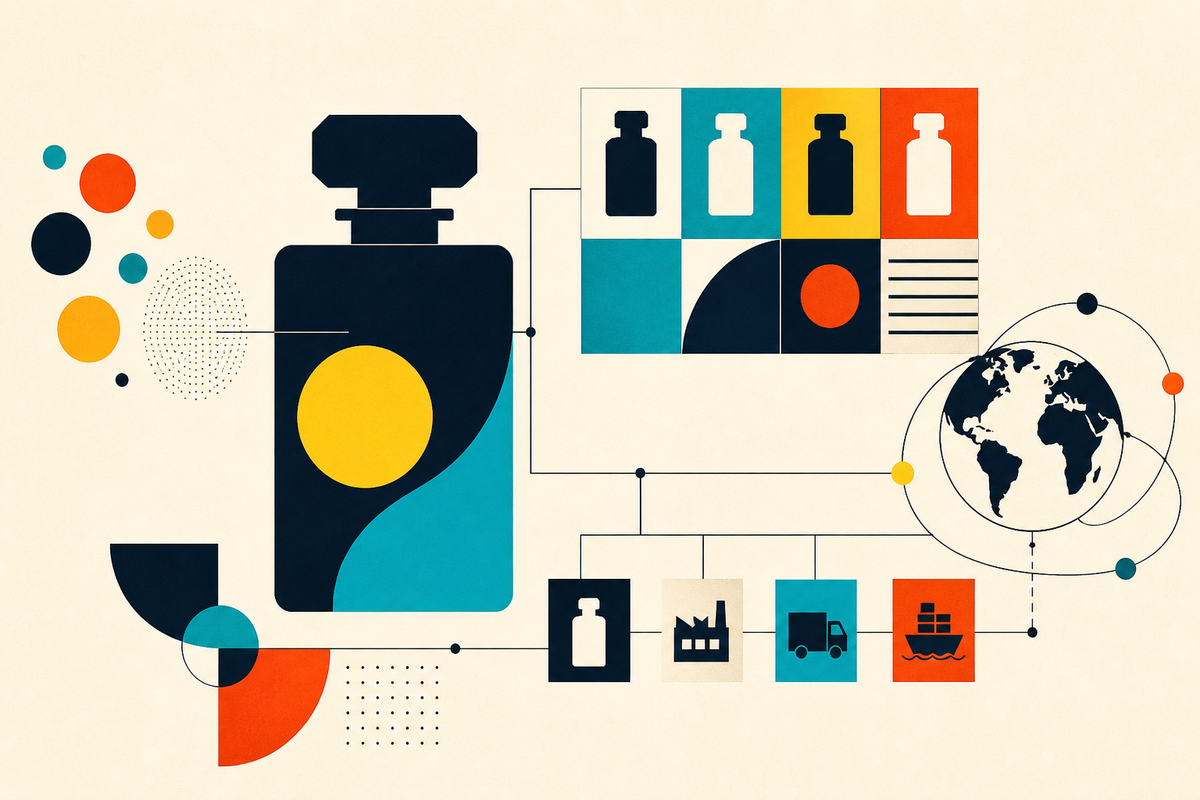
A portfolio built from rented and owned attention
Most of the company’s largest names are licensed. Jimmy Choo represented 17 percent of 2025 sales; Coach and Montblanc supplied 15 percent each; GUESS contributed 12 percent. Add Donna Karan and DKNY, Lacoste and Ferragamo, and seven brands accounted for 77 percent of annual sales. Diversification is real, but a handful of fragrances still do heavy lifting.
Licenses also contain a clock. Abercrombie & Fitch and Hollister currently run to March 2028. Coach runs to June 2031. Lacoste runs through 2038. A renewal can preserve years of development; a lost license can remove a business line. The 2024 exit from Dunhill weighed on U.S. results the following year. Interparfums manages that risk by staggering contracts, adding partners and, increasingly, owning some fragrance intellectual property itself.
Rochas, Goutal and Solférino sit on the owned side of the ledger. The company also controls Off-White’s fragrance and cosmetic trademarks and Lanvin’s Class 3 rights, subject to specific agreements. Ownership eliminates a conventional royalty stream to an outside licensor and offers more freedom, but it also removes the shelter of a partner’s existing marketing machine. Interparfums must create demand for the fragrance name, not merely translate it.
The shelf is the real product
Perfume ends in a consumer’s hand, but Interparfums first sells through a long chain of retail customers: department stores, perfumeries, specialty shops, duty-free operators, wholesalers, distributors and e-commerce platforms. Macy’s represented about 10 percent of company sales in 2025. That single figure is a reminder that a beautiful product without a route to the counter is an expensive glass ornament.
The network reaches more than 120 countries, but its center of gravity is split. European operations, run through the 72 percent-owned and separately listed Interparfums SA, supplied about 68 percent of 2025 sales. U.S.-based operations supplied about 32 percent. The Paris side includes Jimmy Choo, Coach, Montblanc and Lacoste. The American side includes GUESS, Donna Karan/DKNY, Ferragamo, MCM and Roberto Cavalli. New York and Paris are less rival headquarters than two casting offices working from the same script.
The asset-light label can be misleading if it suggests an easy business. Interparfums still buys components, carries inventory, funds advertising, manages foreign exchange and navigates tariffs. It commits to royalty floors and promotion even when consumer demand softens. In 2025, sales rose just 2 percent, helped by currency, as trade destocking and uneven international demand restrained growth. The company nevertheless reported record annual sales and said it gained market share.
Growth arrives years before the product
The most revealing announcements at Interparfums are often about fragrances that do not yet exist. Longchamp signed in 2025 for a first launch in 2027. A 20-year David Beckham agreement starts in April 2028, with a new signature fragrance expected by the end of 2029. Nautica transfers by January 2030. Management estimates the existing Nautica portfolio can exceed $70 million in annual sales in its first years under Interparfums; Beckham can exceed $50 million. Those are company forecasts, not guarantees, but they show how far ahead the pipeline is built.
Meanwhile, recent handovers show what a license can become. Interparfums started managing Lacoste fragrances in 2024. By 2025, Lacoste sales had grown 28 percent to $108 million, above the company’s initial $100 million expectation for the second year. Roberto Cavalli sales rose 33 percent in 2025, helped by new launches. These wins matter during quieter setup years, when teams are spending on future brands before the first bottle ships.
The company’s 2026 story is therefore deliberately unspectacular: extensions for existing lines, wider distribution for Solférino and preparation for Off-White, Longchamp and Goutal work. It reaffirmed its full-year outlook after the first half. The larger release cycle is aimed at 2027 and beyond. Perfume may be sold as impulse and seduction, but the operating calendar resembles infrastructure planning.
The quiet name has become the point
Jean Madar and Philippe Benacin started the company in 1982 after business school, initially doing market studies and inexpensive fragrance. The decisive turn came in the early 1990s, when Interparfums moved toward selective perfumery and signed Burberry. That license eventually ended, a useful early lesson in both the power and impermanence of borrowed brands. The company kept the portfolio model and widened it.
Four decades later, the most valuable expertise is organizational memory. Teams know how long glass takes, when a holiday set must reach a warehouse, which retailer expects which support and how a brand code survives translation into scent. Competitors can hire the same perfumers and component suppliers. The harder imitation is the web of licensors, distributors and launch routines that lets a company place different stories on the same global shelf.
For shoppers, Interparfums offers no single product to seek out. Its utility is indirect: it gives fashion and lifestyle brands the machinery to enter fragrance, refresh an old line or reach markets they could not economically serve alone. For a potential brand partner, the promise is more concrete - one accountable operator from consumer study to duty-free display. For investors, the proposition is a portfolio of royalties, owned marks, repeat launches and contract expirations that must be tended like a garden.
The irony is tidy. Interparfums spends its days making other names more recognizable, and success makes its own name easier to miss. The company is visible mainly in the consistency of the work: a familiar logo on unfamiliar glass, arriving in dozens of countries at roughly the same moment. At the counter, that feels like fashion. Behind it sits a licensing and logistics business with very good taste in labels.