Before a wall is a wall, it is a line. Before the line, it is a coordinate in a model. And between the elegant certainty of the model and the expensive permanence of the wall stands a person on concrete with a tape measure, a chalk box and no appetite for being wrong.
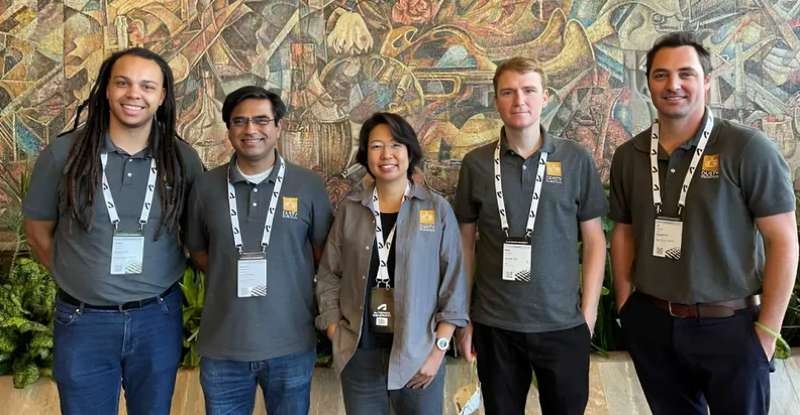
Philipp Herget has built a career inside that troublesome gap between instruction and matter. His route to the construction floor was not direct. It passed through optical storage, magnetic tape heads, tiny power components and hotel corridors. Yet the subject barely changed: how do you persuade a physical machine to know exactly where it is, do one useful thing and recover gracefully when the world refuses to cooperate?
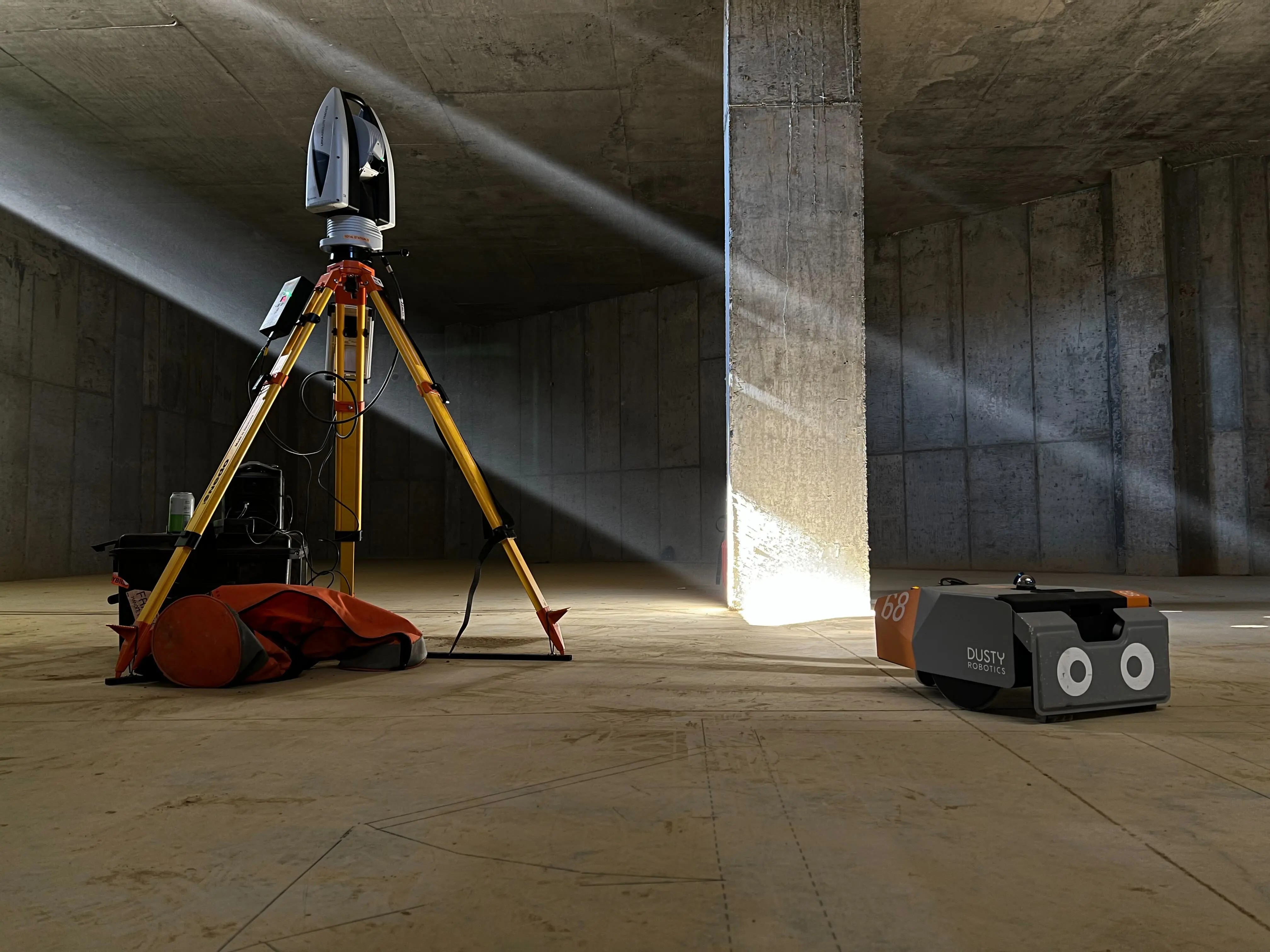
At Dusty Robotics, the company he co-founded with Tessa Lau in 2018, the answer is a compact mobile robot with large round eyes and a printer underneath. The FieldPrinter reads information prepared from Revit or AutoCAD and puts it on the floor at full scale: wall lines, door swings, points, labels and instructions. The robot is charming enough to be photographed. The marks are the serious part.
A physicist walks onto a slab
Herget studied electrical engineering at Worcester Polytechnic Institute, then earned master's and doctoral degrees in electrical and computer engineering at Carnegie Mellon. Precision there could be almost comic in its minuteness. In one published project, he and his colleagues used feedback inside a laser diode to control its height over a spinning glass disk. The residual position error was measured at plus or minus nine nanometers. A human hair is an extravagant boulevard by comparison.
He was also building mobile robots. In 1999, Herget and fellow master's student Jason Messier entered Carnegie Mellon's Mobot race with a machine called Moby Wan Kenobi. It navigated every decision point, won the open class and took the judges' prize. The name suggests that severe engineering and a decent pun were already on speaking terms.
After a postdoctoral year at Carnegie Mellon's Data Storage Systems Center, Herget joined IBM's Almaden Research Center in 2006. His work moved from magneto-optical storage to magnetic heads for tape systems and then to thin-film inductors for power conversion. By 2013, an academic biography credited him with 20 technical papers and 22 issued or pending patents. Later biographies put his patent count above 30.
Research taught him to control the vanishingly small. Savioke taught him what happens when robots leave the laboratory. As robotics hardware lead, Herget worked on autonomous machines that carried goods from hotel front desks to guest rooms. A hotel corridor is civilized only by comparison with a building site. It still contains elevators, luggage, carpet seams, surprised guests and the ancient human custom of standing exactly where a robot wishes to go.
The vacuum that never was
Dusty began with a different machine. Lau and Herget first considered a robotic vacuum for construction sites, a Roomba for a landscape famous for producing dust. The company name survived. The vacuum did not.
While doing field research, the founders pushed brooms and watched how work actually happened. They noticed the markings underfoot: the physical layout that tells crews where the digital building belongs. A sophisticated 3D model eventually became chalk lines, marker notes and repeated measurements. The handoff was slow, dependent on scarce skill and capable of carrying a small mistake into a very expensive future.
So they changed the question. Instead of cleaning the floor, could a robot make the floor more informative? Their answer was less a mechanical worker than an unusually literate printer. It could take coordinated building data and write it where framers, electricians, plumbers and mechanical crews could all use it.
The product appeared when the founders stopped protecting the original idea and paid attention to the marks left by somebody else's work.
The distinction matters. A line printed from a model is not merely a faster chalk line. It can carry a wall type, an offset, a part number or a QR code. It can show several trades at once. When two systems want the same patch of space, the disagreement becomes visible on the slab, while it is still a conversation rather than demolition.
The world gets a vote
Herget's patent record reads like a catalogue of reality's objections. Wind can push a falling ink droplet sideways. Pebbles can catch a low printhead. A column can interrupt the line of sight between a total station and the robot it tracks. Printing every point by stopping and starting wastes time. Each annoyance is modest; together they decide whether a clever demonstration becomes dependable equipment.
One Dusty invention adds a compliant windbreak around the printing path, blocking air while yielding to debris. Another adjusts the firing of print nozzles to compensate for lateral position error. A patent granted in April 2026 describes what happens when the robot enters a tracking “shadow” behind an obstacle: local sensors carry it for a limited distance, and the machine helps the external tracker acquire it again when it emerges.
Precision, translated into the real world
This is Herget's kind of ingenuity: not asking the workplace to become pristine, but making the machine less precious. A grocery-store project once exposed Wi-Fi interference, according to a 2026 company interview. Dusty redesigned the system to remove that dependency. A roboticist may prefer a clean diagram. A customer prefers Tuesday's work to continue.
The commercial proof accumulated in square feet. Dusty printed more than one million square feet of commercial layout in an eight-month period across projects that included San Francisco towers, a public-safety center and Seattle's Climate Pledge Arena. In 2022, the company raised a $45 million Series B, bringing reported total investment to roughly $69 million. By late 2025, Herget said contractors had used the platform across more than 200 million square feet and thousands of buildings.
When the line becomes a platform
By 2024, Dusty was describing the product as the FieldPrint Platform rather than a solitary robot. The change in language was earned. FieldPrinter 2 was joined by software for preparing files, combining trade layouts and sending the right layers to the machine. Native workflows for Revit and AutoCAD reduced the number of conversions between design and field. The printer remained the visible character, but the less photogenic work of version control and file preparation determined whether its marks deserved trust.
The company also broadened what could be printed. A wall line can be accompanied by its type. A point can identify a hanger or penetration. A curve, a door swing or an installation note can occupy its actual place at actual scale. Crews no longer have to perform the mental origami of turning a small drawing into a room around them. More importantly, several trades can be assembled into one coordinated print. The floor becomes a meeting in which the agenda cannot hide in somebody's laptop.
Herget's 2025 account of a new laser tracker partnership shows the same pattern at the hardware edge. The Leica AT500 offered a larger measurement volume and protection against dust and water. That allowed Dusty to work through more setups and in tighter, busier areas, including finished rooms where materials and crews may already be present. The engineering goal was not simply a more accurate instrument. It was fewer reasons for the tool to be sent back to the easy part of the site.
There is an organizational wager underneath all this machinery. If the field can see richer information, it can catch inconsistencies earlier. If the office receives a clearer account of what happened, the model can remain useful after it leaves the screen. The robot therefore sits between professions as much as it sits between columns. Its printhead is a small diplomatic service, armed with orange ink.
A power tool with very good handwriting
Robotics invites theatrical language: replacement, revolution, the end of work as somebody knows it. Herget's own formulation is calmer. Automation, he has said, enhances what people can do. Dusty presents its robot as a power tool. The operator still prepares the job, coordinates trades, manages the space and understands what should be printed. The machine absorbs the stooping, measuring and repetitive marking while giving more people the ability to produce consistent layout.
That restraint may be the most revealing feature of the product. The FieldPrinter does not hang drywall, install conduit or settle an argument between a designer and a superintendent. It makes their shared information visible. It is ambitious about one task and modest about the rest. On a jobsite, modest competence has an excellent reputation.
Herget's career appears, from a distance, to have expanded by orders of magnitude: nanometers, disk surfaces, hotel floors, entire buildings. Up close, it has been an exercise in reducing distance. The distance between a laser and a medium. Between a robot and its destination. Between a digital plan and the place where a crew must build it.
The building still belongs to the people who raise it. Herget's contribution is a machine that arrives early, rolls quietly across the slab and leaves them a remarkably legible note.