Construction Robotics · New Haven, CT
Verustruct
Robotic construction for affordable, sustainable housing.
Robotic construction for affordable, sustainable housing.
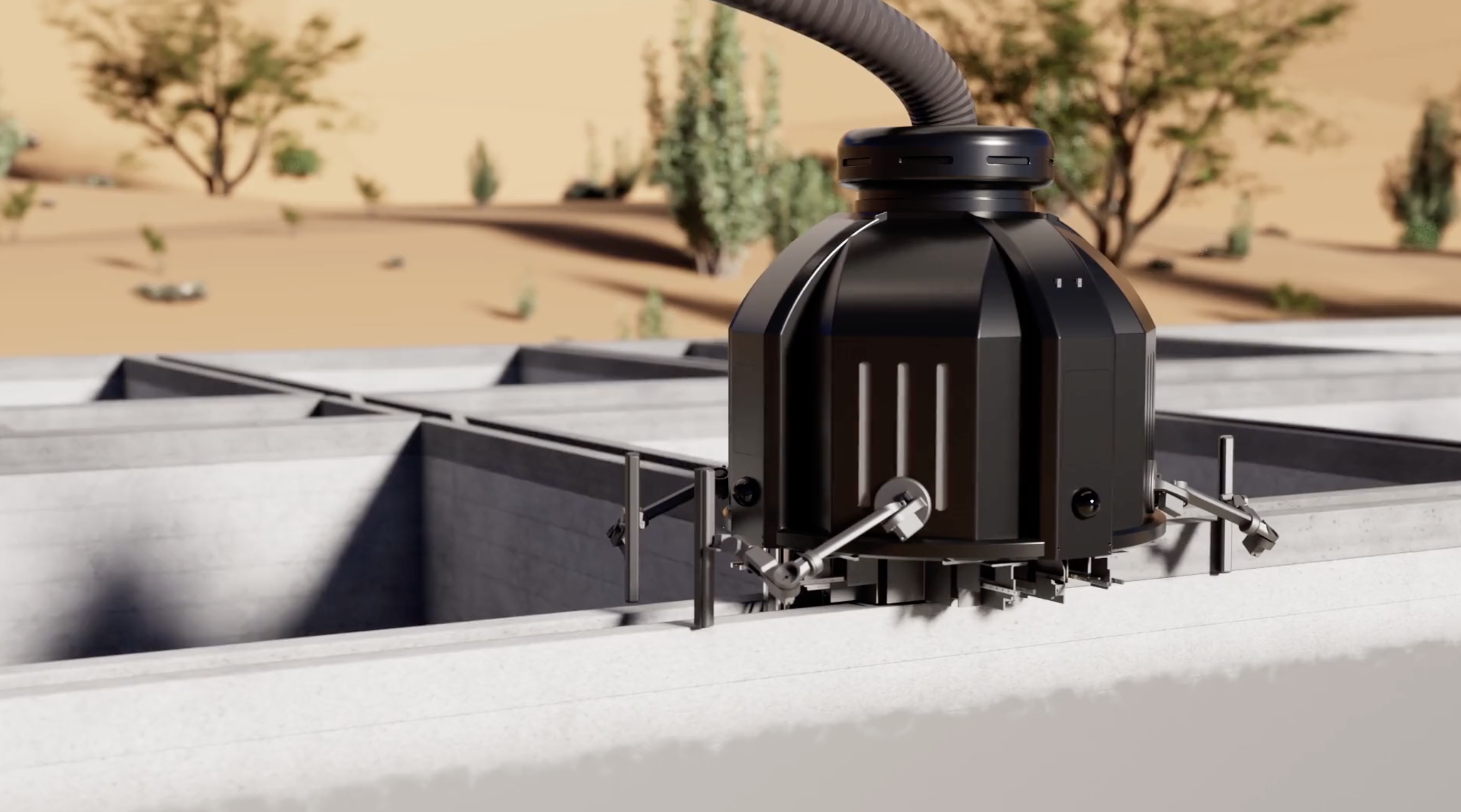
Walk onto a Verustruct site and the first thing you notice is what is missing. No towering steel gantry boxing the build. No robotic arm swinging on a rail. Just a compact printer, a truck feeding it concrete, and a wall that is rising - and, oddly, lifting the machine along with it. The printer lays a layer, scales up onto what it just made, and prints the next. The wall it builds becomes the scaffold it stands on.
That single trick is the whole company. For a decade, 3D-printed construction has been a good demo with a bad ceiling: the gantry frame that holds the print head can only be so big, so the house can only be so big. Verustruct's answer, a method it calls translational slipform printing, borrows from a century-old concrete technique and hands it to a robot. Free the printer from the frame, and the size limit walks away with it.
The walls it leaves behind are not hollow shells waiting for a plumber. Verustruct prints the mechanical, electrical, and plumbing systems and the insulation directly into the wall as it goes. What used to be four trades and four site visits becomes one pass of one machine. The surface comes out smooth, no ribbed layer lines - a deliberate choice, because the fastest way to kill a housing project is a neighborhood that decides the new builds look like they were squeezed from a tube.
The person behind it did not come up through construction the usual way. Nick Callegari was a mechanical engineer at SpaceX, designing structures for the Dragon spacecraft and the Polaris Dawn spacewalk suit. The instinct for walls, though, is inherited: his father spent 30 years in stucco and framing. Callegari is a QuestBridge scholar with degrees from Princeton and UC Berkeley, and he built Verustruct while finishing an MBA at Yale. The company started life under a plainer name, Impact3D, before becoming Verustruct.
The math is the pitch. Verustruct claims a finished single-family wall system in under two days, at roughly half the cost of conventional construction, with about 40 percent lower emissions. Those are targets, not receipts, and the company is refreshingly strict about the last one: it says it will not go to market unless its structures beat the baseline greenhouse-gas number. A construction startup that refuses to ship until it is cleaner than the thing it replaces is a rarer animal than the printer itself.
Figures are company-stated targets / pre-pilot estimates. CO₂ figure cited by Verustruct at ~10.2kg per wall unit.
Software turns a customizable, parametric design straight into a robotic toolpath - design to machine with no manual translation step.
The printer extrudes a load-bearing layer, scales up onto it, and prints again - embedding plumbing, wiring, and insulation as it climbs.
Coordinated robotic assembly and exterior finishing leave smooth surfaces with no visible layer lines, ready for a neighborhood.
Founder & CEO. Former SpaceX mechanical engineer (Dragon spacecraft, Polaris Dawn EVA suit). QuestBridge scholar, Princeton & UC Berkeley, Yale MBA. Named to the Forbes 30 Under 30 in Manufacturing & Industry for 2026.
"We want to capture more of the value so we can pass the savings to people living in these homes."
Affordable-housing developers, general contractors, and municipalities. Verustruct's system is aimed across the residential map:
Founded (as Impact3D) out of Yale's innovation ecosystem.
Audience Choice Award & runner-up at Startup Yale ($15K).
2nd place, Climate Tech track, Yale Innovation Summit.
Closed oversubscribed $2.44M pre-seed round.
Callegari named to Forbes 30 Under 30.
Pilot homes anticipated within roughly two years of the 2025 raise. Competing approaches - ICON, COBOD, Apis Cor, Mighty Buildings - mostly rely on the gantry Verustruct set out to remove.