A college student preparing for a summer in New York had a useful person to call: Philip Berney. In 2020, Morehead-Cain scholar Jack Dinges was heading toward an investment-banking internship at Bank of America. Berney, then Kelso’s co-chief executive officer, was his mentor. Their conversations concerned career choices, skills and where a young person might fit in finance. For an industry that can make an undergraduate feel like a visitor without the correct badge, that was a practical introduction.
The detail that makes the relationship interesting is Berney’s ambition for it. He wanted mentoring to reach “one or two layers deeper.” An introduction could open a door. Understanding the person walking through it required more attention. There is a difference in the amount of work involved, even if both activities fit comfortably under the heading of being helpful.
Today Berney is chairman of Kelso & Company, a member of its management committee and an investment partner. His working life includes corporate boards, financing and the selection of leaders. Yet that encounter with a student gives the career a human scale. A company has a capital structure. A young person has questions. Both benefit from someone willing to remain in the conversation after the first answer.
“one or two layers deeper”
Philip Berney, on his hopes for mentoring
Before the boardroom, the borrowing
Berney graduated from the University of North Carolina at Chapel Hill in 1986 with a business administration degree. He had been a Morehead-Cain Scholar. Finance became his profession: first high-yield work at First Boston, then eight years at Bear Stearns, where he rose to senior managing director and head of the high-yield capital markets group. In 1999, he joined Kelso.
The move put two kinds of financial work next to each other. High-yield capital markets concern the financing of businesses. Private equity adds the responsibilities of ownership. Those responsibilities continue after money has been raised and documents have been signed. The calendar supplies plenty of ordinary Tuesdays after the celebratory dinner.
That distinction helps explain the shape of Berney’s subsequent career. A financing can be assessed as a transaction; an ownership position brings an ongoing relationship with a business and its management. His experience crossed that boundary. It would be too tidy to turn a career into a single lesson, but the sequence is clear: lending markets came before years of work on company boards.
By the 2018 UNC Alternative Investments Conference, he was being introduced as Kelso’s co-chief executive officer. His conference biography connected him with businesses ranging from timber to food and financial services. The variety matters. Private equity can sound abstract until the portfolio begins to resemble the things people eat, build with, ship and use.
- 1986Business degree
UNC-Chapel Hill - Before 1999High-yield finance
First Boston + Bear Stearns - 1999 onwardPrivate equity
Kelso & Company
The room has more than one chair
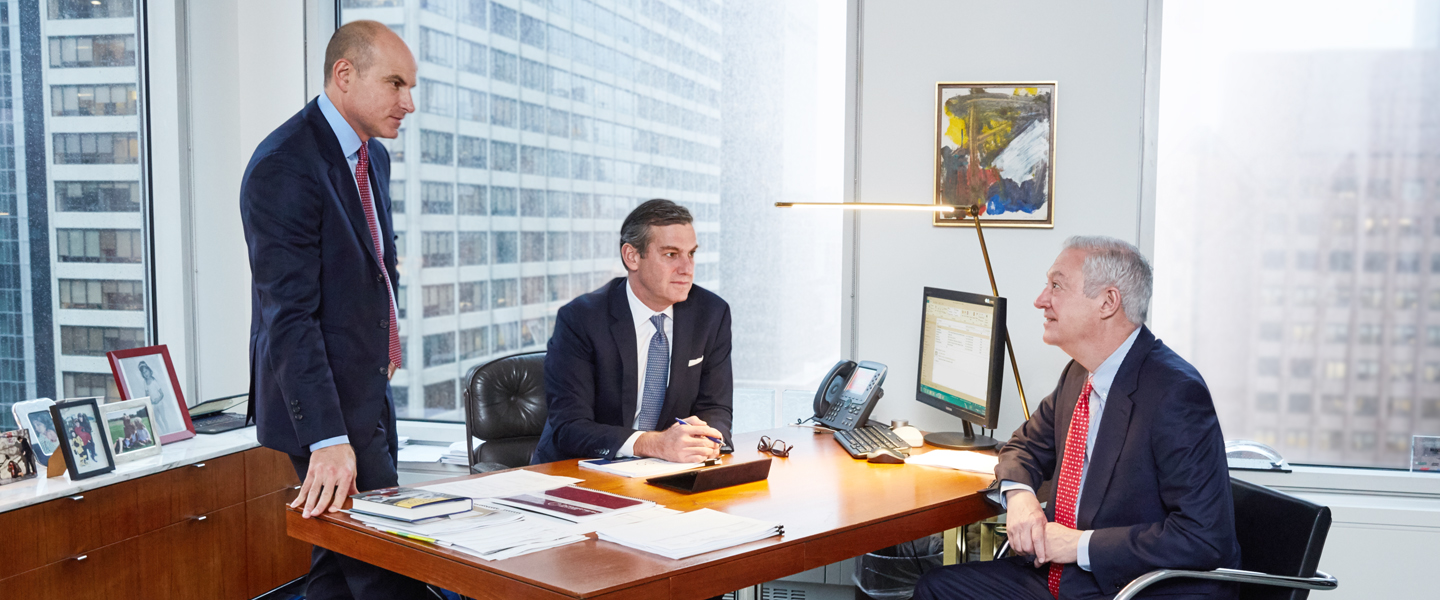
In a Kelso office photograph, Berney appears with Frank Loverro and Frank Nickell around a desk. Windows frame the city; papers occupy the furniture. It is an appropriately unromantic setting for a business built on discussing other businesses. The photograph supplies no secret about their deliberations. It does show that the firm’s public image makes room for colleagues.
Kelso describes an approach built around repeated partnerships, management support and the experience of its investment professionals and industry network. Berney’s place within that organization is consequential: chairman, investment partner and management-committee member. The titles locate him inside a continuing institution, with other people sharing the work and the decisions.
An investor’s name can travel much farther than the details of a board meeting. The useful questions tend to stay close to the table: Who will run the business? What resources will that person need? How will the owners and managers share the consequences of their choices? These are questions implied by Kelso’s stated approach, rather than a transcript of any particular meeting.
For a reader trying to understand Berney, the collective setting is a useful restraint on the usual finance biography. Companies do not acquire their next chapter through one person’s signature alone. Berney’s career sits among executives, fellow partners, advisers and directors. Staying involved means working within that company of people, including when their jobs and incentives differ.
A portfolio you can find in the kitchen
Two of Berney’s current directorships bring ownership down to a familiar level. Eagle Foods operates across meal solutions, baking and ready-to-eat popcorn. Its brands include Hamburger Helper, Suddenly Salad, Eagle, Magnolia, G.H. Cretors and Popcorn Indiana. Kelso dates its investment in Eagle to 2015. These are products with a life beyond an investment committee’s presentation.
In July 2022, Eagle completed the acquisition of the Helper and Suddenly Salad businesses from General Mills in a cash transaction valued at approximately $610 million. The businesses had generated about $235 million in net sales during General Mills’ fiscal 2021. Those figures describe the acquired businesses and the transaction. They make the scale tangible without turning a company purchase into a personal scorecard.
Berney’s board position places him in Eagle’s governance; operating the brands belongs to the company’s management. That allocation of roles deserves attention. An owner can help decide direction and oversee leadership while a team does the daily work. A familiar box in a supermarket aisle carries an astonishing amount of organizational life behind its cheerful front.
Ferraro Foods, another current Berney directorship, serves Italian specialty and pizzeria markets as a foodservice distributor. Kelso’s investment dates to 2021, and Ferraro is based in Piscataway, New Jersey. Eagle and Ferraro meet customers at different points: packaged brands on one side, restaurant supply on the other. Dinner turns out to have quite a busy boardroom.
Put the two businesses beside each other and the language of sectors becomes easier to read. A consumer company and a business-services distributor can both be connected to the same meal. Their commercial problems will differ. The relationship between owners and operators still has to work. This is where a long finance career encounters the practical world it finances.
Cash value of the Helper + Suddenly Salad acquisition from General Mills
The difficult business of choosing a leader
An earlier board assignment offers a more explicit view of Berney’s priorities. In January 2017, Logan’s Roadhouse named Hazem Ouf its CEO and partner after a nationwide search. Berney, then the restaurant company’s board chairman and Kelso co-CEO, supported the appointment. His explanation emphasized experience in revitalizing brands, improving financial results and developing operating teams.
The announcement concerned a turnaround executive. It described Ouf’s prior leadership of restaurant businesses and the skills the board wanted for Logan’s next stage. Berney’s public emphasis was on a combination of commercial performance and management culture. Choosing someone to lead a company requires a view of both the task and the people expected to carry it out.
The word partner also appeared in Ouf’s new title. Titles do not guarantee results, but they reveal how an appointment is being framed. In this case, the incoming leader was presented as someone with a stake in the undertaking. It is a concrete example of the owner-and-operator language associated with Kelso.
A résumé can summarize such work in a list of directorships. The list leaves out the nature of the decisions: hiring, leadership changes, strategy and accountability. Berney’s Logan’s assignment brings one of those decisions into focus. It also keeps the story honest about the division of labor. The board selects and oversees; the appointed executive takes on the operating job.
A scholarship becomes a continuing obligation
Berney’s connection to Morehead-Cain continued well beyond graduation. The program’s 2023-2024 review identified him as chair of the Morehead-Cain Scholarship Fund Board and an ex-officio Foundation trustee. The fund is an alumni-led fundraising initiative, established in 2004, supporting the scholarship program. Its governance links former scholars with the opportunities available to later ones.
In his message for that year, Berney connected alumni support with mentorship, advice and relationships across generations. The 2024-2025 review again featured him as fund-board chair. He thanked alumni for gifts, mentoring, internships and summer opportunities. The range of contributions is telling: a scholarship community can offer access to people and experiences as well as financial support.
His mentorship of Dinges fits inside that larger effort. It is also a useful counterweight to the scale of corporate finance. The unit of attention becomes one student, with choices that still feel provisional. A professional can explain what a field looks like from inside it; the student must decide whether that view appeals.
The institutional connections extend into New York. Berney is a former board president and trustee emeritus of Trinity School, and a trustee of Central Synagogue. Alongside his Foundation involvement, those roles show a working life with commitments beyond portfolio companies. They are positions of governance, each attached to an institution with its own purposes and community.
A scholarship received in college and a scholarship fund governed decades later form a satisfying circle, though the work inside the circle is less decorative. Someone must support the next group of students. Someone must help keep an institution useful. Berney’s participation gives that continuity names, roles and a specific mentoring relationship, rather than leaving it as a pleasant sentiment.
The questions keep changing
Berney’s public professional activity continues to place him among people debating private equity’s next problems. The preliminary agenda for UNC’s January 13, 2026 Current Issues in Alternatives Research Symposium in New York listed him on a fundraising panel with Zach Baran of Arctos Partners and Mike Elio of StepStone Group, moderated by Columbia Business School’s Mike Ewens.
The panel was framed around a difficult fundraising environment and the different experiences of firms seeking their next fund. Its deliberately wry title, Survival of the Funded?, carried a question any investment firm has to face: how does a business dependent on outside commitments persuade investors to commit again? The agenda records the planned discussion, rather than an account of what each participant said.
That question returns the story to relationships, now at institutional scale. A fund manager works with investors, company leaders and fellow partners. Each relationship involves a different kind of judgment. The available record of Berney’s career shows him occupying several of those positions over time, from capital-markets banker to company director and firm chairman.
The student conversation remains the most personal illustration. It contains an experienced financier’s willingness to think about what guidance could do for someone at the beginning. The same person has a seat in discussions about restaurant leadership, packaged-food businesses and fundraising. The distance between those settings is considerable. The work in each begins with taking another person’s choices seriously.