The trash bin came first. It flew out of a pickup on a California freeway in January 2018, forcing the cars behind it into a hard stop. Inside a Hyundai Genesis carrying three TechCrunch staffers and two Phantom AI executives, the human driver hit the brake. The car still struck the vehicle ahead at roughly 20 miles per hour. Nobody was injured. The prototype's front end was not so lucky.
The awkward detail was the important one: Phantom AI's automatic emergency braking was switched off. The feature had produced too many false positives and was being tuned, CEO Hyunggi Cho said at the time. In other words, the function most likely to help in this particular mess was the function the engineers did not trust enough to demonstrate. It was a compact lesson in safety-critical AI. A model that sees danger everywhere is not safe. A model that misses danger is not safe. The product lives in the miserable inch between them.
Eight years later, Phantom AI occupies a less cinematic but more useful corner of the autonomy business. Harbinger, the American maker of medium-duty electric and hybrid vehicle platforms, completed its acquisition of the company in November 2025 and announced it in February 2026. Harbinger will put Phantom AI's software into commercial vehicles. ZF, the giant German automotive supplier, will license the same computer vision for passenger-car driver-assistance products.
The purchase price was not announced. The public cost of getting here is easier to see: Phantom AI said it had raised $80.2 million by its 2023 Series C. That is meaningful venture money, but modest beside the billions consumed by robotaxi programs. Its real expense was nine years of doing the slow work - labeling road scenes, optimizing neural networks for automotive processors, tuning controls and persuading manufacturers that a small supplier could survive a production program.
A vehicle brain sold by the lobe
Phantom AI does not manufacture a car, operate a ride-hailing fleet or ask consumers to bolt a gadget under the dashboard. It sells automotive software to the companies that build vehicles and the Tier 1 suppliers that furnish them. The stack is deliberately modular. PhantomVision sees. PhantomFusion assembles the evidence. PhantomDrive decides how the vehicle should move.
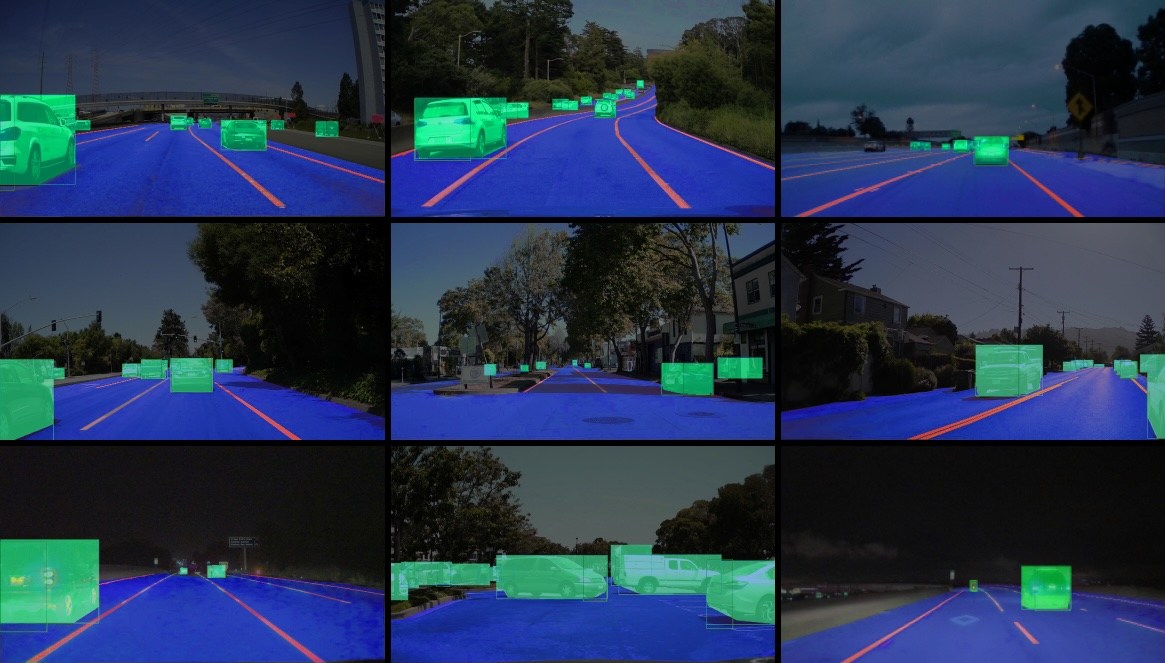
PhantomVision can work with one camera or a surround arrangement. It detects the cast of characters that make roads complicated - cars, pedestrians, cyclists, traffic signs and lights - and turns their movement into a bird's-eye view. PhantomFusion combines those observations with radar, LiDAR and ultrasonic sensors. Its promise is not merely more inputs; it is graceful behavior when one sensor partially fails. PhantomDrive then predicts trajectories, screens questionable detections and chooses from functions such as adaptive cruise control, automatic lane keeping, lane changes and emergency braking.
That division matters to an automaker. A manufacturer can license perception without surrendering its control logic, preserve a preferred radar supplier or move the code to a different automotive chip. Phantom AI describes the software as sensor- and platform-independent, with real-time processing on low-power embedded systems. The customer is really the engineer holding a cost target, a thermal budget, a validation schedule and a terrifying list of edge cases.
The mind change was economic
Cho came from Tesla's early Autopilot team. Co-founder and CTO Chan Kyu Lee had led driver-assistance work at Hyundai. They met in a Tesla cafeteria in 2016 and formally started Phantom AI in early 2017. Their combined toolkit - computer vision on one side, vehicle control on the other - naturally pointed toward the whole self-driving stack. Early demos included Level 2 assistance and a separate Level 4 prototype.
What changed was the commercial premise. By 2020 the company was pitching affordable Level 1 through Level 3 functions for cars that manufacturers already intended to build. By 2023 Cho was explicit: investment in Level 4 and Level 5 robotaxis, shuttles and autonomous trucks had pulled back because near-term commercialization was difficult. Meanwhile, regulations and safety ratings kept pushing automatic emergency braking and lane support into more vehicles.
The distinction is easy to miss. Level 4 autonomy asks software to own the trip within defined conditions. Level 2 assistance asks a human to supervise while software handles specific steering and speed functions. The latter is less magical and far easier to insert into an automaker's product cycle. Phantom AI calls the philosophy incremental autonomy. First make a car harder to crash. Then increase what it can do.
Investors bought that thesis. A $22 million Series A in 2020 was led by Celeres Investments and included Ford, KT, Millennium Technology Value Partners and DSC Investment. A $36.5 million Series C in 2023 brought in InterVest, Shinhan GIB and Samsung Ventures alongside returning backers. Phantom AI said the later round would accelerate series-production development with major OEMs. Its business model is licensing plus the engineering and support required to make safety software behave on a customer's chosen sensors, processor and vehicle.
The customer behind the customer
For years, Phantom AI described its customers without naming most of them: several automakers, one truck OEM, and European and Asian Tier 1 suppliers. That discretion is normal in automotive procurement and inconvenient in a startup profile. The 2026 deal finally made the route to market visible. Harbinger was already using Phantom AI technology. It wanted emergency braking, adaptive cruise control and lane keeping for medium-duty vehicles - the box trucks, delivery vans, recreational vehicles and specialty platforms that spend their days near loading docks, cyclists and front lawns.
Passenger cars made those features familiar. Medium-duty fleets often did not get them. Harbinger CEO John Harris called the gap crazy and said large fleet customers had been asking for better assistance. The acquisition brings the software inside Harbinger's vehicle platform. The ZF license opens a second lane: a global Tier 1 can package Phantom AI vision for passenger-car manufacturers, where sales cycles move slowly but volumes can become enormous.
A January 2025 demonstration offers a small view of how the company sells. D3 Embedded supplied a perception board, Texas Instruments supplied its TDA4VEN-Q1 automotive processor, and Phantom AI supplied trained algorithms. An eight-megapixel front camera detected cars, pedestrians, strollers and signs in real time. The demo was not a moonshot. It was a component chain an automotive buyer could imagine sourcing.
Where the modular bet wins - and breaks
Phantom AI competes with Mobileye, StradVision, Helm.ai, Autobrains, Wayve, Horizon Robotics and automakers' internal teams. Mobileye can offer mature silicon, software and mapping as a formidable package. An OEM can also assemble perception around NVIDIA or Qualcomm computing and keep more work in-house. Phantom AI's answer is flexibility: use its full stack or one layer, keep the sensors, and target lower-power hardware.
That is different, but it is not automatically better. Modularity transfers choice to the customer and integration work along with it. Sensor independence multiplies the configurations that must be validated. A clever model can still lose if it misses an automaker's functional-safety process, price target or production deadline. And incremental autonomy fails as a business strategy when the buyer wants a turnkey hardware-and-software package, has a strong internal ADAS team, or cannot support years of joint engineering.
Steal this
Break an ambitious system into layers customers can adopt independently. Sell the safety-critical job that has a regulation, budget and launch date. Demonstrate on the hardware the buyer already trusts.
It will not work when
Each module changes the behavior of every other module, the customer lacks integration talent, or certification costs erase the savings. “Flexible” cannot become shorthand for “you finish it.”
The copyable part is not automotive-specific. Start with the grand system, then locate the narrow loop that produces value now. Separate inputs, judgment and action. Make each layer useful on its own. Treat the ugly field failure as data, not folklore. Most of all, sell through a channel already authorized to reach the end customer. ZF has the passenger-car relationships. Harbinger has the trucks. Phantom AI has the thing that watches the lane.
A less glamorous finish line
Phantom AI did not become a household robotaxi brand. It became something more legible to an automotive balance sheet: a 30-person software team with production aspirations, a modular stack and two routes into real vehicles. Harbinger expects the software-services line to produce millions of dollars, though it sees the larger ZF opportunity arriving later as passenger-car programs mature.
The company remains in Mountain View and continued recruiting after the acquisition for computer-vision, embedded-simulation, testing and system-software roles. The founders remain with the operation. The work is still the unphotogenic kind: tuning camera exposure for tunnels and direct sun, labeling corner cases, filtering false detections, making multiple sensors agree and ensuring the brake command arrives on time.
That flying trash bin is a useful final image. The road does not care about a pitch deck's definition of autonomy. It produces one ridiculous object, at speed, with six seconds to spare. Phantom AI's business became the software between that object and a better outcome. The robotaxi can wait.