The useful future of driving began, for Hyunggi Cho, with the stubborn problem of a bicycle. Long before he ran a company, he was teaching machines to find moving things in messy streets: a pedestrian at a curb, a vehicle slipping through traffic, a cyclist whose path refused to fit a neat line. Cameras could recognize shapes. Radar could estimate range and speed. Lidar could supply depth. None of them, alone, knew enough. Cho's early work was therefore an argument for cooperation among imperfect witnesses.
That argument became his doctoral work at Carnegie Mellon University. His research pulled radar, lidar, and vision into a multi-object tracking system for urban driving. The equations were serious, but the goal was physical and plain: help a vehicle understand what around it was moving, where it might go, and what mattered next. In 2011, a paper he co-authored on vision-based 3D bicycle tracking was named a finalist for an ICRA automation paper award. By 2014, another paper described a multi-sensor fusion system for tracking objects in urban environments.
The path into automotive AI did not begin with a glossy prophecy. In Korea, Cho studied control and measurement at Sun Moon University, then localization in wireless sensor networks at Yonsei University. His archived Carnegie Mellon page has the homemade optimism of early web research: dense project notes, video links, and, beside an unfinished visual-odometry idea, the promise to “stay tuned.” It is a small relic of an engineer still assembling the pieces.
The Phantom stack, translated
A fast company meets a slow machine
Tesla hired Cho in 2014 for its Autopilot R&D work. His field had left the research vehicle and entered an environment where software schedules met factory schedules, power budgets, processor limits, and the unpleasant habit of roads to produce exceptions. He worked in environmental modeling and computer vision, close to the same perception questions he had pursued in Pittsburgh, only now the answer had to survive inside a car.
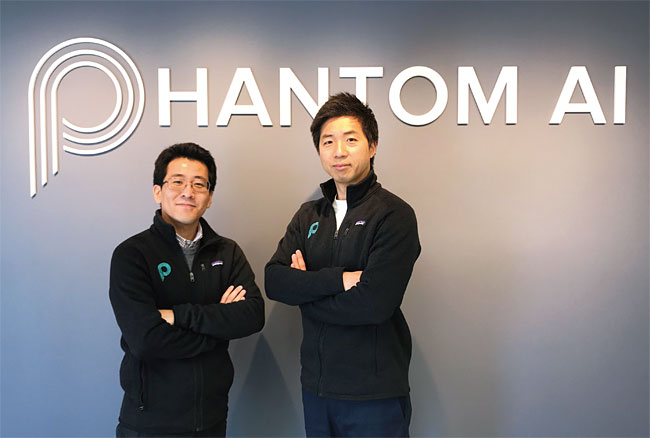
In 2016, the company cafeteria supplied an important collision of a friendlier kind. Cho met Chan Kyu Lee, an engineer with Hyundai driver-assistance experience. The two compared notes on what early ADAS could become. Their backgrounds were complementary: Cho in perception and sensor fusion, Lee in vehicle systems and control. In January 2017 they started Phantom AI, initially working in deliberate secrecy from a house in Foster City.
The company arrived during an era of enormous autonomous-driving promises. Yet Cho and Lee put Level 2 and Level 3 systems first - features that assist a human driver rather than removing the human entirely. Automatic emergency braking, adaptive cruise control, lane keeping, and emergency lane support were less theatrical than an empty driver's seat. They were also products that automakers could place on an actual vehicle program.
“The problem is damn hard and really challenging.”Hyunggi Cho, on building production ADAS
Phantom AI divided the job into three products. PhantomVision handled camera perception. PhantomFusion combined sensors and tracked motion. PhantomDrive translated the resulting world model into vehicle control. The modularity was commercial as much as architectural. An automaker or major supplier could take the portion it needed, customize a configuration, and deploy it across different processors. Cho once summarized the offer as the software side of a familiar ADAS supplier, minus the requirement to buy its chip.
The calendar is part of the product
If Phantom AI's strategy was practical, its development was not easy. The chip inside a car has to process several camera feeds in real time without borrowing the power or cooling of a data center. Sensors disagree. A lens meets rain, shadow, glare, and road grime. A tracking error becomes a control problem. Validation expands with every feature and market. Automotive-grade is a compact phrase for a very long list.
Cho has been unusually direct about the schedule. He thought a production-ready ADAS product might take three years. It took six. Tesla had resources his startup did not, and fundraising arrived alongside engineering. Phantom AI announced $22 million in Series A financing in 2020, with Ford and KT among the participants. A $36.5 million Series C followed in 2023, bringing the company's disclosed total to $80.2 million.
Why a road-ready demo takes time
There is personality in that admission. Startup biographies tend to sand away delay until a company appears to move from insight to outcome in three clean acts. Cho left the calendar intact. His public language swings between engineerly caution and cheerful insistence. At a 2025 entrepreneurship program, he told students that a CEO must be a “cool guy.” The explanation was not about style. It was about keeping a positive attitude and a sense of purpose when circumstances turn strange.
That is a useful temperament for a sector that repeatedly revises its arrival time. Cho questioned the industry's fixation on full autonomy before Level 2 and Level 3 features had reached the necessary scale. His point was not hostility to the driverless goal. It was sequence. Emergency braking and lane support could protect people sooner; broad deployment could create a foundation for more automation later. Ambition, in this telling, is not weakened by an intermediate product. It acquires a road map.
Cho moves from Carnegie Mellon research into Tesla's Autopilot R&D team.
Phantom AI begins with computer vision, sensor fusion, and control as separate but connected products.
Three disclosed financing rounds support the long automotive development cycle, culminating in a $36.5 million Series C.
Harbinger completes its acquisition of Phantom AI.
The deal is announced with two deployment paths: Harbinger commercial vehicles and ZF passenger-car licensing.
The practical moonshot finds a truck
The next chapter was completed quietly in November 2025 and announced on February 25, 2026. Harbinger, a maker of medium-duty electric and hybrid vehicle platforms, acquired Phantom AI. Financial terms stayed private. The 30-person Phantom team would continue to operate in Mountain View, and its leadership would remain. The company's software had found an owner with vehicles, customers, and a particularly clear absence to fill.
Medium-duty trucks do hard, ordinary work in places where perception matters: ports, loading areas, neighborhoods, and delivery routes crowded with pedestrians and bicycles. Many lack safety features now common in passenger cars. Harbinger plans to integrate Phantom AI technology including emergency braking, adaptive cruise control, and lane keeping into its vehicles. At the same time, German supplier ZF agreed to license Phantom AI's computer vision for passenger-car ADAS products.
The arrangement gives the same engineering two routes. One travels vertically into Harbinger's own platforms. The other moves horizontally through ZF to automakers. For Cho, who spent years arguing that driver assistance should become as broadly available as a basic safety technology, the commercial logic matches the original mission. The software does not need the glamour of an empty driver's seat. It needs vehicles to enter, processors to run on, and useful decisions to make before the next few meters disappear beneath the wheels.
The demo can be a moment. The product is a calendar.A lesson from Phantom AI's nine-year road
Cho's career now reads as one long encounter with motion. The student tracked bicycles in academic video. The Tesla engineer modeled the environment around a moving car. The founder organized perception into products and discovered how stubbornly the automobile resists software time. The acquired company now faces a different test: translating years of modular development into features on commercial trucks and licensed passenger-car systems.
The continuity matters because the technology changed names while the underlying question held steady. Research called it tracking. Product teams called it perception. Automakers placed it inside ADAS. In every setting, the task was to turn incomplete signals into a timely judgment without pretending uncertainty had vanished.
There is nothing ghostly about that outcome. It is manufacturing, integration, qualification, and support. It is also the part of the autonomous-driving story that tends to happen after the stage lights go off. Cho's bet was that the intermediate future deserved a company of its own. Nine years later, that future has an acquirer, a licensing partner, and a fresh set of roads on which to prove itself.