Before Peter V. Scola helped finance an $8 billion hotel acquisition, before he co-founded Livingston Street Capital, there was a scholarship. He grew up in North Philadelphia and became the first person in his family to attend college. American University supplied an opening. Decades later, students from the same university have been finding openings at his firm.
There is a familiar way to tell a financier’s life: begin with the largest number, add a few institutional names, finish with a photograph of a building. Scola has the numbers and the names. But the more revealing detail is that his professional circle now includes people at the very beginning of their careers. He has hired graduates and interns from the university where he was once a scholarship student.
That connection gives a personal dimension to a career usually described in the language of capital markets. His work has involved arranging financing, acquiring properties, building investment businesses and deciding what deserves money. The student arriving for an internship encounters the practical version of those abstractions: people making decisions, and being responsible for them.
A very large education in borrowing
Scola studied international business and finance at American University. His subsequent career included executive positions at Bank of America, Fitch Ratings, Merrill Lynch and Wells Fargo Securities. The range matters. A rating agency, a lender and an investment owner each examine a building from a different seat. The rent may be the same; the questions being asked about it are rather different.
One transaction puts that experience into focus. In June 2007, Lightstone completed its $8 billion acquisition of Extended Stay Hotels from Blackstone. Scola, then at Wachovia, was among the people credited with providing the lead mortgage and mezzanine financing. The announcement also named Wachovia’s Rob Verrone and Bear Stearns’ Randy Rieff. It was a transaction with an extensive cast, and Scola occupied a specific place in it.
He was helping arrange the borrowing behind a buyer’s purchase. That distinction is useful when following his later career. Financing a property and owning one are connected businesses, but the responsibilities differ. A lender must understand how it will be repaid. An owner must also work out what to do with the property after the closing dinner is over.
Value of Lightstone’s Extended Stay Hotels acquisition. Scola was among the providers of lead mortgage and mezzanine financing at Wachovia.
At Cantor Fitzgerald, Scola became a senior executive and co-founded Cantor Commercial Real Estate. By 2013, industry conference programs were listing him as a senior managing director. His professional biography also includes direct equity investment, joint ventures, mergers and acquisitions, capital raising and property repositioning. Taken together, those jobs trace a career around the financial machinery that makes real estate change hands.
Putting his own name on the decisions
In 2016, Scola and Joseph Fox founded Livingston Street Capital. The firm operates from Radnor, Pennsylvania, with a New York presence, and invests across the United States. Scola is its president and CEO. His professional profile places him in New York, while the business carries the geographic reach of a national property investor.
Livingston’s investment materials describe a preference for the needs of individuals and businesses over discretionary wants. It is a plain formulation for a complicated occupation. A property is attractive partly because somebody has a durable reason to occupy it. The hard work is in deciding how durable that reason really is, and what price makes sense.
An early Livingston transaction made the industrial side of that approach tangible. In June 2018, Campio announced a 201,810-square-foot sale-leaseback in New Albany, Ohio, for Amcor Rigid Plastics. Livingston was the buyer. A sale-leaseback lets a business sell its premises while continuing to occupy them as a tenant. Ownership changes; the working building keeps its job.
Scola praised the parties’ ability to move from contract to closing in less than thirty days. That is a useful, unromantic achievement. Property deals require many people to agree on details that can become very expensive when misunderstood. Speed counts when it accompanies execution. Otherwise, it merely gets everyone to the disagreement earlier.
The factory and the apartment
Another industrial deal shows the complete arc from purchase to sale. Livingston acquired a 393,817-square-foot property in Columbus, Indiana, in November 2018. The building was leased to Faurecia Emissions Control Technologies. In 2021, it sold the asset to Bridge Investment Group for $55.3 million.
Scola’s explanation of the strategy focused on locations important to a tenant’s operations or growth. For an industrial investor, the building’s usefulness to its occupant can be as consequential as its appearance to a prospective buyer. A factory rarely needs to win a beauty contest. It does need a convincing answer to the question of why its tenant should stay.
The same firm was developing a substantial interest in housing for adults aged 55 and over. Here the question of usefulness becomes more personal. An apartment is both an investment asset and the place where somebody spends an ordinary Tuesday. Access, amenities and the possibility of meeting other residents enter the picture alongside rent and occupancy.
A long look at life after 55
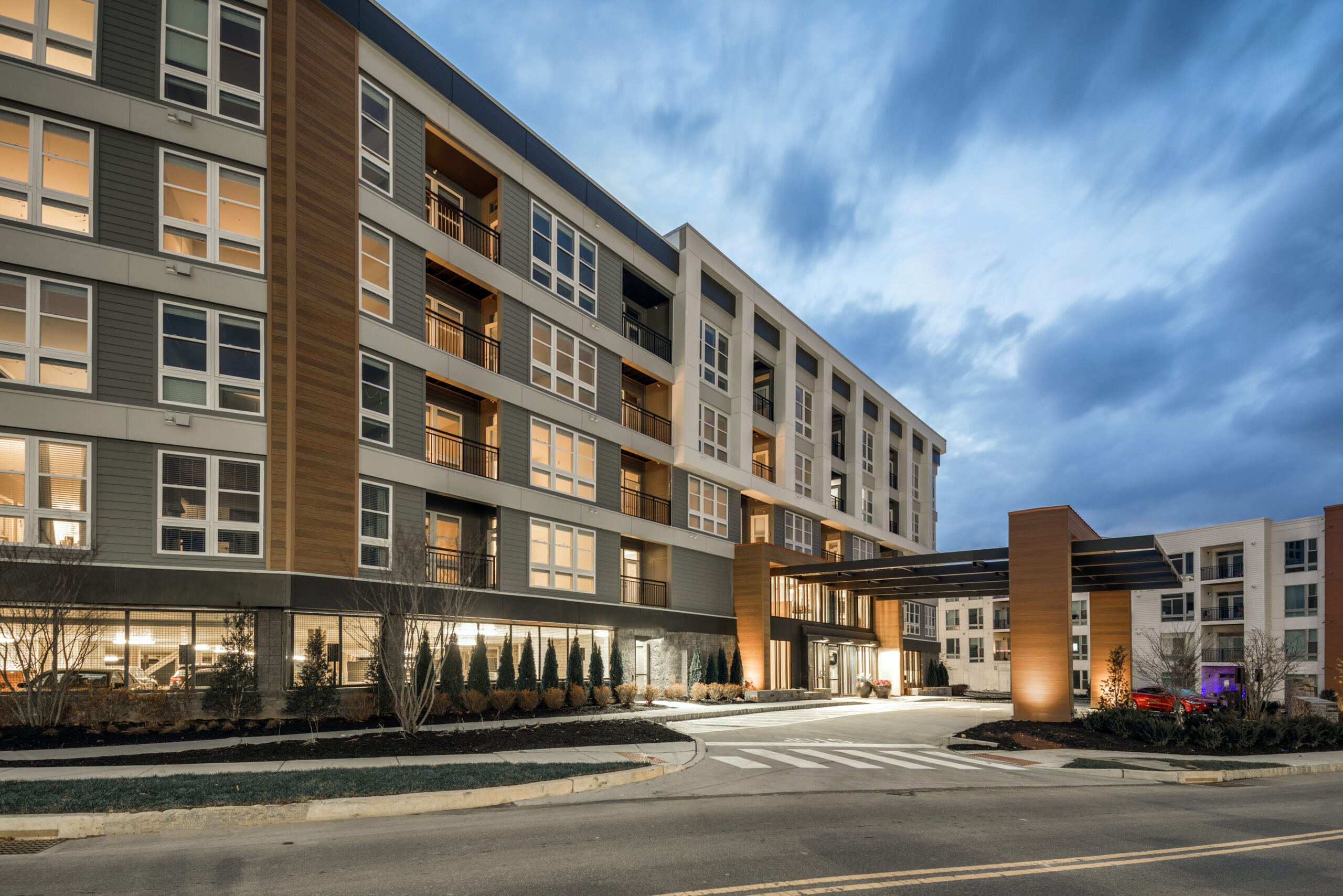
By December 2020, Livingston had acquired Alta at Regency Crest, a 150-unit community in Ellicott City, Maryland. The property had an indoor saltwater pool, a theater room, a courtyard and a putting green. Scola discussed its position between Baltimore and Washington and its fit with the firm’s preference for established communities in desirable locations.
“We studied this sector for a long time,” he said. The purchase followed acquisitions of Schuyler Commons in Utica, Glenmont Abbey Village near Albany and Hanover Place in Tinley Park, Illinois. Those were specific communities in different markets, giving physical form to a demographic investment thesis.
The expansion also required people inside the business. In February 2021, Livingston announced Brian Krill as chief financial officer and Shawn Rose as managing director of asset management. Scola linked the appointments to growing the firm’s acquisitions and management capabilities. Buying more properties had created a corresponding need to strengthen the organization responsible for them.
In June 2022, an affiliate acquired the 231-unit Canvas at Valley Forge in King of Prussia, near Philadelphia. The transaction brought the firm’s multifamily portfolio to more than 1,800 units across seven states at that time. The property sat within a larger planned development, near shops and Valley Forge National Historical Park. Location was doing several kinds of work at once.
Alta at Regency Crest
Canvas at Valley Forge
Mountain Lakes Estates
The work after the purchase
In 2023, Livingston acquired Mountain Lakes Estates, a 131-unit independent-living community in Reno, Nevada, built in 2020. By May 2024, the firm was being described as having $900 million in assets under management. That is a dated measure of the investment business, distinct from the prices of individual purchases or the value of Scola’s personal holdings.
“Capital is there for the right deal,” Scola said in 2024. His other emphasis was the less theatrical part of ownership: “We are focused on asset management.” Livingston had its own property management arm, Allure Lifestyle Communities. The organization buying the apartments was also building an operating business around the experience of living in them.
“Capital is there for the right deal.”
Peter Scola · 2024
Allure describes communities with clubs, activities and opportunities for residents to meet. The investment proposition therefore reaches beyond a set of floor plans. A building can offer common rooms; an operating team has to make those rooms useful. A calendar is a modest document beside a purchase agreement, yet it helps determine what the purchased community becomes.
For Scola, the operating platform adds another layer to the founder’s job. The earlier career involved the financing and structuring of investments. Livingston’s housing business brings the recurring responsibilities of ownership into the foreground. The acquisition is one event. The property has to function the following morning, and the morning after that.
The next person through the door
Alongside its property investments, Livingston runs an internship program intended to give students experience in finance and real estate. The firm also describes support for food banks in communities where it owns properties, and donations to conservation organizations including Natural Lands and The Nature Conservancy. These are stated commitments at company level, with the internship program connecting most directly to Scola’s own beginnings.
By August 2026, his company’s hires included Kogod graduates and AU interns. The connection reached back to his own scholarship years. A business education had given him a route into the profession; his company was now providing an entry point for others. The connection is concrete enough to fit on a hiring roster.
His public encouragement can be considerably less restrained than a property announcement. Congratulating the university’s class of 2026 on LinkedIn, he wrote: “You cannot go up if you give up!” It is an exclamation with very little interest in sounding like an investment memorandum.
Scola has also spoken to graduate real estate programs at Columbia, NYU and UNC-Chapel Hill. Teaching visits, internships and graduate hires offer different ways of shortening the distance between studying finance and seeing it done. His career supplies plenty to discuss: the lender’s seat, the founder’s desk, the factory lease and the apartment community. For someone starting out, the useful part is being allowed close enough to ask questions.