A pension investor wants its money back. The businesses it invested in still have work to do. Between those two perfectly reasonable positions lies a market, and much of Mark Benedetti’s professional life. He helped develop Ardian’s Secondaries & Primaries business, where an existing investment can pass from an owner ready to leave to one willing to stay. There is something pleasingly practical about the premise. Even patient capital occasionally checks its watch.
In May 2026, twenty years after joining the firm, Benedetti became Ardian’s Co-CEO alongside its founder, Dominique Senequier. The appointment moved him further into the business of managing an institution whose investments span private equity, real assets and credit. His title changed; the people around him were familiar. The management team had already been working together, with Benedetti chairing the Executive Committee since September 2023.
The seller’s clock
Secondaries begin with a difference in timing. Private investments are generally held for years. An investor may want to reduce its exposure before the manager sells the underlying companies. A secondary buyer can purchase that investor’s fund interests, taking over the remaining unfunded commitments as well. The seller receives liquidity. The buyer acquires an investment with a history already attached.
That history matters. There are companies to examine, managers to understand and obligations to price. A portfolio arrives with more context than a promise on a blank sheet of paper. It also arrives with complications. For Benedetti’s business, the task is to decide what the remaining exposure is worth and whether taking it on makes sense. Someone else’s wish to sell starts the conversation; it cannot settle the price.
Saint-Lambert, then a much wider map
Benedetti’s roots are in Saint-Lambert, Quebec, and he studied at McGill University. His working life eventually took him to New York. Before Ardian, he worked in KPMG’s Assurance group and then Corporate Finance, gaining experience in financial reporting, transactions, mergers, acquisitions and capital raising. The sequence gives his investment career a concrete beginning: accounts to scrutinize, followed by transactions to evaluate.
He joined in 2006, when the business still carried the AXA Private Equity name. Looking back in 2026, he described a firm with five offices and $14 billion in assets under management when he arrived. His own responsibilities expanded with it. He contributed to the American platform and the development of secondaries, while the firm grew into a diversified international investor.
A career expressed entirely in promotions can lose the work between them. Here, the recurring work is easier to see: understanding private investments, finding buyers and sellers whose needs can meet, and building the relationships that bring a transaction within reach. The long tenure is significant because these activities depend on accumulated knowledge. Twenty years supplies plenty of opportunities to discover that a familiar problem can return wearing a different tie.
A business large enough to buy portfolios
In January 2025, Ardian announced the close of its $30 billion ASF IX secondaries platform. Benedetti was then Executive President and Co-Head of Secondaries. The money was raised by a team, for a platform, from investors. It belongs in his story as evidence of the scale of the business he helped develop, with the collective effort kept firmly in the picture.
At the close, he connected demand to institutions that had increased private-market exposure and subsequently needed to adjust their allocations. Changing interest rates and public-market volatility had helped create that need. He also pointed to two recent secondary transactions, each larger than $3 billion. A buyer with capacity can consider portfolios that would be difficult to place in smaller pieces.
Capital raised for Ardian’s ninth secondaries platform.
A platform total, rather than a measure of personal wealth.Scale has an informational side, too. Ardian’s secondaries operation described a database covering investments in more than 1,600 funds, involving over 650 general partners and more than 10,000 underlying companies. Quarterly analysis and automated data extraction support its monitoring and pricing work. The point is to know the portfolios before a seller calls, then bring that knowledge to the decision.
It is an unusually fitting setting for a former auditor. Financial information is part of the daily machinery of the business. New tools can gather and organize more of it, while the investment team still has to interpret what it means. A database does not remove judgment from a purchase. It gives judgment more material to work on, including material that may make a deal less attractive.
The office behind the relationship
Benedetti’s American work also involved the physical business of being nearby. Ardian opened its San Francisco office in 2015. Ten years later, Benedetti and Vladimir Colas described the move as a response to the growing sophistication of the firm’s West Coast investors and fund-manager relationships. Local presence was a practical next step for an expanding network.
By that anniversary, the office had played a role in more than $18 billion of transactions involving West Coast private equity and infrastructure fund sellers. That figure describes the office’s work over a decade. Behind it sits the less photogenic business of maintaining contact, knowing a market and understanding what an institution needs. Finance has a fondness for maps with dots. A dot acquires meaning when people answer the telephone.
A seat beside the founder
The transition to broader leadership came in stages. Ardian announced a new General Management Team in September 2023. Benedetti was appointed Executive President; Mathias Burghardt, Vladimir Colas and Jan Philipp Schmitz became Executive Vice-Presidents. Nicolò Saidelli joined the arrangement as adviser to Senequier on strategy and acquisitions. Shareholders approved the appointments that November.
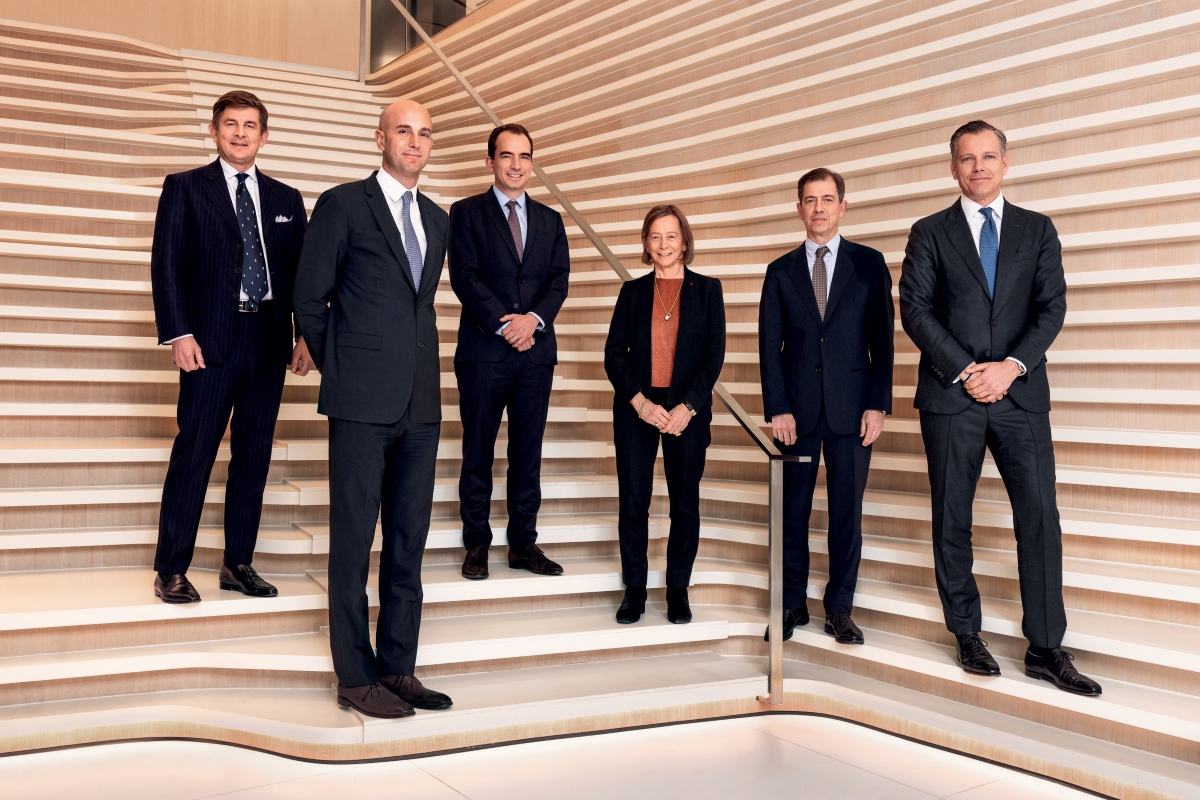
The arrangement placed daily management in the hands of a group of experienced colleagues, allowing Senequier to concentrate on major strategic questions. An expanded Executive Committee brought investment and central functions into the discussion. The design recognized the practical difficulty of running several investment businesses under one roof: a decision useful to one team may have consequences for another.
In the leadership interview accompanying Ardian’s 2024 report, Benedetti set out a five-part growth agenda. It included expanding flagship strategies, entering adjacent areas with transferable expertise, exploring gaps in the firm’s activities, developing private wealth and using AI and data. He emphasized that institutional investors would remain central even as private clients became a larger opportunity.
His approach to political uncertainty was similarly measured. He said, “We do not go in and out of markets just because of what is happening politically.” It was a statement about maintaining an investment approach through changing conditions, with attention to the businesses underneath the headlines. The five-part agenda suggested expansion with a test attached: what does the firm already know that can help it enter the next area?
On April 27, 2026, Ardian announced the next step: Benedetti would become Co-CEO, sharing the role with Senequier. The appointment took effect after the May 26 shareholders’ meeting. Burghardt, Colas and Schmitz became Executive Presidents. The progression formalized wider responsibilities across a management group that had already been carrying out the work.
At his first AGM as Co-CEO, Benedetti spoke about resilient markets whose underlying strength was uneven. His response emphasized discipline, active management and business fundamentals. He argued for greater humility in investment convictions, alongside diversification, sector expertise and operational execution. The language gave doubt a useful place in the process. An investor can believe in an opportunity and still ask awkward questions about it.
The next people through the door
There is another scale of opportunity in Benedetti’s public work. He serves on the Ardian Foundation board and as Co-President of the Ardian US Foundation. His support includes Year Up, which gives young people work experience. These roles concern access to opportunity at the beginning of a career, well before anyone has a portfolio requiring a secondary buyer.
In 2024, he appeared in a filmed conversation with Charles Adjakpa, Co-President of Ardian’s Millennial Committee, about preparing the next generation. The committee gave younger employees a channel into discussions about the firm’s future. In an organization reorganizing its leadership, the pairing brought two career stages into the same conversation. The institution’s future included the people still building their place within it.
Back at Canada’s table
In September 2026, Benedetti participated in the Canada Investment Summit, held on September 14 and 15. He attended with Ardian colleagues Michael Bane and Géraud Dambrine and met Prime Minister Mark Carney. The gathering brought investors and business leaders into discussions about long-term capital, growth and infrastructure. For the New York-based Canadian, it connected his current responsibilities with a market he knew from much earlier.
“a real sense of optimism”
Mark Benedetti on the Canada Investment Summit, September 2026
The Canadian thread had already appeared in a 2024 Montreal interview, where he spoke appreciatively about the depth of institutional investment teams and their cautious approach. By 2026, he was returning as Co-CEO. His public story ends, for now, with that continuity: a wider role, a familiar country, and conversations about where capital can usefully go next. The seller’s clock is still ticking. Benedetti now has an entire firm’s timetable to consider alongside it.