In November 2008, Jonathan Bilzin was talking about starting a lender. The timing was sufficiently awkward to make the proposition interesting. Commercial real estate financing was short of liquidity. Ladder Capital Finance entered that market with approximately $1 billion in equity and debt capital, an experienced management team and an opportunity born of other people’s reluctance to lend. A new business was preparing to open its doors while the financial world was checking whether its own doors still had hinges.
TowerBrook and GI Partners were the co-lead investors. Bilzin’s explanation began with the people. Brian Harris and his colleagues had worked together for more than a decade; the attraction included a team with established habits, relationships and experience. Capital could give that group a balance sheet. It could also give them somewhere to put their accumulated judgment to work.
That episode offers a useful entrance to Bilzin’s career. He is now TowerBrook’s managing partner and co-CEO, sharing the role with Karim Saddi. The distance between those two moments contains promotions, board seats and investments. A recurring interest connects them: the possibilities inside an existing team, and the work required to turn those possibilities into a business.
A lender at an unpromising hour
Ladder’s launch had a practical logic. Financing had become scarce, creating room for a business able to purchase, originate and manage commercial real estate mortgages and related assets. Its managers brought experience from established financial institutions. Bilzin’s public remarks placed particular weight on their experience together. In a new company, a team that already knows how to work together starts with something a cheque cannot immediately supply.
“At TowerBrook, we believe in partnering with exceptional people.”Jonathan Bilzin, at Ladder Capital’s launch, 2008
His involvement continued beyond the announcement. He was a director of Ladder Capital Finance Holdings from its formation in October 2008 and became a director of Ladder Capital Corp at its formation in May 2013. Those dates give the story a different rhythm from the usual transaction account. The opening day was followed by years of responsibility.
When Related agreed to invest in Ladder in 2017, Richard O’Toole was to replace Bilzin on the board. Bilzin described TowerBrook’s pleasure in participating in the company’s creation and growth. TowerBrook remained a large shareholder. A board change could therefore mark a transition in the relationship without bringing the investment itself to an end.
There is an appealing lack of theatricality in that sequence. A group gets backed, a business develops, responsibilities change. The account gives us an investor working through stages. It also suggests why a career in private equity is difficult to describe with a list of purchase dates: much of the actual relationship occupies the spaces between them.
Learning the business, then leading the firm
Bilzin’s education took him to the University of Michigan for a bachelor of business administration and to Stanford Graduate School of Business for an MBA. His professional route included Goldman Sachs’ Principal Investment Area and Real Estate Principal Investment Area in New York, followed by Soros Private Equity. These were positions concerned with investing capital in businesses and assets, a foundation for the work that followed.
He served at TowerBrook from its formation in 2005. The firm’s roots in Soros’s investment business make that move part of an institutional progression as well as a personal one. Bilzin’s career has included the experience of a firm establishing its own identity, then building the leadership structure to carry that identity forward.
In 2019, TowerBrook promoted Bilzin and Saddi to newly created co-president roles. In early 2022, they became co-CEOs. The sequence matters. Their shared leadership arrived through an intermediate role, rather than appearing as a sudden rearrangement of the names at the top.
Today Bilzin sits on TowerBrook’s Equity Partners, Operating and Investment committees. He and Saddi chair the Operating Committee, which oversees the firm’s day-to-day management. Investing and running an investment firm overlap, but each brings its own obligations. One concerns the businesses a firm backs. The other concerns the organisation doing the backing.
The co-CEO arrangement also suits the geography of a transatlantic firm. Bilzin is based in New York; Saddi’s professional base is London. Shared leadership puts a relationship at the centre of the organisation itself. For a business that regularly speaks about partnerships, that is a particularly concrete expression of the idea.
The accounting partnership that kept going
In 2021, TowerBrook partnered with EisnerAmper. Bilzin’s comments identified an established client base and an opportunity to accelerate growth with TowerBrook’s resources and experience. Accounting may lack the glamour of a new consumer brand, but a business trusted with recurring, consequential work has attractions of its own.
The partnership provides a more recent example of the long view. On March 25, 2026, TowerBrook announced a completed continuation vehicle transaction, led by Carlyle AlpInvest with Hamilton Lane as co-lead. Existing investors were offered liquidity while TowerBrook could continue its partnership with EisnerAmper.
By that announcement, EisnerAmper had completed 27 add-on acquisitions during the partnership and reported more than $1.2 billion in revenue. Investments in technology, AI capabilities and talent accompanied the expansion. Bilzin described the partnership in terms of building a larger, differentiated platform with technology embedded in its development.
A continuation vehicle addresses a timing question: investors may want an opportunity to realise value while an owner still sees work ahead for the business. The arrangement makes room for those different horizons. In this case, the investment relationship could continue beyond the point at which some participants wished to take liquidity.
The result gives Bilzin’s career story a satisfying return to its opening theme. A deal can create the conditions for work; another transaction can let that work continue. The business keeps serving clients through both. Its calendar contains deadlines rather more frequent than the arrival of a new capital structure.
Ownership has an operating manual
TowerBrook calls its approach Responsible Ownership. The firm became a Certified B Corporation in 2019 and was recertified in 2023. Certification introduces assessment, accountability and reporting into a proposition that might otherwise remain an attractive phrase. An owner claiming a broader purpose has to translate it into practices someone can examine.
Bilzin has publicly connected responsible business practices with long-term financial performance. That connection is central to how he describes the approach: business conduct belongs inside the work of growing and protecting value. It asks the investor to consider how a company operates over time, alongside what it might be worth at a particular moment.
His remarks about TowerBrook’s VisionOn events add another ingredient. These gatherings bring sector experts, senior managers and the firm’s team into smaller forums to exchange ideas. The usefulness of an investment network can extend beyond finding a deal: it can create a setting in which people compare experience and reconsider what a business might do.
In May 2025, Bilzin joined the Milken Institute Global Conference panel “What’s the Deal with Private Equity?” alongside Caitlin Gubbels, Chris Perriello, Xavier Robert and Thierry Timsit, with Kate El-Hillow moderating. The agenda covered changing market conditions, operational value creation and technology. These are the questions surrounding the work after capital has been committed.
His public LinkedIn reflections have similarly stressed operating capabilities, technology and talent as sources of advantage. The emphasis makes intuitive sense. A transaction changes ownership on a given day. Improved capability has to establish itself in the repeated work of an organisation, through the people who use it.
There is also an ordinary business test hiding inside all the investment vocabulary. Does the company work better? Can its people serve customers more effectively? Does the next stage have a sound basis? The language gets elaborate; the questions remain pleasantly resistant to decoration.
Opening the door from the other side
Bilzin’s education connections extend beyond the degrees on his biography. He serves on the board of the TEAK Fellowship, which supports educational opportunity for New York City students from low-income families. The programme’s free, decade-long commitment spans preparation, access and success across successive stages of education.
TowerBrook has partnered with TEAK since 2019 on career advice and mentoring, and has hosted TEAK interns in its New York office. Bilzin’s board role places him inside that education effort. The relationship gives the idea of developing potential a setting with different stakes and a different timetable from an investment.
Caryn and Jonathan Bilzin were listed as event co-chairs of TEAK’s 2019 gala. TEAK’s 2024 annual report also names them in its Champions giving group. These are specific acts of participation alongside the board position: support for the institution that carries the programme through the years.
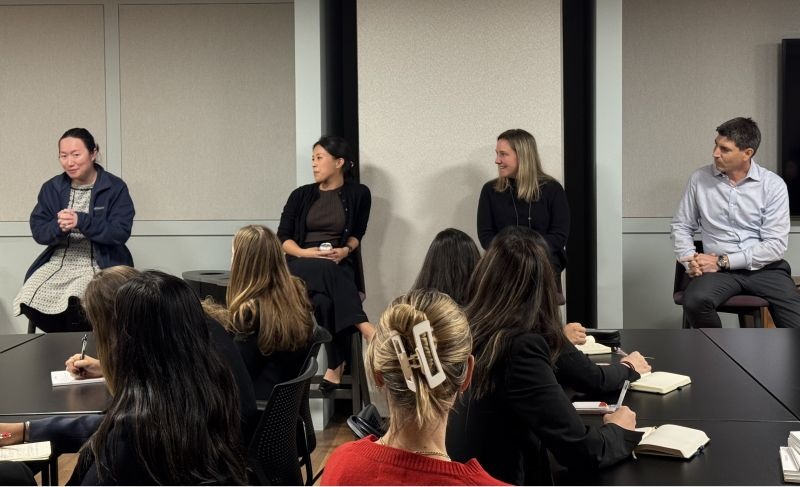
In October 2024, TowerBrook’s New York office welcomed more than 30 participants from the University of Michigan’s Och Initiative for Women in Finance. Bilzin joined investment colleagues in discussing their routes into private equity and offering career advice. An alumnus returned to the education conversation from the professional side of the table.
A career can look inevitable when it is reduced to institutions and promotions. Students encounter the less tidy version: choices, questions and the practical task of finding an entry point. Giving them access to people already in the profession makes the route easier to inspect.
Across these settings, Bilzin’s public record keeps returning to relationships that need time. A management team receives capital. An investment partnership continues. Students receive introductions, advice and institutional support. The circumstances differ, but each involves a possibility that requires work before it becomes an outcome.
The closing dinner still has its place. So does the announcement, the promotion and the photograph. Bilzin’s story is more interesting when the camera stays a little longer, after the room empties and the company opens again for business.