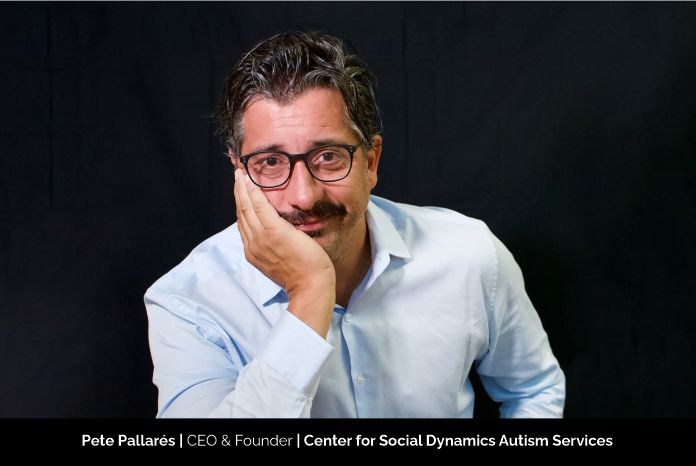
A Catalan in Alameda
Most people who scale a behavioral-health company across six states come up through clinics. Pete came up through Honolulu, a basketball court, and a learning diagnosis nobody told him to be quiet about.
Pete Pallarés runs Center for Social Dynamics from an office near the Oakland-Alameda estuary, where the company has been headquartered since he founded it in 2012. CSD provides applied behavior analysis, speech, and occupational therapy to families touched by autism in California, Oregon, Washington, Idaho, Colorado, and Hawaii. The growth story is the easy part: one Oakland desk in 2012, roughly eight hundred employees by 2019, about fourteen hundred patients and families served each day, a partnership with NMS Capital in 2021, an acquisition of JF Autism Services in 2022 to push into Washington and Idaho, and a second add-on with Behavior & Development Center. The hard part is that he made it look like it was supposed to happen.
It was not supposed to happen. Pete was born and raised in Barcelona, Catalonia, the kind of city that exports painters and goalkeepers more often than it exports behavioral-health entrepreneurs. He was a basketball player, tall and quick enough that the University of Hawaii offered him a scholarship at eighteen. He took it, traded the Mediterranean for the Pacific, and started a short professional career in the sport that brought him over. Then he stopped. The pivot, by his own telling, was not strategic. He was diagnosed with dyslexia and ADHD as a child, and the experience of being a kid whose brain ran on a different timetable than the classroom never quite left him. When he started looking for what to do after basketball, he kept circling back to children who learn differently.
So he went to work. First at Kaiser Permanente, then Easter Seals Bay Area - two of the largest healthcare operations on the West Coast - where he picked up the operating muscle that startup founders usually lack and the clinical literacy that operators usually lack. He worked as an associate on autism research studies with the California Department of Public Health and with Kaiser. He learned, the way an immigrant kid learns, by being slightly behind and refusing to stay there.
The thing he kept noticing, in clinic after clinic, was language. Autism services in California are delivered to families who speak Spanish, Cantonese, Mandarin, Vietnamese, Tagalog, Punjabi, and English, often inside the same building. The clinical literature was being translated into the dominant language of the provider, not the dominant language of the home. Pete is bilingual. He noticed.
Center for Social Dynamics was built on the premise that therapy should arrive in the family's first language, in the family's living room, with a clinician who has some idea of what a Catalan grandmother or a Vietnamese uncle expects from a stranger holding a clipboard. The company calls this multidisciplinary and culturally sensitive treatment. In practice it means a heavier intake, longer onboarding for clinicians, and lower margins per hour than a one-language shop. It also means families stay.
The numbers reward the patience. CSD has been named to the Inc 5000 and the San Francisco Business Times fast-growing lists. It earned a BHCOE accreditation in 2019 for quality improvement in ABA services. In 2020 - the year almost no behavioral-health provider wants to remember - CSD stood up a telehealth platform and Pete was named a finalist for EY Entrepreneur of the Year for Northern California. In 2021, NMS Capital announced a partnership and investment in the company. Since then, the acquisitions have ticked through quietly: JF Autism Services in 2022, Behavior & Development Center on its heels.
None of which is the part Pete will talk about for long. The part he talks about is the foundation. The Pedro Pallares Autism and Behavioral Health Foundation is a 501(c)(3) he set up to do three things: pay college tuition for students who want to enter the autism services field, fund research, and support work in developing countries that are figuring out how to treat autism with very few clinicians and almost no infrastructure. The foundation is named after his father. It is the closest thing Pete has to a public emotional argument: if the field is going to get bigger, it should get bigger from the bottom up, with people who would not otherwise be able to afford the credential.
In September 2024 he published a book. Not the kind you might expect from a CEO of a multi-state ABA provider. Happiness Declassified is co-authored with Rafael Santandreu, one of Spain's best-selling psychologists, and it argues a fairly old idea: that the quality of your inner monologue, repeated daily, becomes the quality of your emotional world. The book leans on cognitive psychology and the work of Albert Ellis. It cites Stephen Hawking. It is exactly the kind of book a man writes when he has spent two decades watching parents and children try to make sense of a diagnosis, and has noticed that the families who do best are not necessarily the ones with the best clinicians.
Friends describe Pete as direct, often funny, and unreasonably specific about food. He trains Muay Thai. He keeps a soft spot for Spanish wine and Catalan cooking. He still answers his phone. The growth has not made him less reachable, which is unusual; the field is full of founders who, somewhere between the second clinic and the seventh state, became uninterruptible. Pete did not.
The CSD story now reads as inevitable, the way stories do once they've worked. It was not. A Catalan basketball player with a learning diagnosis and no clinical degree was the unlikeliest candidate to build one of the largest culturally calibrated ABA providers on the West Coast. He did it anyway, in the order he found, with the tools he had.
// CSD Reach Across the West
Sources: CSD, NMS Capital announcements (2021-2022). Bar lengths illustrative.