Forty thousand people had used the podcast app. Pete Birsinger had helped build it from scratch, and its promise was easy to understand: tell the software what you enjoyed, and it would help you find something else worth hearing. Then Podible ran out of money. The audience number remained quite handsome. It could not cover the payroll.
“We ran out of money with Podible for the app,” Birsinger recalled. Nearly everyone had to be laid off. He described the experience as a collapse of the assumptions he and his colleagues had been working under. They had believed the thing would work. Now they had to decide what, if anything, could follow it.
Today he is the co-founder and CEO of Podscribe, a business concerned with the less leisurely side of listening: whether an advertisement appeared, how it was delivered, and what happened afterward. The connection between the two ventures runs through their machinery. Software that could read a podcast to recommend it could also read a podcast to inspect it. The original customer wanted a better commute. Another customer had an advertising budget to account for.
Forty thousand listeners, and a cash problem
Podible had been trying to address a familiar irritation. A listener liked a couple of shows and wanted something similar. Browsing titles and descriptions could only reveal so much about an hour of conversation. Birsinger’s approach went into the recording itself.
By March 2018, the New York company was describing a system that transcribed episodes, extracted their topics, and organized the connections into a database called the Podcast Genome. Listening history, saved episodes, and followed shows helped shape recommendations. As someone used the app, the system gained more information about their preferences. It could suggest an individual episode as well as an entire series.
There was considerable engineering inside that modest request for another good listen. An episode’s title might offer a joke or a guest’s name. Its transcript offered what people actually discussed. Podible was making a bet that this extra information could improve discovery.
A measure of adoption, with a business still to solve.
Birsinger’s professional account lists $700,000 raised for the early business. Those figures give the failure some definition: money had been committed, a product had been built, and an audience had appeared. The missing piece was sufficient financial durability. For a founder, it is an awkward combination. Enough had worked to make walking away complicated.
A programmer before a founder
Birsinger grew up in San Francisco and graduated from the University of California, Berkeley in 2013. His studies combined electrical engineering and computer science with applied mathematics. Before podcasting, there were jobs in software: Cisco Meraki, where he was a member of technical staff from 2013 to 2015, then Tapad.
At Tapad, between 2015 and 2017, his work included software engineering and solutions engineering. That sequence placed the construction of technology beside the work of explaining how it could be useful. In the company he would later lead, both jobs would matter.
By May 2018 he was appearing publicly as Podible’s CTO and co-founder. His professional timeline subsequently lists a move into the CEO role in 2019. The transition involved more than a new title: the story of the product was changing alongside the person responsible for telling it.
His advice to people entering software has a practical starting point: build side projects, put them on the web, and get feedback. The public record of his own work includes both a web player and an iOS app. His GitHub profile still carries an earlier professional identity, Podible CTO, beside a list of programming tools. The internet is quite good at keeping old business cards.
The transcript gets a second job
By 2020, Birsinger was discussing two related businesses, Podscribe and Picasso. Podscribe offered podcast transcription; Picasso helped advertisers with intelligence drawn from podcast content. The names described different ways of making the same unruly material easier to examine.
A recording asks a person to spend time listening. A transcript lets software search for a company, a topic, or a particular passage. That change in format matters when the question concerns thousands of episodes rather than a single recommendation. The work can become a repeatable process.
The company’s account of its development follows that opening into airchecks: checking where advertisements actually ran. Placement verification then led toward impression verification and broader measurement. Birsinger’s route through podcasting had brought him from helping someone choose a show to helping someone check a purchase of advertising space within it.
- DiscoverWhat should I listen to next?
- VerifyWhere did the paid message run?
- MeasureWhat happened after exposure?
“We transcribe every episode, label ads, and snapshot episodes multiple times to track ad placements,” he explained. That last detail matters in a medium where dynamically inserted advertisements can change. A recording checked once may not capture every version delivered over a campaign.
His conversations also began reaching further into the mechanics of advertising. In 2023, he discussed attribution’s limitations, dynamic insertion, host-read messages, and the use of AI with Marla Isackson. The transcription tool had become an entry into a much larger set of questions about how audio businesses worked.
When the counter changes
Measurement gives Birsinger plenty of opportunities to distinguish a recorded event from the meaning attached to it. In his conversation with fellow founder Cameron Hendrix and host Jeff Umbro, one example involved Apple’s iOS 17 update. Changes to automatic downloads altered the relationship between delivered episodes and audience behavior.
Birsinger described a narrowing gap between the observed performance of dynamically inserted ads and baked-in advertisements. When the behavior producing a denominator changes, a performance comparison can change with it. An advertiser looking only at the headline result might miss the mechanism underneath.
By June 2026, he was discussing podcast impression standards with Dan Granger and Giles Martin through the Alliance for Measurement in Podcasting. His concern was the data entering attribution systems. An analysis can only do so much with an input that fails to describe what the buyer thinks it describes. That is an engineering problem with consequences for contracts and budgets.
“So if you put garbage in, you get garbage out.”
Pete Birsinger, on attribution inputs
In September, Podscribe announced automated reporting of YouTube engaged views for publishers who opted in, scheduled to begin September 21. The company framed it as a way to keep reporting consistent and reduce manual exchanges of screenshots and spreadsheets. Here was another version of the problem: two parties needed a number they could both interpret, without spending their afternoon copying it between documents.
A seat at the table
There is a social side to this apparently numerical career. Measurement crosses company boundaries. A platform can produce a report, but publishers, agencies, and advertisers have to understand what it represents. Birsinger’s public appearances include conversations with other founders and people whose businesses use the resulting data.
At Cannes Lions in June 2026, he and Podscribe’s head of partnerships, Matt Drengler, joined the Marketecture and Gracenote teams to co-host an industry dinner at Zuma. Podscribe’s photographs show the conversation relocated from dashboards to a table overlooking the water. The spreadsheets had acquired a rather better view.
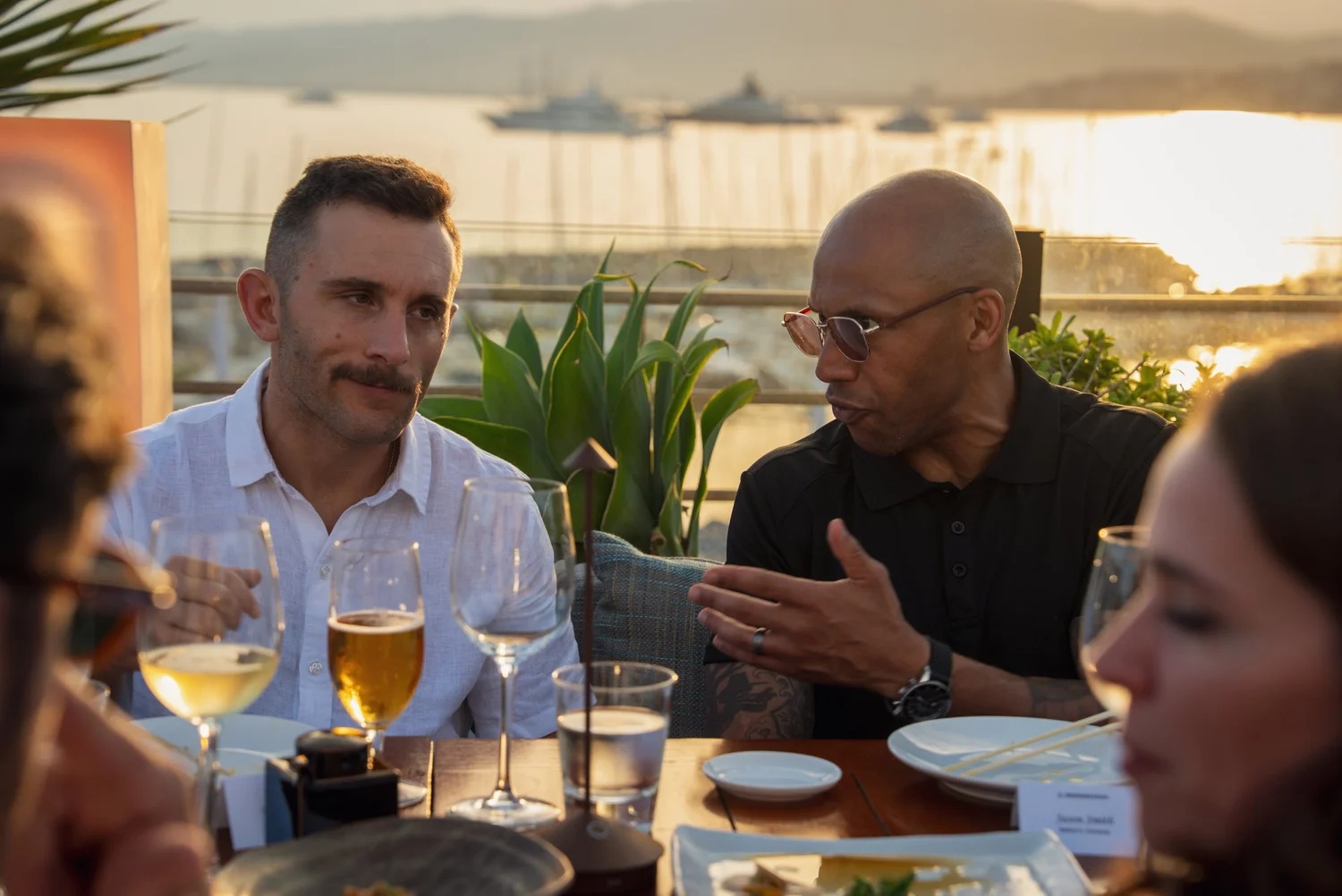
For a remote company, the gathering also gave colleagues time together in person. Podscribe described a larger team presence in Cannes than the previous year. It is a useful glimpse of the work around the product: introductions, shared terminology, and conversations that continue after a presentation ends.
Outside work, Birsinger has listed a cheerfully crowded set of interests: fishing, hunting, jiu jitsu, skiing, triathlons, gymnastics, and country music festivals. It is an unusually active counterpoint to a career spent making recordings and data easier to inspect. Podcasts appear on that list too; the original interest survived the change of customer.
The caveat beside the number
In October 2026, discussion of Podscribe’s targeting research offered a revealing moment. Geography and previous visits to an advertiser’s website were strong signals in the analysis. Gender appeared less influential. Birsinger cautioned against reading that result as evidence that gender itself did not matter: inferring it at household level from an IP address could produce an imprecise signal.
The qualification is worth keeping. A characteristic can matter while the available measurement of it remains poor. The distinction affects what an advertiser should do next. It also describes the sort of care a business selling measurement has to practice when presenting its own findings.
The wider Q3 benchmark report covered more than 105,000 campaigns and 36 billion impressions, drawn from August 2025 through July 2026. Its scope included conversion windows, targeting factors, and engagement signals. Those are dataset totals, rather than counts of customers or people. Even a large number benefits from being introduced properly.
Birsinger’s stated 2026 plans included better international measurement and expanded reporting across radio, connected television, and social platforms. He also outlined contextual targeting, randomized holdout testing, and AI-assisted analysis. These were ambitions on a roadmap, with implementation still requiring the ordinary work behind any product promise.
That work has a recognizable beginning in his career. A podcast app accumulated listeners, then encountered a financial limit. The team’s ability to understand audio still had uses. Birsinger kept following them, into a business where the question after a number is often the most useful one: what, precisely, have we counted?