A company sets a goal. Someone builds a spreadsheet. Someone else builds another spreadsheet, because the first one does not quite describe what their department does. By the next meeting, everyone has numbers and nobody has quite the same picture. PerformanceUp by 500apps occupied this familiar gap between agreeing on an ambition and knowing whether the work was getting anywhere.
Its proposition was straightforward: put objectives, measurable results and the initiatives supporting them in a shared cloud application. Its commercial proposition was more unusual. The goal tracker came inside a subscription promising 50 business applications. A manager shopping for clarity could leave with software for much of the company.
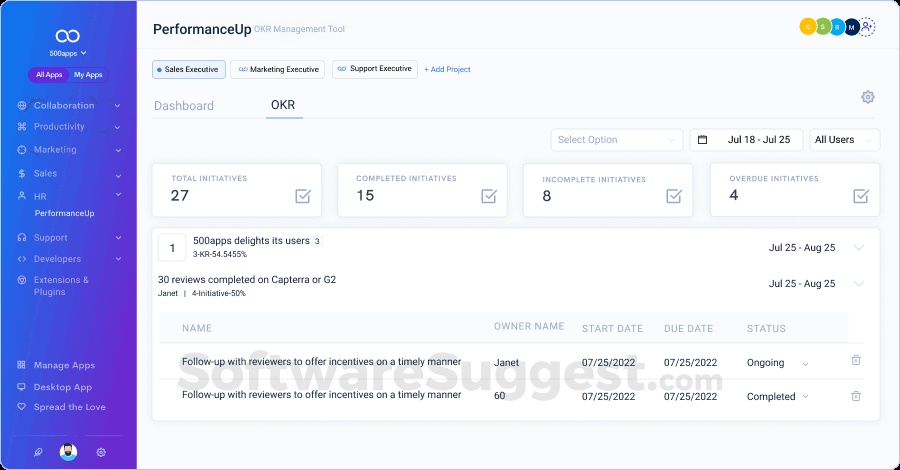
- PerformanceUp connected goals, KPIs, assigned initiatives and progress reports.
- The advertised bundle cost $14.99 per user per month, with a 14-day trial.
- 500apps now announces a suite wind-down and a move toward 500agents.
A goal needs somewhere to live
OKR stands for objectives and key results. An objective names the destination; key results describe measurable evidence of arrival. PerformanceUp supplied a place to record that relationship, track it and show it to colleagues. Its published feature pages described individual, team and organizational goals, with KPIs helping make progress visible.
Consider a hypothetical support team trying to improve the customer experience. “Improve support” leaves plenty of room for interpretation. A measurable response-time target gives the team something to examine. Assigning an initiative to a person, with a due date, gives the next meeting something better than a general discussion about trying harder.
PerformanceUp's Quick Add feature handled those mundane details: describe the initiative, assign employees and set the deadline. That is the useful seam between strategy and task management. A target without work attached can sit untouched for a quarter. A task without an objective can keep someone busy without explaining why.
The meeting before the meeting
The dashboard was meant to reduce the work of assembling a status update. Published product material described visual progress tracking, initiative summaries and reports downloadable as JPEG, PNG or PDF files. Email notifications carried activity updates to project employees. The information could travel beyond the person who remembered to open the application.
These details explain the intended customer better than a grand mission statement would. Department heads, project owners and managers needed to see how separate pieces of work contributed to a common goal. Smaller businesses could use the same structure without first buying a sprawling performance-management program. Public listings also positioned the product for midsize and larger organizations.
One seat. Fifty applications.
PerformanceUp's distinctive feature in the market was its company. 500apps grouped tools for sales, marketing, support, collaboration, developers and HR inside its Infinity Suite. Its HR materials placed PerformanceUp at the performance end of an employee lifecycle that also included recruiting, interviews, personnel management, time tracking and training.
The bundle changed the purchasing question. A standalone OKR buyer asks whether a goal tracker merits another subscription. A 500apps buyer could ask whether several useful tools justified one seat. The historical offer included no feature caps and 24/5 support. It also included onboarding, an unglamorous provision that matters when a team must learn a new routine.
At the advertised $14.99 monthly rate, ten users would cost $149.90 per month, or $1,798.80 over twelve months, before any taxes or other charges. That calculation describes the old offer. It is not a current purchase recommendation. Nor does access to 50 applications establish that a business needed all 50.
A crowded category, a different receipt
Alternatives occupied overlapping territory. Profit.co appeared alongside PerformanceUp in OKR comparisons; Asana, monday Work Management and ClickUp appeared among broader work-management options. Those are useful comparison points, though they do not imply identical capabilities. PerformanceUp's case rested on goal tracking plus the economics of a wider software subscription.
The public review record offered encouraging but narrow signals. G2 displayed two reviews, both from midsize information-technology-and-services users. Capterra displayed one. Such small samples can suggest what to investigate; they cannot establish how the product performs across thousands of teams. The larger customer counts used in 500apps marketing described the suite, not a measured PerformanceUp customer base.
One G2 reviewer, Rex T., described entering company objectives and team KPIs, and also using Projectsly for project work. That is a concrete glimpse of the bundle's appeal: adjacent problems could be handled by adjacent applications. It is still one user's account, rather than proof of a general productivity gain.
Then the company chose a narrower goal
The current website redirects to a notice from 500apps. Signed by “Manohar & the team,” it announces a move toward 500agents and describes the previous approach as “spreading thin across 50 products.” The team attributes its change in direction to customer feedback. The statement frames the change as a decision about focus.
“spreading thin across 50 products”500apps, explaining its change in direction
The notice sets out a 90-day wind-down and offers help exporting customer data. It describes 500agents as a conversational AI platform. The timing is relative to an undated announcement; the day this profile was researched should not be mistaken for the start of that countdown.
The useful habit survives the tool
There is something readers can take from PerformanceUp without adopting its software: give an objective a measurable result, give the supporting work an owner, and revisit the connection regularly. This is an operating habit that a dashboard can support. It still needs people willing to update the numbers and discuss what those numbers mean.
That distinction matters wherever a company treats installing software as the completion of a management task. An ambiguous target stays ambiguous on a polished screen. An ignored update stays stale in a shared workspace. PerformanceUp made the relationship between ambition and action visible. Its own company's next decision brings the same question back to the builders: how much work can one team usefully keep in view?