The person holding a card reader has a modest ambition: finish the transaction. The person responsible for ten thousand card readers has a different ambition: keep tomorrow from becoming a support ticket. PAX Technology makes equipment for the first person and increasingly builds software for the second. That difference explains why a machine you barely notice can occupy such a large part of the payments business.
- The product: payment hardware with Android business applications and remote management.
- The buyers: payment providers, banks, software vendors and distributors serving merchants.
- The advantage: reusable integrations and an ecosystem for managing devices after installation.
- The buying question: who maintains the software, security keys and support roadmap?
A computer wearing a card reader’s clothes
PAX Technology, Inc. is the North American subsidiary of PAX Global Technology, the Hong Kong-listed parent. The Jacksonville company dates its founding to 2001; the international business dates its beginning to 2000. Keeping those identities straight matters. A global shipment total belongs to a global group, even when it appears on an American website.
The catalogue covers countertop terminals, customer-facing PIN pads, mobile devices and unattended payment hardware. Its customers include acquiring banks, payment service providers and software companies. They combine PAX equipment with payment applications and merchant services. A restaurant may encounter PAX through its payment provider rather than by buying directly from the manufacturer.
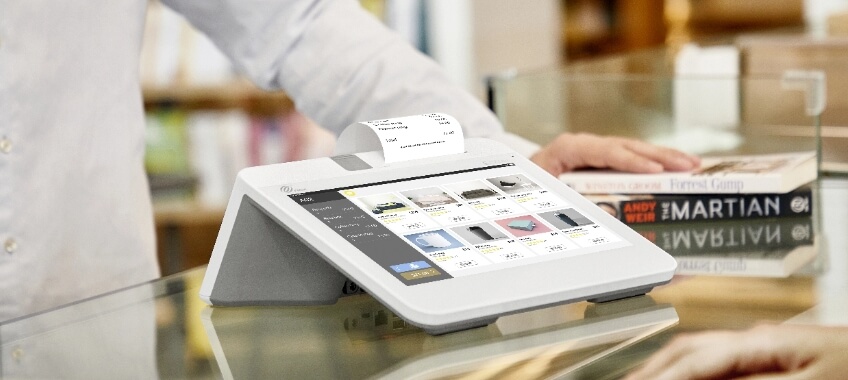
The interesting feature is how much the terminal can do besides accept a card. Android provides a platform for applications: ordering, loyalty, scanning, reporting. Developers can put business software on equipment that already has a reason to be in the merchant’s hand. The checkout becomes useful real estate.
Consider the current A920Pro Duo. PAX lists Android 14, a built-in printer, barcode scanning, a main touchscreen and a smaller customer-facing screen. It accepts chip and contactless payments. These are practical combinations for a waiter moving between tables or a retailer taking checkout to a queue. Payment acceptance and a business application can share the same piece of equipment.
Then there is the larger L1620 Elys Station Pro Max, an Android workstation with a 16-inch display. It connects to compatible payment devices and peripherals. PAX’s restaurant portfolio also reaches into kitchen displays, bump bars and printers. The company’s ambition now extends across the room, including the parts where nobody is paying.
The deadline came before the breakdown
A useful example comes from PayFacto, the Montreal payments and hospitality technology business. In a partner account published by PAX, PayFacto’s chief product officer, Karen Cox, described a looming end-of-life deadline for existing payment technology. The danger was a date on a calendar: merchants could lose the ability to process payments.
“There was a literal cliff at the end.”
Karen Cox, PayFacto chief product officer, in PAX’s partner account
PayFacto selected PAX for its common kernel, developer tools and remote application management. Its hardware was installed months before the final change. PAX says new software then reached more than 25,000 terminals within ten weeks through PAXSTORE.
months ahead
the new platform
through PAXSTORE
The lesson is to separate a physical rollout from a software transition. Ten weeks describes the distribution window, not the entire project. The published account describes development, certification and hands-on support too. Anyone borrowing the example needs comparable preparation, working connectivity and control over the deployed applications.
An app store with a maintenance department
PAXSTORE handles application distribution and terminal management in North America. The broader global ecosystem is marketed as MAXSTORE. A partner can manage a branded marketplace, distribute approved applications and keep a terminal estate configured. The international platform also describes separate tenant environments for segregating customer data.
That is more consequential than the phrase “app marketplace” suggests. At fleet scale, someone has to decide which application goes to which device, what settings accompany it and whether an update completed. PAX’s knowledge base includes merchant setup, terminal registration, application push tasks and role management. These are the chores behind the cheerful touchscreen.
connected devices reported by PAX Global
Connected devices are a platform metric, not cumulative terminal shipments.AirViewer offers remote assistance. GoInsight supplies terminal analytics. AirLauncher lets partners configure access and the device interface. Taken together, these tools make the payment machine something a provider can operate over time. An application can change while the hardware stays on the counter.
In its August 2026 interim announcement, PAX Global reported that Android solutions generated 75% of group revenue in the first half, and MAXSTORE had passed 18 million connected devices. Those figures suggest that the Android approach has become central to the business. They do not tell us how many terminals a particular American partner manages.
The real price is in the plumbing
PAX operates through a business-to-business channel. Hardware, software and associated services reach merchants through distributors, processors and integrators. A terminal’s purchase price is therefore only one part of the buying decision. Payment processing, connectivity, applications, configuration and support have to be considered with it.
A useful quotation should identify the exact model, installed payment application, supported processor, key-loading arrangements and ongoing services. TecStore’s listing for a blank A920 Pro explicitly warns retailers against purchasing it for immediate use. The object in the box is only part of a working payment setup.
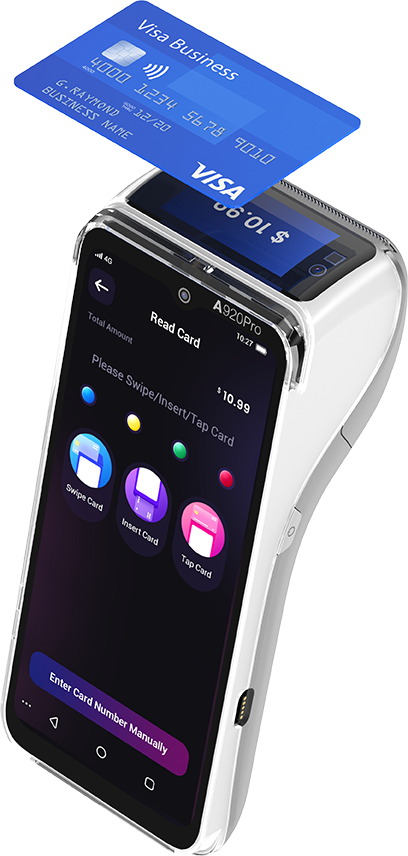
The terminal still needs a supported payment application, a processor connection, secure keys and a plan for updates.
Product photo: PAX Technology.PAX’s integration expertise is another part of the proposition. Its common kernel can reduce repeated work across device types. The Payroc BroadPOS programme offers pre-certified connections to processing platforms including Fiserv and TSYS, alongside deeper cloud and SDK integration paths. For a software vendor, reused payment work leaves more attention available for its own product.
There are credible alternatives. Ingenico offers Android AXIUM terminals and cloud estate management; Verifone also offers device management for its payment hardware. Android and remote updates alone do not settle the contest. PAX’s case rests on the combination of hardware choices, integration paths, marketplace and partner support that suits a particular deployment.
Flexibility requires checking the details. A device, application and processor must work together in the intended market. PAX’s careers page champions partner choice and technical ownership; that is a revealing statement of intent. A buyer still needs the actual compatibility and service commitments in writing.
A device can pass a test and still need scrutiny
Payment terminals carry sensitive information, and PAX’s history includes a serious episode of scrutiny. In October 2021, US federal authorities searched its Florida office and warehouse. Reuters reported that the parent said it was unaware of charges being filed at that time. A search establishes an investigation, not the truth of every allegation circulating around it.
In December 2021, PAX published its account of a commissioned review by Palo Alto Networks’ Unit 42. According to PAX, the review examined network traffic from 15 terminals across three Android models and identified no malicious traffic or events in the activity reviewed. That conclusion belongs to a defined test environment and scope; it is not a blanket security guarantee.
The ongoing work is less dramatic and more useful to customers. In February 2026, PAX announced a partnership with Utimaco to encrypt cryptographic keys during local loading into supported devices. The solution preserves existing physical key-injection workflows while improving protection during transfer. PAX also offers a separate remote loading option. The distinction matters to organisations that already operate secure facilities.
Software support needs equally precise language. PAX’s Android 10 guidance says its terminals run customised systems based on the Android Open Source Project, with manufacturer-controlled firmware and security updates. Consumer smartphone support announcements do not automatically determine those terminals’ lifecycles. Buyers should ask about their model, firmware version, patch level and upgrade roadmap.
The useful lesson fits in a shipping box
One small design detail captures the wider business. The L1620 workstation has a folding base intended to reduce package size, storage requirements and shipping volume. A customer may admire the display. A distributor has to move the display, warehouse it and deliver it to somebody who needs to open on Monday.
That is where PAX’s proposition becomes persuasive: the company addresses the work around the transaction. Reusable integrations help developers. Remote management helps operators. Different device shapes serve different merchant settings. The value depends on whether those pieces reduce effort in the customer’s actual deployment.
For a small shop that wants a ready-made payment bundle, the right provider and support arrangement may matter more than the breadth of the catalogue. For an acquirer or software vendor managing thousands of endpoints, the estate-management layer deserves close attention. Both should test the whole path from application to processor before committing.
The customer at the counter can remain blissfully indifferent to all of this. That is a reasonable division of labour. Someone else has to make the beep uneventful.
Follow the machinery
Explore the devices, browse the software ecosystem, or watch a terminal earn its keep.