Four people, a desk, some phones and a telex machine. The room had no windows. In 1985, this was the working environment of Trans-Tec, the marine fuel services company Paul H. Stebbins founded with Michael Kasbar. The view was evidently an expense they could postpone. The customers, scattered across the shipping world, were rather more urgent.
Kasbar would later remember those beginnings with affection. He and Stebbins had met the year before. They started a business whose reach depended on making connections across distances their little office did nothing to suggest. London and San Francisco followed in 1987, Singapore in 1988. Within a decade, the venture was being acquired.
It is an appealing business story. It also introduces a question that keeps returning in Stebbins’s life: what allows people with separate interests to get something done together? First came fuel transactions and a lasting partnership. Later came a commitment to the national debt, political cooperation and an initiative with a name that distributes responsibility rather widely: FixUS.
Four people, no windows
Marine fuel is an unromantic place to make a career, which is one of its charms. Ships require it whether or not the transaction produces a good anecdote. Behind a delivery sit questions of price, quality, financing and timing. A business that can manage those questions gives customers something more useful than a stirring speech: fewer things to worry about.
Stebbins and Kasbar built Trans-Tec in New York. Their later corporate careers can obscure the order of events. They were founders first, then executives inside a larger public company. The 1995 acquisition brought their marine business together with an enterprise active in aviation. The company subsequently took the World Fuel Services name, and years later became known as World Kinect.
The partnership survived the change in scale. Stebbins became president and chief operating officer of the parent company in 2000, then chairman and chief executive in July 2002. Kasbar remained central to the business. Their relationship connects the improvised early office to the much larger organization that followed.
There is an ordinary discipline beneath that continuity. Partners have to keep making decisions together after the delight of starting something has worn off. A founding photograph freezes enthusiasm. A partnership has to survive the following Monday, the following year and, in this case, the transition into a public company.
A government degree, then a global business
The government degree came before the fuel company. Stebbins graduated from Georgetown University in 1979 with a B.A. in government. His first career chapter was in public policy at the Forum for Resources, a nonprofit concerned with public understanding of scarce fuel and mineral resources. Energy and public decisions were already sharing space in his working life.
That beginning makes his later civic commitments less surprising. A biography arranged around executive appointments can make everything outside business look like an extracurricular activity. In his case, policy was there at the start. Entrepreneurship supplied another setting in which to encounter resources, competing interests and decisions with consequences beyond one desk.
His chief executive years ran from July 2002 through the end of 2011. In January 2012 he became executive chairman. In May 2014 he became chairman emeritus and a non-employee director. These are distinct jobs, and the distinctions matter. Stepping back from daily management left him connected to the institution he had helped build.
His comments to investors give a more practical sense of the executive at work. In a 2010 earnings discussion, Stebbins emphasized customer quality, overall gross profit and the value of investing in technology, people and training. The discussion concerned the details of a fuel services business recovering its footing in an uncertain market. He was arguing for a service customers would have reason to keep buying.
There is a distinction here between handling a transaction and building the organization that can handle the next thousand. An individual can negotiate a price. A company needs people, systems and judgment that continue working across locations and over time. Much of the founder’s task eventually becomes making the business less dependent on the founders being present for every decision.
Another corporate connection had begun in 2006, when he joined First Solar’s board. A marine fuel entrepreneur serving as a director of a solar manufacturer makes a neat juxtaposition. The practical point is broader experience of the energy business. His work has included both operating a company and sitting on the boards responsible for overseeing companies.
- 1985Co-founds Trans-Tec
- 1995Acquisition; joins the parent company’s board
- 2002Becomes chairman and CEO
- 2006Joins First Solar’s board
- 2014Becomes chairman emeritus
- 2020FixUS formally launches
The argument leaves the boardroom
By 2012, Stebbins was publicly making the case for joining the Campaign to Fix the Debt. His argument reached beyond the arithmetic. He objected to the trivializing of serious issues and called for a restoration of civil discourse. He wanted elected officials to agree on a lasting fiscal plan, rather than stumble into blunt decisions at a deadline.
He gave the commitment a compact explanation: “It is a matter of citizenship.” That is a demanding description of what can otherwise become an exercise in blaming Washington. Citizenship includes the people making the complaint. It leaves less room for an executive to regard public dysfunction as an irritating service failure somebody else must repair.
“It is a matter of citizenship.”
Paul H. Stebbins / 2012
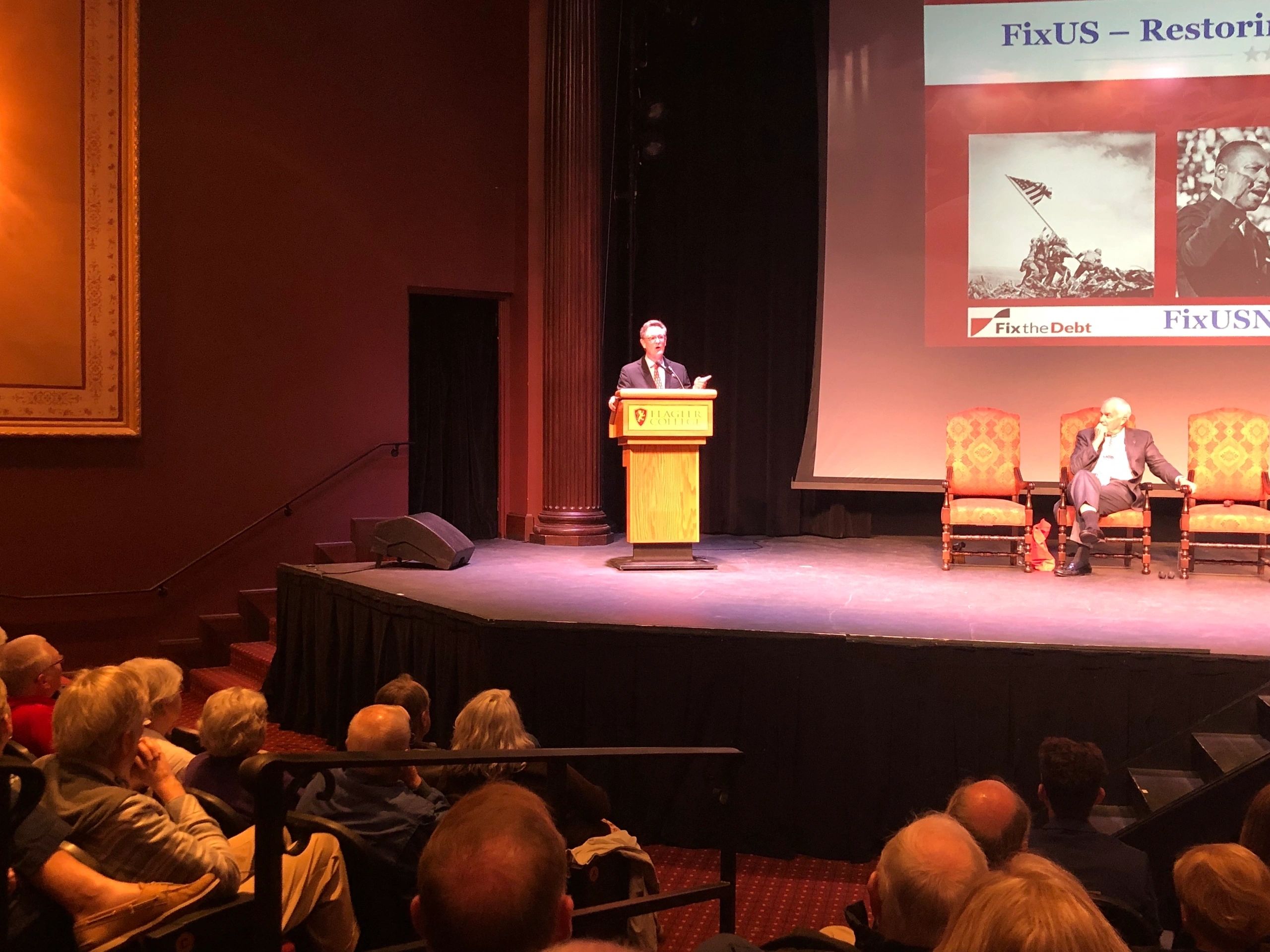
He took that argument into public rooms. In October 2015, he appeared with former Pennsylvania governor Ed Rendell at a fiscal-policy event in Des Moines. In February 2016, he spoke at Loyola Marymount University about the national debt and the risks facing the American experiment. The subject was becoming a sustained public commitment.
The speaking subjects had once been closer to the commercial work: fuel procurement, derivatives, fuel quality, entrepreneurship and business. His public biography records lectures and industry writing across those areas. The national debt joined that list. He was carrying the habit of explaining complicated systems from a specialist audience into a much wider conversation about public choices.
That expansion matters because fiscal arguments can become detached from the people expected to accept their consequences. A university appearance creates room for the questions behind the numbers: who decides, what trade-offs follow, and why should the audience believe that the process is fair? Those questions belong to government as much as accounting.
Universities and civic forums make an interesting change of audience for a former chief executive. Students and citizens owe a visiting speaker no obedience. They can disagree, question the premises or simply remain unconvinced. A public argument has to earn something that an organizational chart can sometimes supply automatically: a reason for people to keep listening.
A listening tour, rather than a victory lap
FixUS grew out of a recognition within the Committee for a Responsible Federal Budget: agreement on public policy would remain difficult while division and distrust governed the conversation. Stebbins became a founder alongside Maya MacGuineas, the committee’s president. Michael Murphy led the initiative. The subject widened from the federal balance sheet to the conditions under which Americans could make decisions together.
Preliminary work began in 2018. By the formal launch in January 2020, a nationwide roadshow and listening tour had engaged more than 70 audiences in 27 states. Those figures describe the initiative’s reach, rather than a personal tally of Stebbins’s appearances. The purpose was to hear what people valued, what frustrated them and what they believed was pulling the country apart.
FixUS began with a question for citizens: what is driving our divisions?
The choice to listen is revealing. People can agree that politics is broken while disagreeing fiercely about the cause. Gathering those explanations is slower than announcing a culprit. It also makes a different demand on the person holding the microphone. Sometimes the useful thing is to hand it over.
FixUS’s account of its work allows for economic, political and cultural causes of division. Its wider community includes researchers and democracy reform groups. Questions about election rules sit beside questions about civic relationships. That breadth reflects the difficulty of the assignment: distrust does not arrive neatly labeled with the name of the department responsible for it.
The business comparison has limits. A country contains competing values and legitimate disagreements that cannot be settled by appointing a chief executive. Stebbins’s civic work is interesting precisely because corporate authority offers no shortcut here. Cooperation has to accommodate people who may never become partners, customers or shareholders.
The volunteer never quite left
Long before Georgetown, Trans-Tec or the board appointments, Stebbins was an AMIGOS volunteer. He served in Honduras in 1972 and Nicaragua in 1973, then joined the organization’s staff in Colombia in 1974. Those early assignments add three places to a life usually summarized through company names.
The connection lasted. His later affiliations include the advisory council of Amigos International, a youth leadership organization. There is something quietly persuasive about an institution appearing near both ends of a biography. The volunteer did not simply disappear when the executive arrived. The relationship continued through different responsibilities.
His other affiliations widen the picture further. He is a member of the Council on Foreign Relations and has an advisory role with Silkroad, the cultural organization founded by cellist Yo-Yo Ma. Music, youth leadership, energy and civic reform make an unusually varied list of meeting subjects. The list also cautions against reducing a person to the industry that paid his salary.
There is no need to turn those commitments into a tidy theory of character. The record is interesting enough on its own. A teenager worked with AMIGOS. A government graduate entered energy policy. Two partners started a company. A former chief executive began spending more of his public attention on the problem of Americans getting along.
The windowless room remains a useful place to leave him. Four people had work to do, and the world beyond the walls was much bigger than they were. Years later, the rooms had changed and the question had become more difficult. Stebbins was still putting time into the uncertain business of getting people to cooperate.
Read, watch, connect
- Watch: Stebbins’s 2016 Loyola Marymount lecture ↗
- Watch: A conversation with Paul Stebbins, 2020 ↗
- Meet the FixUS team ↗
- Explore the FixUS mission and history ↗
- Read Michael Kasbar on building Trans-Tec ↗
- Read Stebbins’s 2012 case for civic action ↗
- Stebbins’s AMIGOS connection ↗
- First Solar: board and leadership ↗
- His Georgetown and early policy background ↗
- The January 2020 FixUS launch ↗
- Paul Stebbins on LinkedIn ↗
- Business Journal: his shift toward civic work ↗