Cary Grace grew up in a town with an opinion about how people should live together. Columbia, Maryland, was developed by Jim Rouse with inclusion built into its plans. There was subsidized housing, room to walk, and a religious center where different congregations entered through the same doors. For a child, this was simply the neighborhood. Only later did it become an explanation.
Consider the advantage of starting life with that assumption. A workplace organized around narrow expectations can look permanent to someone who has never known anything else. Grace had known something else. When she eventually encountered the conventions of financial services, she brought a different reference point. Her childhood had supplied an inconvenient question for the adults in charge: why should things have to work this way?
Her first employer supplied another influence. Grace worked in her father's dental practice, and years later called him her most formative boss. “He taught me a lot about service to the community,” she recalled. The lesson was about humanity in business. Before she ran national businesses or sat on public company boards, she had watched a small enterprise operate through personal relationships.
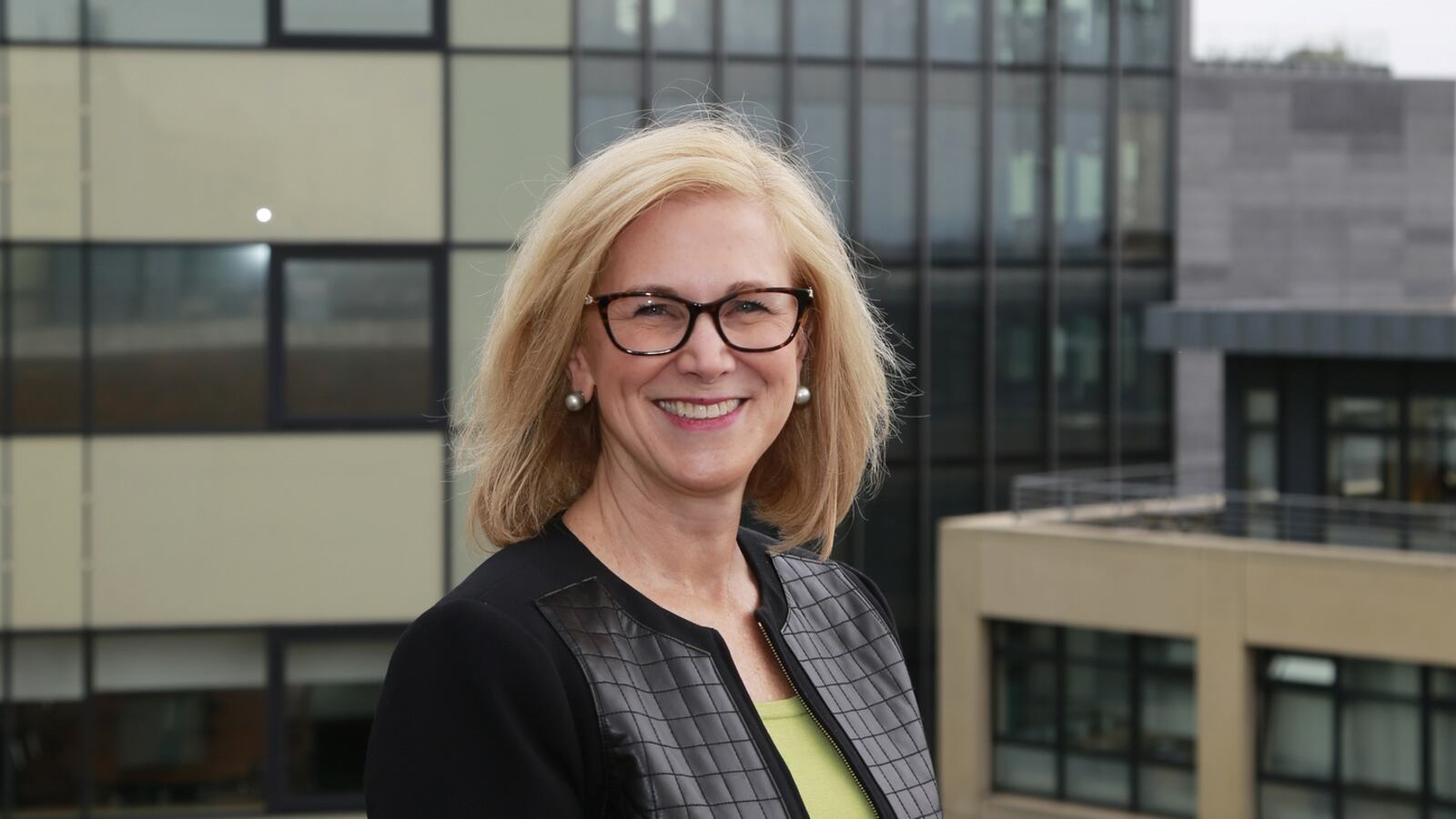
Today she is president and chief executive officer of Dallas-based AMN Healthcare. The distance between a neighborhood practice and a listed staffing company is considerable. Her career makes more sense, though, when you follow the organizational questions along the way: who gets an opportunity, what customers actually need, and whether the machinery of a business helps people do their work.
A banker learns the machinery
Grace graduated from Georgetown University in 1990 and was a Baker Scholar. She also earned an MBA at Northwestern University's Kellogg School of Management. Her professional education continued inside large banks, where the subject matter included institutional investments, private banking, strategy and the rather less tidy business of bringing organizations together.
She started at First Chicago in 1990 and moved to Bank of America in 1998. The institution where she began would become part of JPMorgan Chase through mergers. A career launched in one bank could therefore deliver an education in several corporate identities without requiring quite so many new business cards.
At Bank of America, her responsibilities included institutional asset management and specialized businesses such as philanthropic management, institutional advisory and retirement services. Earlier work at the JPMorgan predecessor included investor relations, strategy and sales for private banking and investments, and positions in corporate and investment banking. These were jobs on different sides of the same transaction: understanding the customer, explaining the enterprise, and making the economics function.
Her move to Aon in April 2012 extended that work into a different kind of professional services organization. She joined as president of Aon Hewitt's Strategy and Solutions group. By January 2016, she was leading Global Retirement and Investment; in May 2017, she became an executive officer. The titles changed. The work continued to involve systems that ordinary people depended on but could rarely see in full.
- 1990First Chicago
- 1998Bank of America
- 2012Aon
- 2022AMN Healthcare
The golf invitation that never came
In 2017, Grace appeared at number 20 on American Banker's Most Powerful Women in Finance list. Her team served clients with more than $4.2 trillion in assets under advisement, a figure describing the clients' assets, rather than money personally managed by Grace. She had also overseen a reporting change in Aon's retirement business while it delivered 3 percent organic revenue growth.
Then came a much smaller piece of evidence about the business world. Fellow executives organizing golf outings would assume she did not play. She did. Apparently, running a substantial operation could be easier to establish than eligibility for the first tee.
She described handling such incidents individually, sometimes with humor and sometimes by expressing her displeasure. There is something useful in the scale of that anecdote. Exclusion can arrive dressed as a minor social arrangement, too ordinary to command a policy meeting. Yet invitations determine who spends unstructured time with whom, and those hours belong to the working life of an organization too.
Grace's response has also taken more formal shapes. At Aon, she launched programs supporting mentorship and sponsorship. She has been a chair of The Chicago Network, whose membership connects women in senior leadership. Her public record joins individual encouragement to institutional work: someone willing to offer advice, and someone willing to help another person get the assignment.
“He taught me a lot about service to the community.”
Cary Grace, on her father
Taking the keys after seventeen years
AMN announced Grace's appointment on October 31, 2022. She took over on November 28, succeeding Susan Salka, who had spent more than 17 years as chief executive and 32 years with the company. The handover involved more than an office. Salka had helped shape the organization that Grace was being asked to lead.
The board's announcement emphasized both growth and culture. Grace arrived with experience running Aon's $2 billion annual revenue retirement, investment and human capital business, as well as enterprise client management and acquisition integration. AMN was hiring someone familiar with the awkward stretch between having a strategy and getting a large organization to carry it out.
Her earlier Aon remit had included 12,000 colleagues across 50 offices, serving 10,000 clients. Scale changes the management problem. A leader can no longer rely on knowing every customer or observing every interaction. Decisions have to travel through reporting lines, incentives, software and habits. What seems obvious in the executive meeting can arrive at the other end as another form to complete.
Grace and her husband were to relocate to Dallas when she began. In November 2023, AMN completed its acquisition of MSDR, comprising Medical Search International and DRW Healthcare Staffing. It was an early, concrete example of the acquisition work that had featured in her previous career. Buying an organization gives a chief executive a closing date; bringing its people and processes together supplies the longer assignment.
A sale with a partnership attached
One revealing decision came in July 2025. AMN sold its Smart Square scheduling software to symplr for $75 million. The transaction included $65 million at closing and a $10 million note due at the end of 2026. Alongside the sale, the companies established a commercial partnership connecting their respective capabilities.
Grace described the decision as a way to concentrate on workforce planning, analytics and artificial intelligence within AMN's WorkWise platform while integrating with clients' scheduling and operational tools. The distinction matters to understanding her approach. A company can extend what it offers through an agreement as well as an acquisition. Ownership is one way to organize a service; a working relationship is another.
AMN had launched WorkWise in 2024 to bring its technology solutions together. Its 2025 annual report described the rollout of the reworked ShiftWise Flex vendor management system, the introduction of another platform solution for managing labor disruption events, and early applications of AI in internal processes and digital recruiting. These are unglamorous categories with substantial operational consequences. The calendar, the candidate record and the approval process are where a strategy eventually meets a working day.
Her September 2026 interview set out a practical boundary for that technology. AI could help with forecasting, matching and scheduling; human judgment still had a role. She described automated recruiters identifying themselves as AI, checking candidates' interest, and passing qualified candidates to human recruiters. She said the deployment saved almost 12,000 hours of human work. That remains her account of the result, rather than an independently established measurement.
The interesting management question is what happens at the handoff. Does the person receiving the candidate have better information? Has the software removed a repetitive step? Can the customer tell the difference? Those questions provide a more useful way to read the investment than treating the mere presence of AI as an accomplishment.
The boardroom leads back to Georgetown
Grace's work now extends into institutions with different ownership structures and responsibilities. State Farm lists her as a director elected in June 2022. AMN's board biography identifies her as chair of State Farm's Finance and Investment Committee. The role draws directly on the financial experience that preceded her staffing career.
Georgetown's board of directors also lists her, with Dallas as her city. The university welcomed her to the board in its June 2025 meeting announcement. For a 1990 graduate, it was a return to the institution where she had been a Baker Scholar. Her earlier Georgetown responsibilities had included the Board of Regents and its Career Committee.
That combination of education and careers has a long history in her public service. A 2014 biography listed work with United Way of Metropolitan Chicago, past service on the New England Aquarium's board, and trusteeship of Georgetown's Baker Scholars Program. Board lists can read like an executive's collection of lapel pins. In her case, the recurring connections to her university and to women's professional networks give the list a more particular shape.
Recognition has followed her across industries: American Banker in finance, Staffing Industry Analysts in recruitment, and D CEO's Outstanding Healthcare Executive award in December 2025. In January 2026, she appeared on SIA's Staffing 100 list again. The continuity lies in the kind of job she does, running organizations whose value depends on other people being able to do theirs.
A different problem for the next generation
There is a limit to how much a childhood can explain. Columbia did not write Grace's operating plans, and a philosophy of inclusion does not decide the price of an acquisition. Still, her account of growing up there gives a clear starting point for her expectations. She had seen people deliberately arrange an environment around an idea of belonging.
Her Irish American family supplied another kind of continuity. Her full name is Caroline Sullivan Grace; her family roots run through Limerick and Kilkenny. As a girl, she took Irish dancing lessons. Her father learned Irish as an adult and traveled back to explore his ancestry. The interest in where people come from was quite literal at home.
When she discussed workplace equality in 2019, Grace said she wanted the next generation to inherit different challenges. It is a more demanding aspiration than simply encouraging someone else to persist. Persistence asks the newcomer to cope with the existing arrangements. Changing those arrangements requires work from the people who already have authority.
Her January 2025 conversation with Kerry Perez returned to trust, integrity and collaboration in business partnerships. Those words acquire weight through decisions: who receives sponsorship, which work a company retains, what a partner is trusted to handle, and where a recruiting system passes responsibility back to a person. Grace has spent her career making such decisions at increasing scale. Long before Dallas, she grew up somewhere that treated the design of an institution as a choice. She still has reasons to remember.
Follow the conversation
More of Grace’s work, in her own professional circles.
Cary Grace on LinkedIn ↗Her AMN Healthcare biography ↗Watch: building true partnerships · YouTube ↗Read the September 2026 interview ↗The 2017 finance profile · PDF ↗AMN Healthcare ↗