In September 2023, Maryann Mannen handed Autumn Bennington the keys to a house in Findlay, Ohio. Bennington had spent nearly two years working toward homeownership through Habitat for Humanity. Marathon Petroleum had put $100,000 into the build; 258 volunteers had contributed 1,412 hours. Mannen was then the company’s chief financial officer. For once, the return on an investment came with a front door.
There is something useful about that scene when trying to understand her career. The numbers matter, and they are unusually easy to see: dollars, people, hours. But they become meaningful when someone can turn a key. A corporate biography will tell you which positions Mannen held. A moment like this gives those positions a little scale that a title cannot supply.
By October 2026, her title had grown to chairman, president and chief executive officer of Marathon Petroleum. She holds the same three positions at MPLX GP LLC, the general partner of the company’s midstream affiliate. The responsibilities span fuel refining and the infrastructure that moves and processes energy. It is a substantial distance from a home dedication, though both involve deciding how money becomes something useful.
Thirty-five years before the new letterhead
Mannen earned a bachelor’s degree in accounting and an MBA at Rider University. Before joining FMC in 1986, she worked as finance manager at Sheller-Globe Corporation. Her route toward the executive office began in financial work, then widened through administration, treasury and leadership. The dates offer a welcome correction to the idea that a chief executive arrives fully assembled on appointment day.
She became vice president of administration at FMC Technologies in 2007. From 2010 to 2011, she was deputy chief financial officer and treasurer. In 2011 she became CFO. These are related jobs, but they ask different questions: how an organization works, how it finances itself, how it accounts for what it does. In her case, they became successive parts of the same education.
The next change involved a company rather than merely an office. Mannen helped negotiate and execute the merger of FMC Technologies and Technip SA. When the combined TechnipFMC began its next chapter in 2017, she served as executive vice president and CFO. The work carried her financial responsibilities into a global engineering and energy technology business, with operations and obligations crossing borders.
That long tenure is a distinctive part of her story. Between joining FMC in 1986 and moving to Marathon Petroleum in 2021, thirty-five years passed. The corporate names changed; her responsibilities expanded. In an executive culture fond of the dramatic entrance, Mannen’s progression makes a case for accumulated knowledge. There was plenty of time to learn what the figures represented before being asked to direct a different enterprise.
- 1986The FMC years beginAdministration, treasury and finance leadership follow.
- 2017A merger, a wider remitExecutive vice president and CFO of TechnipFMC.
- 2021Marathon PetroleumJoins as executive vice president and CFO.
- 2024-26President. CEO. Chairman.Three appointments, made in stages.
The promotion came in stages
Marathon Petroleum brought Mannen in as executive vice president and CFO in January 2021. Her remit included finance, investor relations and supply chain operations, among other functions. Those responsibilities placed her where the company’s financial choices met its physical requirements. Fuel businesses need capital, certainly. They also need supplies to arrive and operations to keep working.
In January 2024, she became president. On August 1, she succeeded Mike Hennigan as CEO and joined Marathon Petroleum’s board. Hennigan moved into the executive chairman role, while John Surma became lead independent director. The sequence matters: the handover distributed responsibilities across several people and several dates. It was a succession arranged through steps rather than one ceremonial exchange of office keys.
The same August brought her appointment as president and CEO of MPLX GP LLC, whose board she had joined in February 2021. Two leadership jobs therefore sit inside the headline appointment. Refining and midstream infrastructure have different operating questions, and Mannen’s remit reaches across both. Reading only the Marathon Petroleum title leaves half the organizational picture outside the frame.
On January 1, 2026, she also became chairman of Marathon Petroleum, succeeding Hennigan following his retirement from the board. Her progression from CFO to president, CEO and chairman took place over five years. The pace looks brisk beside the decades that preceded it. Put the two periods together and the appointment seems less like a sudden ascent than a long preparation followed by a concentrated transfer of responsibility.
“I’m excited about our future.”
Maryann Mannen · May 2024
A percentage with pipes attached
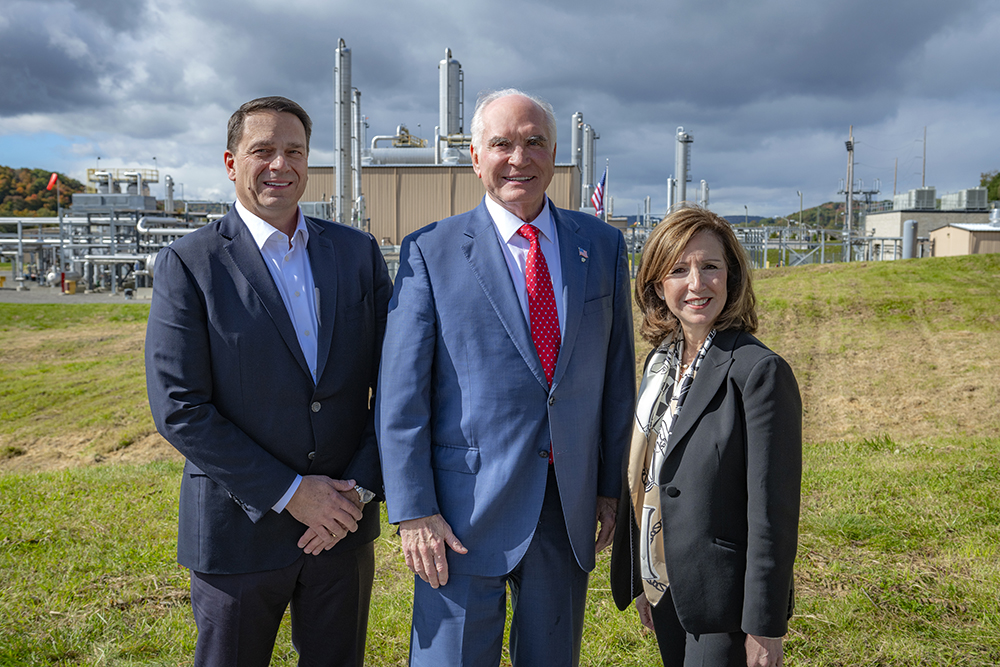
At MPLX’s Bluestone natural gas plant in Pennsylvania, Mannen joined colleagues and public officials for an industrial showcase. The facility had become the first in the U.S. natural gas processing sector to achieve the EPA’s ENERGY STAR Challenge for Industry. A photograph places her beside Greg Floerke and Pennsylvania Representative Mike Kelly, with the plant stretching behind them. The business has obligingly supplied its own backdrop.
The challenge required a 10 percent reduction in energy intensity within five years. Bluestone’s measured reduction was almost 15 percent from its baseline; absolute energy consumption fell 9 percent at constant throughput. These are measures of different things. Intensity describes energy relative to activity. Absolute consumption describes the amount used. Keeping those distinctions visible gives the achievement its proper dimensions.
For Mannen, the plant offers a concrete setting for a recurring argument: operating performance and environmental performance belong in the same management conversation. In the company’s 2025 discussion of sustainability, she described the relationship between the work and the way it is done. Her compact formulation was that “the how” mattered alongside “the what.” The useful test of such language is what happens at a facility.
The following year brought another set of measurements. In August 2026, Marathon and MPLX said they had achieved their 2030 greenhouse-gas and freshwater-withdrawal goals five years early. They also reported a 68 percent reduction in MPLX methane emissions intensity from 2016 levels. These remain company-reported results with defined baselines and boundaries. They describe progress against particular goals; they do not turn an entire energy system into a single tidy percentage.
Index: baseline = 100. Almost 15% lower energy intensity. Separately, absolute energy consumption fell 9% at constant throughput.
Facility results described January 2025 · Company-reported dataThe accountant still has questions
Running the enterprise also means answering for its financial outcomes. For the full year 2025, Marathon Petroleum reported $4.0 billion in net income attributable to the company and $8.3 billion in operating cash flow. Those measures tell different stories: one concerns earnings, the other the cash produced by operating activities. Mannen’s earlier profession has followed her into the chief executive’s office. It has plenty to discuss there.
In the second quarter of 2026, the company reported $5.1 billion in net income attributable to MPC, compared with $1.2 billion a year earlier. Crude capacity utilization was 94 percent, with total throughput of 2.9 million barrels a day. Investments intended to improve yields at El Paso and Robinson came online during the quarter. Here the financial result and the physical operation occupy the same page.
A quarterly profit is a company outcome, produced by employees, assets, commercial decisions and market conditions. It cannot sensibly be awarded to one person as though the chief executive had refined the barrels herself. For a leader with Mannen’s background, the more interesting question is how reliably an organization can translate those moving parts into results. The job is collective even when the accountability has a name.
Her appointments during 2026 show the work continuing inside the finance function she once led. Maria Khoury became CFO in January. In May, Marathon announced Brian Worthington’s move to investor relations and Kristina Kazarian’s move to finance and treasury. Mannen’s comments on those appointments emphasized knowledge of the business, capital allocation and shareholder value. The vocabulary is familiar; the people carrying the responsibilities change.
Crude capacity utilization
Barrels per day
Marathon Petroleum · Second quarter 2026 · Company-reported operating figures
There is also a stage, and a handshake
Her institutional commitments extend beyond petroleum. She serves as secretary of the Cynthia Woods Mitchell Pavilion’s board, with executive and finance committee responsibilities. In Findlay in 2023, she thanked sponsors at the MPCgives Gala and introduced Train, the evening’s featured band, at the Marathon Center for the Performing Arts. Even a finance executive occasionally gets to introduce something more tuneful than quarterly results.
In June 2025, a different public appearance involved no corporate succession and no earnings presentation. Nearly 80 Ohio veterans traveled to Washington on an Honor Flight co-sponsored by Marathon Petroleum and Ohio Logistics. Mannen surprised the visitors there, greeting veterans and thanking them for their service. Employees and company leaders had accompanied the group as volunteer guardians. The photograph records an ordinary human gesture: she leans forward to shake a visitor’s hand.
These appearances are small pieces of a public life that is otherwise heavy with committees. In 2026 she also joined Prudential Financial’s board. Her current responsibilities there include corporate governance and business ethics, and compensation and human capital. She previously served on Owens Corning’s board and chaired its audit committee. The connecting subject across those assignments is how large organizations are governed and held accountable.

What she wants to keep moving
Mannen’s energy responsibilities now reach into public policy. She chairs the American Petroleum Institute and is a member of the U.S. Secretary of Energy Advisory Board. At API’s January 2026 State of American Energy event, she appeared with Cheniere’s Jack Fusco and EQT’s Toby Rice on a panel about energy demand. Their conversation placed company operations within a broader argument about infrastructure and investment.
In her account of that discussion, she argued for additional infrastructure and greater certainty around permitting and policy to support long-term projects. She also maintained that reliable, affordable energy and environmental protection can be pursued together. These are her stated priorities, and they are consequential ones for someone overseeing refineries and midstream assets. Decisions about new capacity commit resources well beyond the next reporting date.
The house keys in Findlay remain a useful place to end. They make a distant-sounding word like investment unusually tangible. Across Mannen’s career, the scale has changed from finance roles to a merged international company, then to Marathon Petroleum and MPLX. The practical question keeps returning: what does the money allow people to do? A refinery, a pipeline and a front door offer very different answers. Her work now requires her to account for more than one.
Further reading & public profiles
- Marathon Petroleum · current leadership
- Maryann Mannen · LinkedIn
- Her 2024 CEO appointment
- The 2026 chairman transition
- Bluestone · plant visit and efficiency results
- Honor Flight · the Washington visit
- The Findlay home dedication
- 2026 State of American Energy · event coverage
- Second-quarter 2026 · financial and operating results
- 2026 sustainability update
- Marathon Petroleum · corporate X account
- Marathon Petroleum · corporate Facebook account