At seven in the morning in Nairobi, Paul Sheehan was moderating a discussion about small businesses and money. The breakfast, part of the 2023 Sankalp Africa Summit, brought together investors and people who help entrepreneurs develop their companies. The hour deserves a little sympathy. The question deserved the early start: how do you make business support and access to capital work together?
That question provides a useful entrance to Sheehan’s professional life. He is now chief executive of SEAF, an organisation that invests in and supports enterprises in underserved markets. His earlier work involved banks, equity research and running a fund in Hong Kong. Across those roles, the subject has remained capital; the vantage point has changed.
The Nairobi conversation also supplies a warning against making this a solitary executive story. Its participants brought research, donor experience and entrepreneurial support into the room. A small company’s growth can depend on several kinds of expertise arriving at a useful moment. The chief executive’s job includes getting those people into the same conversation. Occasionally, it seems, before they have finished breakfast.
An examiner before an investor
Sheehan began at the Federal Reserve Bank of New York as a bank examiner. He later covered Asian banks and financial institutions at Bear Stearns, Lehman Brothers and ING Barings. His career then moved to the investment side: he co-founded Thaddeus Capital, a Hong Kong institutional fund manager.
Each position offers a different relationship with a balance sheet. Supervision asks whether an institution is sound. Research asks what an investor should understand about it. Running a fund adds responsibility for deciding where money goes. Read in sequence, these jobs suggest a professional education in the machinery connecting institutions, markets and investment decisions.
At Thaddeus, Sheehan worked with Charle Peza, the fund’s chairman and chief investment officer. In April 2007, the firm was preparing an event-driven strategy focused on northern Asia. Its opportunities included mergers, restructurings and other corporate changes. The launch plan favoured liquid positions and holding periods of three to six months. This was a business organised around identifying an event and judging its consequences.
By January 2019, Sheehan had joined Ho Chi Minh City Securities Corporation as acting head of research. His academic route included economics at Albany and graduate degrees at Yale and Harvard. His subsequent SEAF role places investment, advisory work and global operations under one brief. The connection between those responsibilities becomes clearer when the unit of attention is an entrepreneur trying to make a company grow.
- ExamineFederal Reserve Bank of New York
- ResearchAsian financial institutions
- InvestThaddeus Capital, Hong Kong
- ConnectCapital and enterprise support at SEAF
The business between the boxes
The phrase “missing middle” appears repeatedly in SEAF’s work. It describes a financing problem around small and medium-sized enterprises underserved by conventional sources of capital. The phrase sounds tidy. An actual business is less obliging: it has an owner, a payroll, customers and some inconvenient combination of things it needs next.
For an investor, that makes preparation part of the problem. A company may need management support alongside funding. Putting those services in different institutional boxes creates another task for the entrepreneur: finding the right people, on the right terms, in the right order. SEAF’s programmes try to bring the pieces closer together.
In January 2024, SEAF and FMO Ventures announced a multi-year partnership for Daraja Impact in Tanzania. The five-year project combines capital and technical assistance, with inclusion and empowerment for women and young people among its objectives. Sheehan linked the partnership to attracting further local and international capital and developing the entrepreneurial ecosystem.
The design offers a practical way to read his current work. Investment requires attention to what a company can do with the money. Assistance requires attention to how the company will finance its next step. Bringing them together makes each answer dependent on the other. The business still has to perform; a programme cannot do its selling, hiring or management for it.
A supermarket makes the numbers visible
A Serbian supermarket chain provides a particularly concrete example of the kind of enterprise story SEAF supports. Goran Kovacevic founded Gomex. When SEAF invested in 2007, it had 16 stores and 306 employees. The organisation’s 2023 account of its completed exit described 207 stores and nearly 2,400 jobs.
Those figures belong to Gomex’s development and SEAF’s investment history. They help explain the organisation Sheehan leads without assigning him personal credit for an investment that began years earlier. The founder, employees and investment teams have their own places in the account.
Gomex developed a neighbourhood-supermarket format, balancing range and price with proximity to customers. That is an unusually legible expression of growth. A store has a location. A job has a shift. Customers decide whether the business has understood their needs. The abstraction of SME investment acquires shelves, deliveries and a checkout queue.
There is also an ending to the investment relationship. SEAF’s exit transferred the holding to CEECAT Capital, a regional private equity manager. Growth capital has to consider what follows its involvement. The company’s operating life continues after the investor’s chapter closes, which is rather the point.
A fund needs a local address
In early 2024, Sheehan represented SEAF at the launch of Oyass Capital’s SME fund in Dakar, alongside Jan Cherim, Bert van der Vaart and Moctar Sarr. The gathering included Senegalese government representation, FONSIS, the German embassy and the World Bank. Its €80 million fund size included €53 million already committed by KfW, the World Bank and the State of Senegal.
The distinction between a fund’s size and its committed capital matters. It tells the reader where the financing effort stands. It also makes the partnership visible: institutions with different roles are assembling the resources around a local enterprise opportunity.
SEAF’s account emphasised its dedicated team in Senegal and local expertise. For a global executive, this arrangement poses a recurring management challenge. International relationships can help bring money into a market. The work of understanding companies happens closer to the companies. A headquarters can organise support, but a fund’s usefulness is eventually tested where its entrepreneurs operate.
Reconstruction, one contractor at a time
That relationship between the global and the local becomes especially tangible in SEAF’s work around Ukraine. In October 2025, the organisation announced a memorandum of understanding with the City of Lviv. The agreement linked reconstruction to the development and financing of small and medium-sized enterprises.
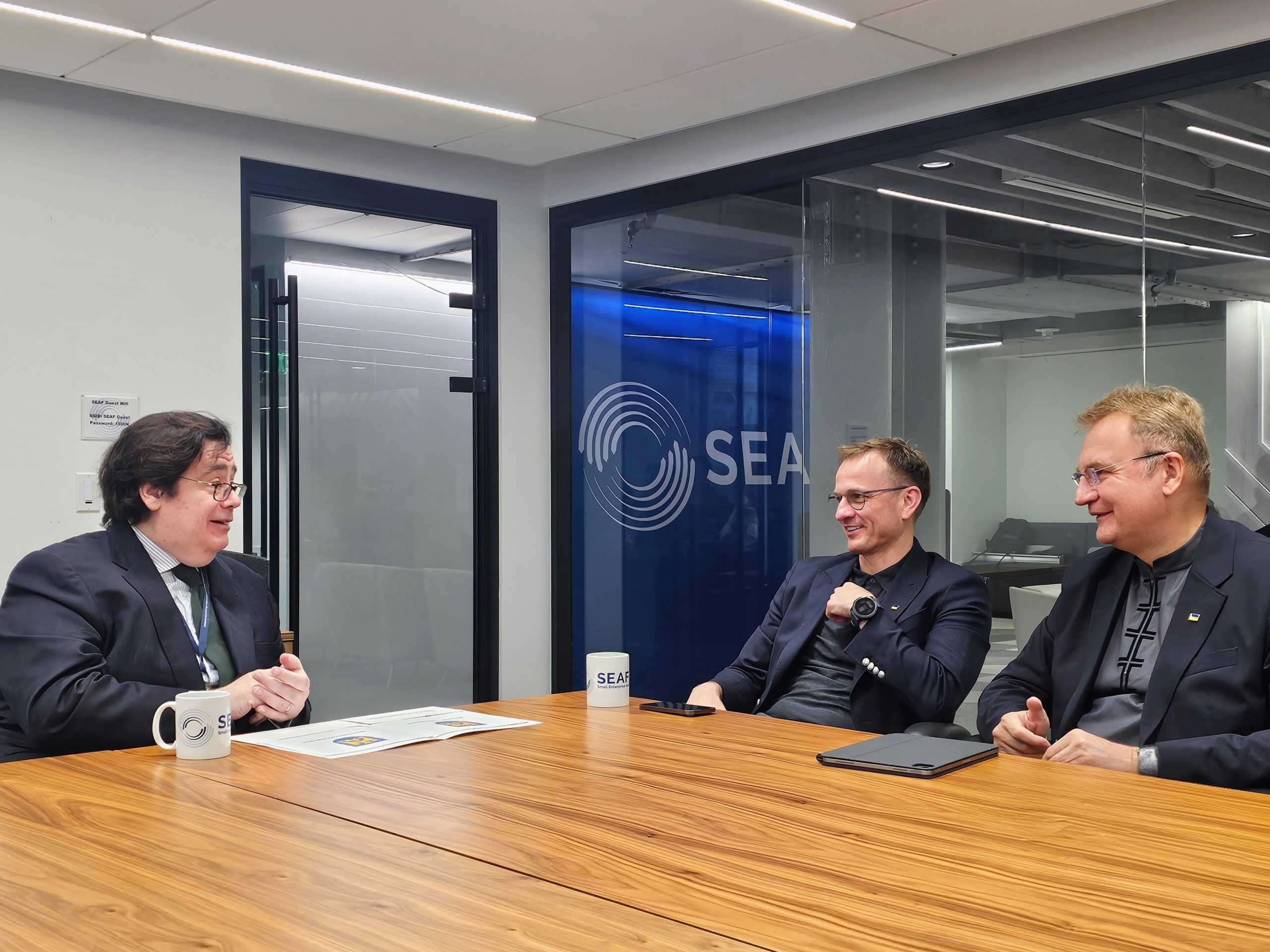
The planned Lviv Construction and Recovery Fund was expected to mobilise $30 million at its first close. Its intended recipients included businesses in engineering, procurement and construction, and the supply chains around them. The figure described an expectation for raising capital. It did not establish that the money had already reached contractors.
“Rebuilding Ukraine cannot wait for the end of the war, it has to begin now.”Paul Sheehan, October 2025
The brevity of that statement is useful. It connects reconstruction to present work. Financing smaller firms is one proposed way to develop the capacity needed for it. A rebuilding programme ultimately depends on companies able to take part, with people, equipment and management ready for the task.
SEAF’s March 2025 partnership with bechtel.org and Caterpillar Foundation approached that preparation through construction skills and enterprise development in Poland and Ukraine. By March 2026, Autodesk Foundation had joined the collaboration. Digital capabilities and project readiness sat alongside workforce training, management support and finance.
The latest announcement described a fund that would operate alongside this preparation and supply working capital to qualifying participating companies. That pairing is revealing. Technical expertise helps a contractor become ready for work; working capital helps the contractor carry it out. A training certificate cannot settle a supplier’s invoice. An investment cheque cannot teach a technical skill. The initiative is designed around needing both.
Who gets thanked when capital works
The financial-institution chapter of Sheehan’s career also finds an echo in MicroVest’s integration into SEAF. The acquisition process began in December 2024. MicroVest invests through institutions serving microenterprises and small businesses, adding an indirect route for reaching entrepreneurs alongside SEAF’s direct enterprise work.
Accountability travels with those routes. SEAF’s 2023 impact-management disclosure, signed by Sheehan, described an external assessment by BlueMark in 2022 and recommendations being implemented across its funds. Measurement gives an organisation a way to examine its intentions against its practices. It also creates work after the investment announcement, when public attention may have moved elsewhere.
In his letter accompanying the 2024 impact report, Sheehan’s acknowledgements extend from entrepreneurs and investors to accounting staff, technical assistance providers, administrators and CEED mentors. The list has little of the glamour associated with a fund launch. It has considerably more of the people required to keep an organisation functioning.
Read alongside the Nairobi breakfast, those thanks offer a fitting closing view of his role. Much of the work involves connecting people whose expertise is useful to the same business at different moments. The owner remains responsible for the enterprise. The investment organisation tries to make support and capital available when they can help. Sheehan closes his letter with five words: “On to the next challenges.” There is, apparently, another meeting to arrange.