Paul Russo bought a newspaper on his way to work and discovered that his employer had disposed of the reason for his journey. RCA was leaving the mainframe business. He was at RCA Laboratories, working on computer architecture. Corporate strategy had reached the newsstand before it reached his desk.
Remembering the episode years later, he supplied a brisk conclusion:
“So I turned around and went back home.”Paul Russo, recalling RCA’s mainframe exit
It is a pleasingly economical response to a large company’s change of mind. The more consequential response came afterward, when the group began working on smaller computers.
The newspaper got there first
Russo had arrived at RCA in Princeton in the autumn of 1970, after graduate work and a period teaching at Berkeley. His research had involved using computers to design large-scale integrated circuits. The machinery required boxes of punched cards, a reminder that even the digital future once needed a considerable amount of paper.
After the mainframe retreat, colleague Joe Weisbecker’s processor project offered another direction. Russo became involved in work on the early RCA microprocessor family and its applications. An abandoned corporate business had left room for a different scale of computing.
The change makes a fitting opening to his career. It also gives a reader something more useful than a tidy tale of uninterrupted foresight. Plans changed. Work continued. The interesting decisions followed the interruption.
Today, Russo is the founder, chairman and CEO of K2X Capital. Between the research laboratory and the investment company lie several semiconductor businesses, board seats and decades of evaluating startups. The titles change, but a practical question keeps returning: what can this technology become once it leaves the room where it was invented?
Learning to make the picture fit
Russo’s education began with a B.Eng. from McGill University and continued with master’s and doctoral degrees in electrical engineering and computer science at the University of California, Berkeley. Those disciplines supplied a vocabulary for understanding both circuits and the systems built around them.
His professional life later included management at General Electric’s Microelectronics Center and Industrial Electronics Laboratory. Research, engineering and management had become successive responsibilities. Eventually, the company itself would be his to build.
In 1987 he founded Genesis Microchip. The business worked in image processing for displays, an unglamorous description of a rather visible task. People notice a picture that looks wrong considerably faster than they notice the chip responsible for making it look right.
Genesis went public on Nasdaq in 1998. The milestone placed a company Russo had founded in the public markets, adding investors and reporting obligations to the demands of making semiconductor products. A chip business has several audiences; only some of them look through microscopes.
STMicroelectronics announced its agreement to buy Genesis in December 2007. The proposed cash price was $8.65 a share, implying an equity value of approximately $336 million. The transaction concerned a business with real customers, products and a place in the digital television market.
ST acquired effective control in January 2008 and completed the subsequent merger that month. By then, Russo’s entrepreneurial work had already moved on. The Genesis chapter had a public-market beginning and an acquisition ending, but his career refused to observe the same stopping point.
Another company, another use for a pixel
Russo founded Silicon Optix in 2000 and served as its chairman and CEO. The venture continued his involvement in video processing. There is a recognizable concentration here: the picture on a screen may look effortless, while the engineering needed to produce it is anything but.
GEO Semiconductor followed. Its public launch in June 2009 brought together business lines and intellectual property acquired from Silicon Optix, including Realta and Geo technologies. New ventures sometimes begin with an entirely fresh invention. This one also carried existing engineering into a new corporate home.
The sequence gives Russo’s company building a particular texture. Genesis, Silicon Optix and GEO were connected by image processing, yet each was a separate business with its own responsibilities. Experience could travel between them; a company still had to earn its place.
Over time, GEO concentrated on automotive cameras. Its processors handled images for viewing and sensing, two related jobs with different audiences. A driver might look at the picture; a computer-vision system might analyze it. In either case, the useful result depended on what happened between the sensor and the decision.
By the time indie Semiconductor announced its acquisition agreement in February 2023, GEO had design wins across more than 20 Tier 1 suppliers and 400 car models. Its customers’ vehicles included those from Honda, Hyundai, Kia, Nissan and Toyota.
GEO’s later development involved other leaders, including president and CEO Dave Orton. That matters in a founder’s story. Starting a company and carrying it through every subsequent stage are different contributions, and a fair account leaves space for the people who do the later work.
indie completed the acquisition on March 3, 2023. The career that had touched early computer architecture now included a company whose work helped cars process camera images. The line between those activities is long, but it is visible.
Chips at the Petroleum Club
One photograph catches Russo taking that engineering into an unexpected room. On February 18, 2014, he was the guest at the Calgary Petroleum Club for an event connecting Silicon Valley technology with Alberta’s oil industry.
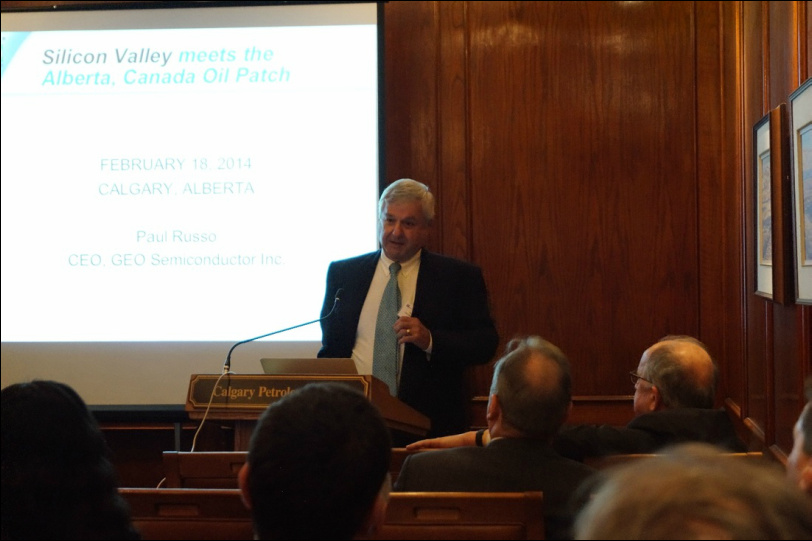
He presented live demonstrations and discussed possible connections between information technology and the petroleum business. Transportation and processing were among the applications that interested him. The setting gave his work an audience beyond the customary semiconductor gathering.
The photograph has the useful awkwardness of a real business event: a projected slide, a lectern, a microphone and guests close enough to ask questions. No cinematic workshop is required. Explaining a technology to people from another industry is ordinary work with potentially consequential results.
For a founder, such a room presents a straightforward test. The audience has its own problems and its own language. A demonstration has to give those people a reason to care. The circuit diagram cannot be expected to make conversation entirely on its own.
A seat on the other side of the table
Russo also built a parallel life as an investor and director. He served on ATI Technologies’ board from 2001 through its acquisition by AMD in 2006. His startup involvement has included companies such as InBay Technologies, Beam Semiconductor and Dynamount.
He became active in the Band of Angels and the Keiretsu Forum, communities where company builders encounter other people’s plans. The change in position is significant. The founder responsible for answering questions becomes the investor responsible for asking them.
In April 2018, he became CEO of Kyto Technology and Life Science. The investment business now presented as K2X gives that chapter an organizational form. The work concerns a collection of young companies rather than the product roadmap of one semiconductor venture.
Its approach emphasizes an additional review of startups already examined by experienced investors. The earlier Kyto investment description specified following vetted angel groups rather than leading financing rounds. An outside evaluation becomes the beginning of another examination.
A process for selecting companies; investment outcomes remain uncertain.
That structure fits a recurring theme in Russo’s working life: an idea has to survive several kinds of judgment. Technical promise, business execution and an investor’s requirements are related considerations, each capable of changing the result.
The company around the chairman
K2X’s current team puts colleagues around that process. Zach Noling is CFO, Simon Westbrook is VP of finance, and John Ricci directs portfolio management. Richard Ayllon serves as senior advisor for due diligence. The duties extend beyond making an introduction or enjoying a persuasive pitch.
Russo chairs the board’s investment committee. Other directors include lead director Jon Saxe, Amit Vohra and Peter Staple. The arrangement makes the investment business a shared undertaking, with finance, governance and evaluation sitting alongside the founder’s experience.
The firm describes a network of more than 100 expert advisors, all investors in K2X, whose advisory compensation takes the form of stock options. The stated intention is to align their interests with the company. It is a concrete organizational choice in a business where the quality of advice matters.
K2X reports a portfolio of more than 85 early-stage companies spanning several countries. Breadth is part of its proposition. The ambition described in Russo’s conference biographies is to make startup investment accessible to people with limited experience in it, using a portfolio rather than requiring each person to select companies alone.
His public speaking follows that subject. A March 2026 Beverly Hills agenda listed a session on a liquid way to invest in startups. The topic extends his interests from whether a young company can succeed to how an investor might hold an interest in such businesses.
A little less solemn, please
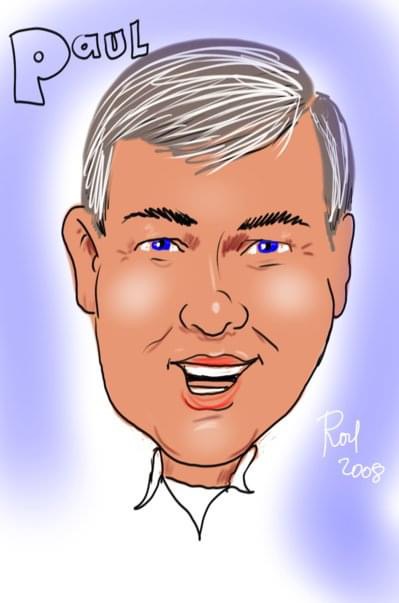
There are familiar credentials to accompany the career: eight patents, the IEEE Centennial Medal and the World Economic Forum’s Tech Pioneer Award. They belong in the account. So does the caricature included on his Canadian semiconductor conference profile.
Signed and dated 2008, the drawing supplies a large smile and rather more visual freedom than the standard executive portrait permits. After a procession of committees, acquisitions and integrated circuits, a cartoon is excellent company.
The professional story continues around it. Russo’s name appears on 2026 investor-conference programs, and K2X’s current team page still places him in the chairman and CEO’s seat. His work has moved from designing and building to evaluating and organizing, carrying a long acquaintance with technology into each new assignment.
There is something appealingly practical about where that leaves him: considering other founders’ plans, with plenty of plans of his own already behind him. A newspaper once interrupted the journey to work. He has found a considerable amount to do since.