Patrick Sheridan once described an art student's dinner with admirable economy: a spoonful of barbecue sauce, accompanied by the thought of chicken. His K Street refrigerator had little to contribute. Years later, the co-founder of Modus Create would help fund opportunities for other art students. There is a pleasing symmetry here. The young painter who had to improvise his meals eventually acquired the means to support somebody else's education.
His career has involved a good deal of improvisation, though the underlying interest has stayed remarkably steady: making things people can use. Murals gave way to websites, websites to digital products, and a consulting business to a company spread around the world. In October 2025, after fourteen years as CEO, he handed the job to Sharon Lynch and was announced as chairman. A completed chapter, perhaps. Sheridan has since found another blank page.
A fine-arts degree, with practical complications
At Corcoran, Sheridan moved from graphic design into fine arts. The sensible business of earning a living and the less easily budgeted business of becoming an artist were already negotiating terms. He worked on community murals, took a detour into architectural design, and returned to complete his BFA in 1999. Georgetown's MBA followed in 2009. The two degrees look like unlikely neighbors until one considers how much business depends on deciding what to make.
His working education included freelance graphics, an internship at the Natural History Museum, exhibition installation at the Kennedy Center, and assisting in Corcoran's printmaking department. These are useful preparations for a career in which an idea eventually has to survive contact with an audience. A drawing, an exhibition and an interface all ask someone else to understand what their maker intended. Software would give Sheridan a different material to work with.
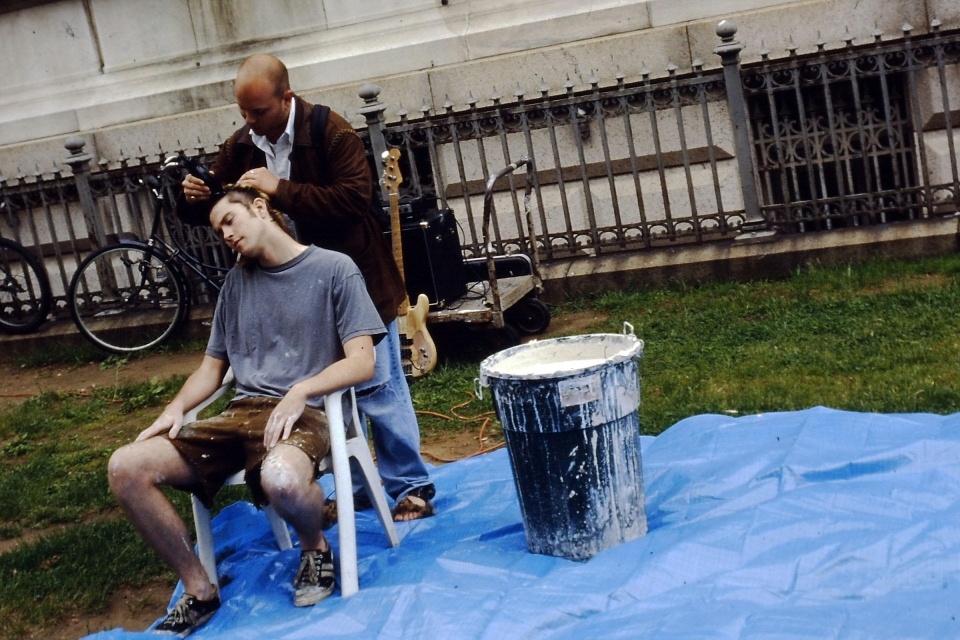
By 2022, he had committed $100,000 to an endowed scholarship bearing his name at Corcoran. The award supports an undergraduate with financial need. Grants and scholarships had helped him study; now he could help extend that chance. There is something particularly apt about a software founder supporting a fine-arts education. His own route suggests that a discipline can be valuable well beyond the profession printed beside it in a prospectus.
Two makers meet in a forum
Sheridan and Jay Garcia met through the Sencha Forums in 2008. Garcia, an Air Force veteran and JavaScript author, brought a different background to the conversation. Their common ground was the pleasure of building. They worked together, pursued separate commitments, and reunited to found Modus Create in 2011. An online software community had produced a business partnership. It would also supply a model for the company they wanted to run.
The timing mattered. Smartphones were changing what customers expected from companies, and established businesses needed help responding. Sheridan had sold his earlier user-experience consultancy in 2009 and worked with publishers entering the phone and tablet market. He saw a change in consumer behavior arriving alongside a change in technology. A digital product could alter a company's relationship with its customers, which made the work rather more consequential than putting a respectable website in the shop window.
Early entrepreneurship also offered instruction in less glamorous subjects. An accidental double payment of federal taxes nearly emptied the business account. Sheridan recalled working daily with a bank manager to get through the cash squeeze. He also remembered arriving for New York pitches in business casual and discovering how formally even web designers dressed on Wall Street. One lesson concerned liquidity; the other concerned trousers. Both belonged to the curriculum.
The office was an idea
Modus took its organizational cues from open-source projects: people in different places contributing knowledge, solving problems and earning credibility through their work. Sheridan wanted that collaborative spirit inside a commercial firm. Remote work followed naturally from the model. A capable person did not have to move within commuting distance of a particular building before becoming useful. The challenge was to make distributed work coherent enough that clients could depend on it.
In November 2024, Sheridan described a company that had grown from three employees to more than 400 people across 65 countries. Those are dated figures, a snapshot of a particular stage. His argument was about the structure beneath them: give teams authority within their domains, make knowledge easier to share, and create opportunities for people to develop. He also defended in-person connection within a remote organization. An internet connection can carry the work; belonging still requires attention.
- 1999Fine arts
Corcoran BFA - 2009Business
Georgetown MBA - 2011Company building
Modus Create - 2025Leadership handoff
CEO to chairman
One example came in August 2024, when Sheridan traveled to Kyiv to visit his colleague and longtime friend Dmytro Kovalenko. He brought an Apple Vision Pro for experiments in product development. Kovalenko had stayed in Ukraine to support his family and country. Sheridan's account of the visit made a practical point about leadership across distance: executives need experience of the circumstances in which their colleagues actually work. Remote employment does not make geography disappear.
Growth acquires a price tag
Sheridan was thinking publicly about the mechanics of expansion long before the CEO transition. In a 2015 essay, he used geometry to describe startup growth, moving from the individual toward repeatable structures and then more complicated forms. He wrote about strengthening senior management, financial discipline, and preparing for acquisitions. The painter's vocabulary had picked up a balance sheet. Even the drawing needed to show where the money would go.
He also reflected on values as something learned through experience. Decisions that felt wrong, internally or with clients, helped clarify what should remain fixed as the business grew. That is a more convincing origin for company principles than an afternoon spent selecting agreeable nouns. Growth makes choices repeat themselves at greater scale. Deciding which choices deserve repetition becomes part of the founder's work.
In December 2021, Modus announced a growth investment from JLL Partners. Sheridan continued as CEO. The deal gave the company a partner for its next phase, and his public response emphasized the global team and client trust behind the business. Private equity entered a company whose identity had been shaped by open-source communities. Keeping a recognizable culture while adding new financial and operational demands would require more than a fond recollection of the early days.
Later, talking with Elizabeth Shea on Branching Out, Sheridan described growth creating demands a bootstrapped business could no longer comfortably finance. He explained how advisers helped the founders evaluate alternatives and select an investment banker. After the transaction, acquisitions became a way to add capabilities and strengthen partnerships. His name for the planning exercise was an M&A bingo board. A surprisingly homely phrase for a process with expensive consequences.
The questions survived the technology
Alongside running Modus, Sheridan became an interviewer of other people attempting change inside organizations. His Conversations with Chief Innovators series opened in 2022 with Audi Business Innovation's Andreas Sicheneder and Florian Beck. They discussed how an innovation unit could become strategically useful to a much larger business. The recurring concern was the relationship between an experiment and the organization expected to benefit from it. A clever project needs somewhere to belong.
The conversation widened to leaders such as OneMain Financial's Larry Fitzpatrick and Harrisburg University's Jay Jayamohan. Finance, cars and higher education present different constraints, but Sheridan kept returning to how people organize around technology. Those interviews offer a portrait of his professional interests: the machinery matters, and so do the people permitted to use it, the decisions they can make, and the customers whose lives the resulting product enters.
His own writing grew increasingly concerned with AI. In February 2024, he argued that customer strategy and developer experience still deserved attention amid the excitement. In January 2025, he drew parallels with the mobile boom and encouraged organizations to improve AI fluency. By May, he was writing about why promising pilots stall: unsuitable infrastructure, untidy data, unclear outcomes and teams without the necessary skills. The new technology had inherited some decidedly familiar management problems.
“I make things.”
Patrick Sheridan, LinkedIn profile
A smaller canvas, deliberately chosen
The October 9, 2025 succession announcement put Sharon Lynch in the CEO role and Sheridan in the chairman's seat. Lynch came from leading Slalom Build's organization across the Americas. Sheridan welcomed her appointment and expressed confidence in her ability to carry the culture forward. The business he and Garcia had founded would have another chief executive. For a founder, leaving room for somebody else to lead is its own kind of design decision.
His subsequent venture, Sirideain Ventures, asks a question about scale from the opposite direction. Its founder describes an experiment in building with one operator and AI doing work that once required a larger team. He believes cheaper software creation changes which businesses can exist. That is his investment thesis, still being tested through products and investments. The appeal is recognizable: a change in tools might make room for a different kind of company.
The portfolio ranges from Photo Time Machine, an application for dating scanned family photographs, to KissyKat Games Studio. It also lists angel investments in water-management technology, AI governance and an AI study tool. The cats introduce a welcome note of frivolity to a page otherwise populated by serious business questions. Sheridan also mentions his 1969 Volkswagen Beetle as a perfectly reasonable alternative occupation. Apparently, an old car has competition for his attention.
From an art-school performance to a distributed consultancy, then back to experiments at a smaller scale, the pleasure of making remains visible. The scholarship connects his work to the students who may take equally circuitous routes. The new venture gives him somewhere to test his next ideas. He has already built an organization substantial enough to hand over. Now he gets to find out what he can make when the canvas is small again.