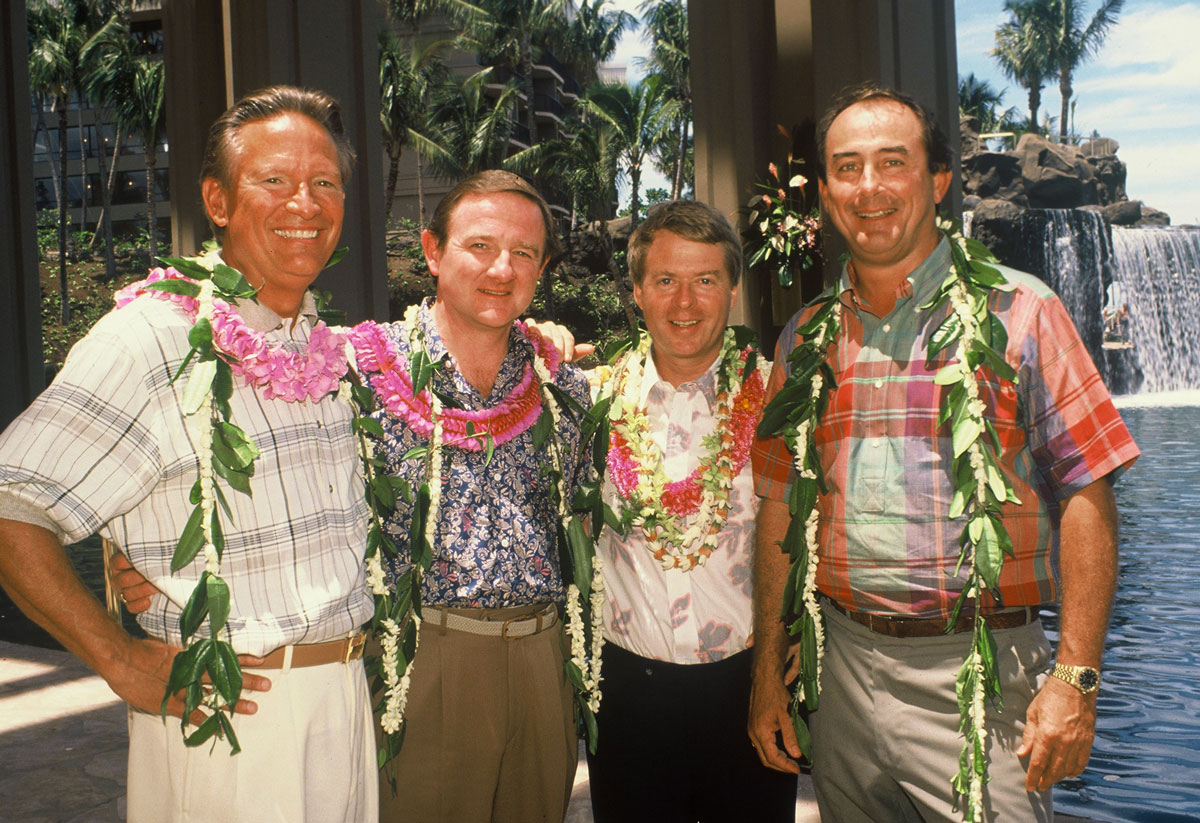
At the opening of Hyatt Regency Waikoloa in 1988, Patrick Cowell stood for a photograph with flowers around his neck. Beside him were developer Christopher Hemmeter, Hyatt president Darryl Hartley-Leonard, and Waikoloa Land Company president Thos Rohr. The setting was lavish. The shirts were cheerful. Cowell, third from the left, had a job whose less photogenic side involved making a resort work once the opening celebration was over.
That photograph makes an unexpected starting point for someone associated with Workday. Cowell is an advisor to the software company’s CEO. Yet the earlier chapters take place in hotel lobbies, airport businesses, and stores selling things people intend to use in their kitchens. Before the advisory titles came a succession of operating jobs, each with its own practical obligations.
The route is worth following in its actual order. Otherwise, an affiliation with a technology company can flatten a working life into a technology biography. Cowell’s experience reaches across several industries and more than one kind of customer encounter. A hotel guest checks in. An airline passenger passes through. A shopper pauses at a display. Each encounter gives a business a small, immediate examination.
A long apprenticeship in hotels
Cowell attended East Tennessee State University from 1967 to 1971. His Hyatt career followed in the early 1970s and continued until 1994. That is a substantial stretch of time to spend within one company before a résumé starts changing industries. The later executive appointments are easier to understand when placed beside this extended first chapter.
His Hyatt responsibilities included Hawaii resort management. He was regional vice president of Hyatt Resorts Hawaii and managing director of the Waikoloa property. In 1993 and 1994, he served as divisional vice president of Hyatt’s Western Division. The sequence takes him from the running of a particular resort toward responsibility across a wider operating territory.
Waikoloa supplied an unusually theatrical setting for that work. Getting guests to their rooms could involve a boat or a tram. It was the kind of property where transportation within the hotel became part of the holiday. A guest could arrive expecting accommodation and find that the journey from reception had acquired a plot.
Cowell understood the appeal of something a traveler could describe afterward. He put it with a distinctly social sense of humor: “Can’t you imagine that kind of story in the Des Moines bridge circle?” The observation gives the grand setting a human scale. The resort might be in Hawaii; part of its audience was waiting back home, ready to hear how the trip went.
That distinction between an impressive place and an experience worth recounting offers a useful way to read the photograph. Buildings have opening dates. A guest’s experience is made again with every stay. The celebration marks a point on the calendar; the operating responsibility continues after the leis have been put away.
From the resort to the airport
In 1994, Cowell moved to Sun International Hotels and Resorts as president for the Americas and Caribbean. He remained in that role until 1996. His responsibilities belonged to another regional hospitality business, extending the hotel chapter beyond the Hyatt organization in which he had spent more than two decades.
The work included the expansion and redevelopment of the Paradise Island resort in the Bahamas and planning and redevelopment connected with the Mohegan gaming project in Connecticut. These were physical places with development work attached to them. A title such as regional president can sound abstract until the geography and the projects are restored to the sentence.
Then came a change of industry. From 1996 to 1999, Cowell was president and CEO of Airport Group International. The traveler remained in the picture, but the setting had shifted. A resort is a destination. An airport is generally somewhere people hope will help them get to one. The operating context, and the expectations brought into it, are different.
His airport leadership coincided with international interest in private airport management. Cowell commented publicly on the spread of airport privatization across countries. This placed him in a business shaped by international contracts and changing approaches to ownership and operation, rather than solely by the hospitality setting of his earlier career.
It is tempting to make every career move sound inevitable in retrospect. This one is more interesting when its differences remain visible. Hotels and airports both serve travelers, but that does not make them interchangeable businesses. The move brought an executive trained in hospitality into another part of the travel economy, with another set of demands.
- HyattHotel operations
- Sun InternationalRegional presidency
- Airport Group InternationalPresident & CEO
- Williams-Sonoma brandBrand president
- KKR & WorkdayAdvisory work
A shop window on Union Square
By 1999, Cowell was president of Cowell Development. In March 2002, another kind of operating responsibility arrived: the presidency of the Williams-Sonoma brand. The distinction matters. This was a named brand within Williams-Sonoma, Inc., whose businesses also included other retail names. His title concerned the Williams-Sonoma brand itself.
The terms of the new job were precise. His employment agreement began on March 4, 2002, with an initial three-year period and provision for annual extensions. He would report to the chief executive. The role called for substantially all his working time, with business travel as needed. There was relocation support for moving to the San Francisco area. The change of industry came with the ordinary practical arrangements of taking a new job.
There were also details that could only make sense in a retailer’s executive package. Cowell qualified for a merchandise discount: 40 percent on catalog and retail purchases, with a lower discount for electrics and sale goods. His monthly car allowance was $500; parking would cost him $100. Even a brand president had a parking bill. Among the formal provisions about duties and compensation, that small line brings the office commute into view.
The appointment put him in a business whose customer experience could begin with a shop window. During his presidency, Williams-Sonoma planned a three-story flagship at 340 Post Street, on San Francisco’s Union Square. The location had previously housed Bullock & Jones. The planned store would replace the brand’s smaller location at 150 Post Street.
Union Square was dealing with vacancies and a decline in international tourism. A larger store in that setting represented a visible commitment to a particular location. Cowell saw a benefit in the building’s continuous presence on the square. The shop could keep doing a kind of work even when nobody was standing at a cash register.
“It’s a great 52-week-a-year billboard.”Patrick Cowell, on the planned Union Square store
The phrase is economical, and rather good retail arithmetic. A prominent store is both a place of transaction and something people see as they go about the city. Cowell’s comment treated the address as part of the brand’s public life. The larger footprint offered more than additional room for merchandise.
There is a pleasing change of scale between the Hawaii opening photograph and this San Francisco shopfront. One belongs to a resort landscape; the other to an urban square. Both put the executive’s work inside a place customers can enter. Whatever a business says about itself, a person eventually arrives and looks around.
What an advisor brings into the room
Cowell’s later career includes senior advisory work at KKR and an advisory role to Workday’s CEO. Those appointments began in 2010 and 2014 respectively. KKR’s advisor directory identifies him through his earlier presidencies at Kerzner Hotels in the Americas and the Williams-Sonoma brand.
That description is revealing in a modest, practical way. It puts operating experience beside the advisory title. The earlier jobs remain part of how he is introduced. A person can move from running a business to advising one without the previous responsibilities disappearing from the professional picture.
Workday adds enterprise software to a career previously associated with places, travel, and retail. Cowell’s educational background also includes an MBA from California Coast University. Together with his years in operations, that business education forms part of a professional history spanning regional management, company leadership, brand leadership, and advice to executives and investors.
Seen across its full span, the sequence resists a tidy industry label. His Hyatt years were long. His later appointments changed the setting repeatedly. Hospitality gave way to aviation, then retail, followed by advisory responsibilities. The continuity lies in a working history of operating and leading businesses, even as the businesses themselves changed.
Return to the Waikoloa photograph, and its usefulness becomes clearer. Cowell appears amid the flowers and the assembled leadership, at the beginning of a resort’s public life. Decades of subsequent titles lie ahead. For the moment, there is a place opening its doors and a manager whose work will continue when the photographer has gone.
That is a fitting image to keep beside the current advisory role. It gives a face and a setting to an otherwise compact professional description. Before there was advice to offer, there were businesses to run, people arriving with expectations, and the ordinary next day after an opening celebration.