Before Pat Gallagher became the chief executive, his grandfather put him in a chair and asked how it felt. Arthur J. Gallagher had founded the insurance business in 1927. His grandson would eventually inherit responsibility for a company carrying the family name, along with a family instruction considerably shorter than most corporate mission statements: “Don’t screw it up.”
There are more elaborate preparations for leadership. There are probably less effective ones. The instruction leaves little room for misunderstanding, although it does leave the recipient to work out precisely what must be preserved. The name? The customers? The way colleagues behave when somebody needs help?
Gallagher has spent much of his working life answering that last question. He became CEO in 1995 and chairman in 2006. The business has expanded through hundreds of acquisitions. Yet the object he keeps returning to is a set of 25 principles his uncle wrote down in May 1984. A company can buy another company. Persuading the people inside them to trust one another takes longer.
The intern with the familiar surname
His beginning was both ordinary and conspicuously unusual. Gallagher entered the internship program in 1972. Three of the four interns that year were cousins. The family connection was hardly hidden behind an anonymous application number.
He joined full time in 1974 as a production account executive. At that point, by his later recollection, the firm had 125 people and annual revenue of $6 million. That is a scale at which a workplace can still feel like a place: people with recognizable voices, habits and customers, rather than names arriving through a directory search.
His degree was in government, from Cornell. The work ahead involved selling insurance, learning operations and eventually coordinating an organization that would reach far beyond Chicago. He became vice president of operations in 1985, joined the board the following year, and became president and chief operating officer in 1990.
One piece of advice from his grandfather survived the promotions. Gallagher has recalled receiving it in 1974: “Plan your work, and work your plan.” It is wonderfully resistant to being turned into a fashionable management theory. There is a task, a plan and the obligation to return tomorrow.
Twenty-five rules, and very little jargon
Robert E. Gallagher, his uncle, wrote The Gallagher Way in 1984, the year the company went public. His father, John, helped distribute and promote it. Pat inherited a family business with an unusually explicit account of how its people were supposed to behave.
The document gives professional courtesy the same seriousness that other businesses reserve for quarterly targets. It asks people to help one another and recognizes that everyone’s work matters. It also describes a competitive company. Warmth and ambition are expected to share an office.
“Fear is a turn-off.”
Tenet 17, The Gallagher Way
That little sentence does a surprising amount of work. A frightened employee has reasons to conceal a mistake, postpone an awkward conversation or keep a useful contact to themselves. The principles put a different expectation into writing. Leaders have to earn cooperation; a title alone does not supply it.
Gallagher has repeatedly described maintaining that culture as a particular source of pride. As the business grew, he recalls being told that its family feeling would disappear at the next threshold: 500 people, then 1,000, then 2,000. The numbers changed. The prediction kept coming back.
His answer has been to treat cooperation as something people practice. An instruction to collaborate will not, by itself, make a colleague in another country answer a request for help. Hiring, acquisitions and the example set by managers all bear on whether that request receives a useful response.
Buying businesses means meeting their people
Acquisitions are where this philosophy becomes expensive enough to test. In a 2026 conversation with Al Sica, Gallagher put the overwhelming share of his acquisition due diligence on culture. He was describing his own approach, rather than offering an independently measured recipe. He wants successful businesses led by people who enjoy the work and can fit with the organization.
He has also acknowledged mistakes. Looking back in 2017, he singled out acquisitions in which he had overridden his own judgment. The consequences were personal as well as financial: disappointed entrepreneurs, revenue that failed to materialize and management time absorbed by a relationship that did not work.
That admission matters because the polished acquisition story normally ends with the announcement. His version has an uncomfortable second act. Two groups must actually work together after the advisers have gone home. An entrepreneur who expected one kind of future can find themselves living another.
In describing his model, Gallagher emphasizes local authority and a consistent culture across the wider business. The attraction is straightforward: preserve the relationships that made a firm worth buying while giving its people access to capabilities they could not easily assemble alone.
The scale of the challenge grew again when Gallagher completed its AssuredPartners acquisition on August 18, 2025. The transaction expanded the firm’s middle-market business and added operations across the United States, Britain and Ireland. Welcoming colleagues is the pleasant part. Making the combined organization useful to them is the continuing assignment.
Quarter ended June 30, 2026 · year-over-year company figures
By the second quarter of 2026, those combined segments reported 24 percent revenue growth, including 6 percent organic growth. The distinction matters: some growth arrives through buying businesses, and some through the work of the existing organization. Both require attention after the celebration.
Making the case for an unfashionable business
Gallagher is an enthusiastic advocate for an industry that rarely gets thanked during a quiet week. His favorite description is succinct: “Insurance is the oxygen of commerce.” The phrase reveals how he thinks about the job. Insurance makes it possible for people to undertake things whose risks they could not comfortably carry alone.
In September 2026, he was still making that argument, talking about everything from ordinary purchases to satellites. He described a market in which different types of coverage respond differently to available capital and the risks being insured. Explaining those differences to customers remains, in his telling, a central responsibility of the broker.
It is a useful glimpse of the salesman beneath the chairman’s title. He wants the customer to understand the purchase. A policy is easier to resent when it looks like a compulsory bill. The adviser’s job includes explaining what the customer is receiving, where protection ends and why the terms change.
His international connections also have a distinctly personal chapter. In 2007, he received Freedom of the City of London for his contribution to the Lloyd’s insurance market and support for the Gallagher Lifelong Learning scholarships. The recognition tied commercial relationships to education, a recurring interest in his public career.
A florist, three trucks and a computer
Artificial intelligence has given him a newer version of the familiar question about whether the broker will still be needed. In his 2026 discussion with Sica, he recounted a colleague’s experiment involving an invented florist with several employees and three trucks. The colleague asked a chatbot what insurance the business should buy.
What followed was a multiplying list of coverage requirements. A seemingly simple business turned out to contain several different kinds of exposure. Gallagher’s conclusion was that automation could take over repetitive work and leave professionals more time for advice.
That is his forecast, and it will have to meet the evidence of customers’ choices. It also fits his larger management instinct. Useful tools should help the people who know a client do their work. Whether the new resource is another acquired specialty team or faster software, he returns to the relationship at the center of the transaction.
The chairman stays after class
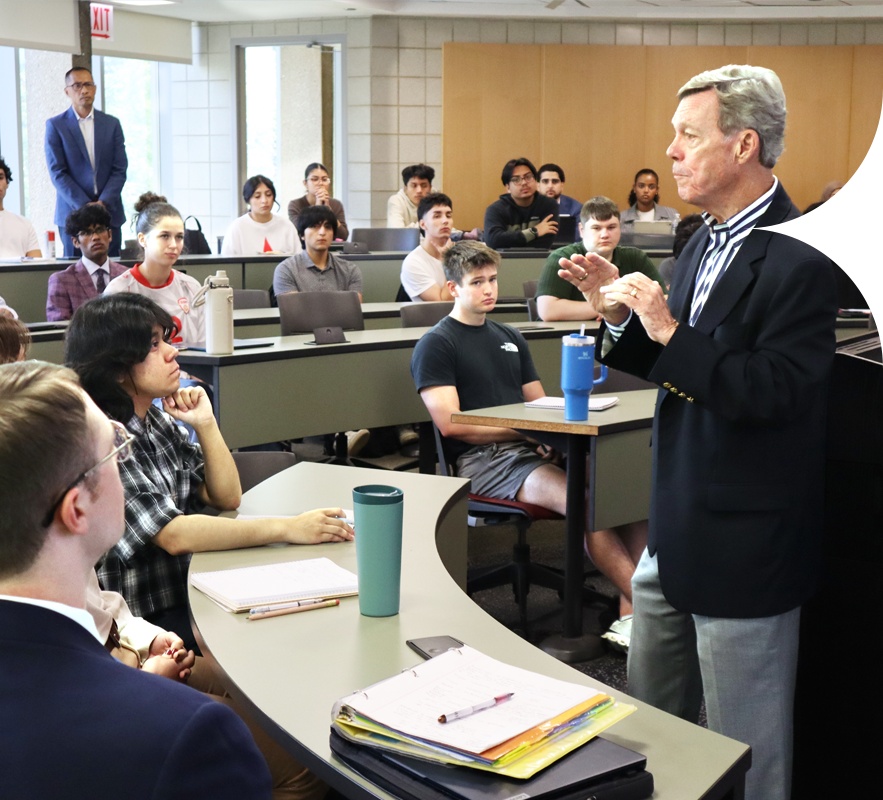
A September 2026 visit to the University of Illinois Chicago offers a smaller setting for those ideas. Gallagher spoke to the Executives in the Classroom course, hosted by Mel Diaz. He organized his leadership advice around HEART: humility, ethics, attitude, respect and trust.
There were questions during the session and conversations afterward. He stayed to keep answering. For someone whose career began among a handful of interns, the scene has a pleasing continuity. There are more people in the room now, and the questions come from a generation with different tools. He still seems interested in the conversation.
That interest had another public outing in June 2025, when Robert Reiss interviewed him before an audience of 500 Gallagher interns. The former participant had become the subject at the front of the room. The distance between those two seats measures a career rather neatly.
Chicago also supplies a less solemn detail. Gallagher is a Cubs fan. Discussing the club’s 2016 World Series victory the following year, he joked about the quantity of ballpark hotdogs he had consumed during the playoff run. Decades of assessing risk apparently leave room for a baseball season to get out of hand.
His career has acquired the usual markers of seniority: board service, industry honors, a chairmanship. But the more revealing scenes remain modest ones. An account executive receiving advice. An acquisition that did not work. A chief executive waiting for another student’s question. The family name may be on the business. Keeping people willing to work together is still a daily job.
Keep the conversation going
- Gallagher · official biography
- Pat Gallagher · personal LinkedIn
- Chicago CEO Series · watch on YouTube
- Map Left Behind · listen to the conversation
- Sica | Fletcher · Leaders & Legends interview
- The Insurer TV · September 2026 interview
- UIC Business · classroom visit
- Semafor · the family business and acquisitions
- Gallagher · corporate YouTube
- Gallagher · corporate Instagram
- Gallagher · corporate X
- Gallagher · corporate Facebook