Mango jelly is an unusual exhibit in a business consultant’s portfolio. So is a dog’s medical record. Partnerhub Thailand has a claim to both: an investment in Thai food manufacturer HNK and a role building AnyVet, a veterinary technology platform. Together, they make its sprawling service list easier to understand. This is a company trying to sell knowledge acquired by putting businesses to work.
For Korean and other foreign companies looking at Thailand, Partnerhub offers help with the unromantic parts of expansion: company setup, local operations, marketing, software and, increasingly prominently in its current pitch, product registration and imports. The attraction is practical. A business can have an attractive product and still need someone to handle the sequence between arriving in a market and making a sale.
The interesting question is how much those different activities reinforce one another. An animal hospital, a software platform and a food factory create opportunities to learn about customers and distribution. They also make for a complicated company. Partnerhub’s case is most convincing when it gets specific about the work.
A dog’s chart makes the pitch tangible
AnyVet is the clearest example. In January 2025, Partnerhub announced that the project had received approval from Thailand’s Board of Investment, or BOI. Its announcement described a collection of connected services: remote veterinary consultations, electronic medical records, imaging systems for animal hospitals and a microchip data center.
Those are different jobs for different users. A pet owner wants access to a veterinarian. A hospital needs to retrieve records and images. An identification system needs to connect an animal to information that remains useful beyond a single appointment. The project’s scope places Partnerhub close to the everyday work of running veterinary services, rather than leaving software as an abstract item on a capabilities page.
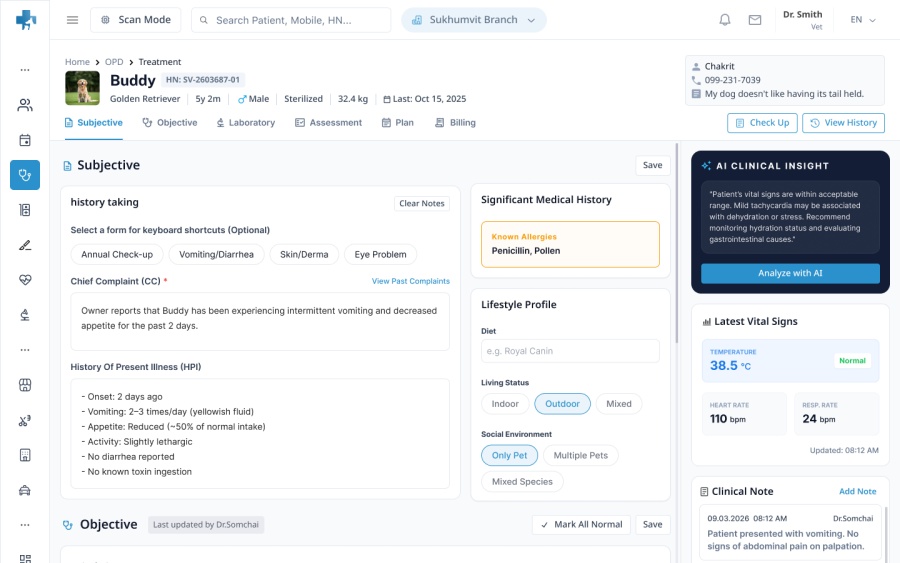
The current AnyVet website presents three connected products: hospital-management software, microchip registration and a pet-owner app. It advertises more than 880 partner animal hospitals and more than 110,000 microchips. Those are AnyVet’s own reported figures. They describe the platform’s reach, not the number of companies paying Partnerhub for consulting.
There is a consumer product to inspect, too. The Android listing describes video consultations, an online pet shop and membership benefits. Its recent release notes concentrate on ordinary software maintenance: smoother video calls, more reliable chat, appointment notifications and improvements to shopping flows. That detail is revealing. A veterinary platform has to make the call connect and the message arrive before its larger ambitions can matter.
Two hospitals behind the software
Partnerhub describes operating two Happy Pet Hospital locations in Bangkok. The hospital’s own site lists Sukhumvit and Ratchada branches, both offering round-the-clock care. Its services range from diagnostics and surgery to grooming, pet transport and boarding. The combination gives the veterinary venture a physical setting as well as a digital one.
The hospital also supplies a concrete example of Partnerhub’s development work. In a public account of the project, the company described designing Happy Pet’s website around mobile use, readability and the hospital’s Korean-influenced visual identity. The work involved choices about navigation, typography and how people would use the information. A prospective software customer can understand that assignment without needing to decode a list of technologies.
There is a plausible commercial connection here: working around hospitals can expose a developer to problems that a distant design brief misses. That is an interpretation of the structure, not a measured claim about better software. The useful evidence is the existence of the work and the operating relationship.
“People who have built businesses themselves in Thailand.”
Partnerhub’s company-page heading, translated from Korean
The veterinary work also appears in a modest, specific community activity. Partnerhub reported supporting AnyVet and The Voice Foundation in microchipping 58 shelter dogs on September 12, 2025, at a disabled-animal shelter in Bang Len. The post framed identification as part of giving the dogs a safer route toward adoption. It is a small example, but an understandable one: the technology has a use beyond a hospital dashboard.
Then there is the mango jelly
In October 2024, Partnerhub announced an investment in HNK, a Thai startup making mango jelly. The product uses Mahachanok mangoes, and the announcement described HNK supplying GS25 convenience stores in Korea. That gives the cross-border story a pleasing reversal: alongside helping Korean businesses enter Thailand, Partnerhub backed a Thai producer selling into Korea.
The stated purpose of the investment was to support production-facility expansion and access to larger markets. Partnerhub’s current company materials also point to HNK’s food-manufacturing operation and placement with The Mall Group as evidence of experience in food registration and distribution.
For a prospective food-brand customer, this is a more concrete reference than a general promise of regional expertise. Factory capacity and retail placement are recognizable commercial tasks. The HNK connection does not establish that another product will sell, but it gives a buyer a specific case to discuss: what work was done, which channels were involved and which parts might carry over.
The name on the paperwork matters
Partnerhub’s current website puts registration, license holding and imports at the center of its offer. It describes handling cosmetics, food, medical devices and pet food, then connecting the approved products with sales channels. The service is aimed at brands that want to reach Thailand without assembling every local function themselves.
Its importer-of-record guide explains the proposed arrangement: Partnerhub acts as the named importer and handles the import process under that structure. The company emphasizes putting the treatment of registration materials and the procedure at contract termination into writing. That emphasis makes control of documents part of the sales conversation.
The commercial logic is straightforward. A brand needs to know who is responsible at each stage and what happens if the relationship ends. Partnerhub packages those stages together. For a buyer, the practical lesson is to ask for the responsibility map at the beginning, while there is still time to change the proposed arrangement.
Pet food illustrates why categories matter. Partnerhub’s dedicated guide describes a separate route through the Department of Livestock Development, with an import license and product registration treated as distinct pieces. It also pitches access to a veterinary distribution network. Administrative work and channel development meet in the same offer, but completing one does not automatically complete the other.
The starting price is the opening line
Partnerhub publishes a fee schedule. Registration starts at THB 6,000 for cosmetics or food, THB 12,000 for pet food and THB 24,000 for medical devices. Its annual license-holding and maintenance charges are listed separately: THB 18,000 for the first three categories and THB 30,000 for medical devices, on the units specified in the schedule.
Published registration starting fees / THB
Different categories use different billing units. Annual holding, government charges and other costs are additional. Published prices checked September 2026.
The published importer-of-record charge is THB 5,000 plus 1.5 percent of declared value. Translation, labeling, transport and customs-related expenses sit outside the core registration service scope. A starting fee therefore belongs in a larger launch budget; it is not a complete price for putting a product on a shelf.
That disclosure makes the business model unusually legible. There is an initial administrative service, recurring maintenance and an import-related charge. Historical consulting materials also describe project fees or retainers, while the HNK announcement demonstrates investment activity. These are distinct ways of earning money and participating in businesses, with different obligations attached.
A local address is only the beginning
Partnerhub’s indexed growth-service materials describe customers that already have a Thai company but still need sales, distributors or local business partners. One proposed partner-search process starts with 30 to 50 prospects, then narrows the list to five to 10 after checks on financial stability, reputation and capabilities. This is a stated service process, not a published conversion rate.
The same materials discuss Korean-brand positioning, local influencers and trade-show support. Its venture-building offer adds technology planning, development-team recruitment and product co-development. KON-TICKET, an associated concert and event-ticketing platform, broadens the operating references beyond animal health and food.
That breadth puts Partnerhub between several familiar alternatives: a market-entry adviser, a registration agent, a distributor and a development agency. Its argument is that connected experience can reduce the work a client has to coordinate. A buyer should still decide which of those jobs the project actually requires.
The staffing picture has similarly practical details. Partnerhub’s JobThai recruitment listing advertises health insurance, annual leave, weekends and public holidays off, along with performance-related pay increases and bonuses. An accounting vacancy fits the less visible side of its service range: somebody must maintain the records while other teams work on products and promotion. Those advertised benefits describe the employment offer, rather than proving a particular workplace culture.
Copy the sequence, check the fit
The most transferable idea is the sequence. Define the product and category. Establish who handles the documents. Price the continuing work. Identify a plausible sales channel. Partnerhub’s current offer makes those steps visible enough to discuss separately, even when one company proposes doing them all.
The arrangement is most relevant to a business that needs local execution across several of those steps. A company with an established Thai team and distributor may need only a narrow assignment. A brand whose customers sit outside the advertised channels should examine the channel fit before assigning much value to network size.
The operating ventures deserve the same precision. Hospital participation is useful context for veterinary software; HNK is relevant experience for food production and retail. Neither is universal proof of market demand. The work is in identifying the transferable part of each example.
Partnerhub gives prospective customers something concrete to inspect: an application, hospital operations, a named food investment and a published fee schedule. For a company selling help with unfamiliar territory, those are useful exhibits. The next conversation can begin with a product, a process and a price.
Follow the work
Explore Partnerhub’s services and published prices; see the AnyVet products and Happy Pet hospitals.
Company updates: LinkedIn, Facebook and LINE. Read the announcements on HNK and AnyVet.