A Melbourne startup wants to sell abroad. Nearby, an international student wants a business to take their experience seriously. The startup has a product but questions about another country. The student has lived in that country but needs a practical assignment. Put them together and the ordinary language of international expansion becomes considerably less abstract.
This is the useful premise behind ACASE’s NexStar program. The Australia-China Association of Scientists and Entrepreneurs is a Melbourne not-for-profit, established in 2015, working on technology commercialisation across the Asia-Pacific. Its name sounds like a committee. Its programs ask people to produce something.
- NexStar: student teams research and pitch a business’s market-entry strategy.
- Nexus: Australian startups meet Asian market networks, mentors and establishment support.
- Asia Market Sprint: workshops turn an expansion idea into a plan founders can present.
The student was already a market specialist
NexStar began in 2018 with the City of Melbourne. Its appeal rests on a small rearrangement of status. A student’s background becomes relevant to a business problem, rather than an interesting detail at the end of a résumé. Teams conduct research, learn from experts, work with mentors and present their strategy to businesses and judges.
The learning runs in both directions. Students get a company whose decisions matter. Businesses get people who can bring another country’s assumptions into the discussion. Familiarity is a starting point for research, of course, rather than permission to generalise about millions of consumers. The program supplies the discipline: investigate, compare and explain.
NexStar’s published cumulative figures. They describe participation, rather than sales generated.
A market plan has to leave the classroom
The 2019 cohort shows the machinery. NexStar accepted 105 students from eight Victorian universities, representing 19 regions. It selected 13 startups from 33 applications on the basis of global market readiness. The businesses covered digital technology, manufacturing, education, life sciences and finance.
The endpoint was a go-to-market report and a pitch deck. That detail matters. A pleasant conversation can remain pleasantly inconclusive; a report demands choices about a destination and an approach. A pitch makes those choices available for challenge. The founders have to explain their businesses, and students have to make their research useful to someone beyond a marker.
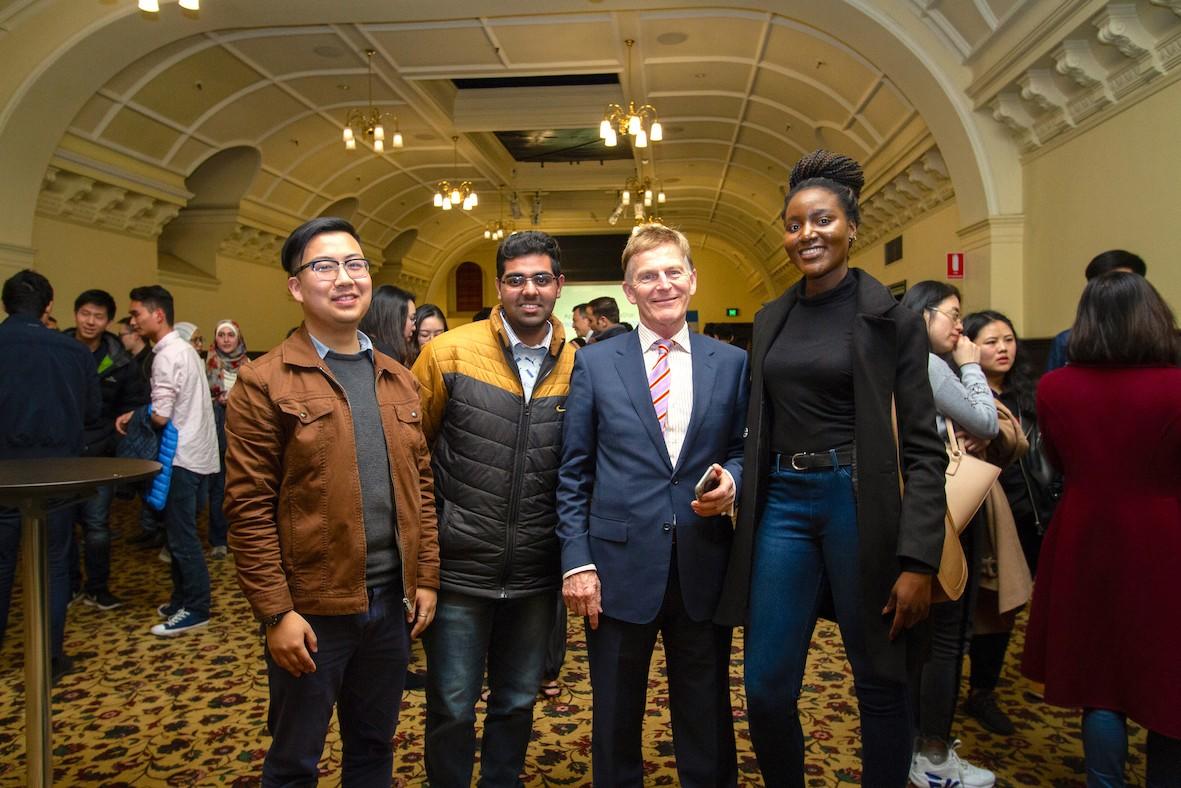
PwC joined ACASE and the city in delivering that cohort, with support from Study Melbourne, DLA Piper and La Trobe Accelerator. Education, professional services and startup support met around the same assignment.
The paperwork is part of the product
Nexus, launched in 2019, addresses the founder’s side more directly. Its original delivery partners included Melbourne and Nanjing Pukou High-Tech Zone, with Victorian Government support. The offering combines competitions, coaching, specialist market-entry advice, investment connections and establishment incentives.
It occupies the space between an accelerator, a market-entry consultancy and an institutional convenor. Its distinctive combination is the link to local counterparts, alongside preparation for doing business with them. For a founder, access is useful when it helps resolve a particular obstacle.
“it enabled KERB to simplify the process of incorporating a legal entity in China”Rob Brown, CEO of KERB, in a Nexus testimonial
That is an unusually concrete endorsement. Incorporation sits well beyond the applause at a pitch night. Nexus reports 216 participating businesses, more than 30 established in Asian markets and over 600 matching activities. These are different measures of work. They should stay separate: a meeting is not a company established, and neither automatically proves profitable expansion.
Five weeks, with somewhere to go
Asia Market Sprint supplies a shorter, intensive route. Designed by ACASE and InnoNex, with support from Runway HQ and Nanjing Pukou High-Tech Zone, its published example moves from an opening session to investors, local-government representatives, professional advice and a final pitch. The fourth week includes intellectual property, local business law and human resources.
- 01Open & scope
- 02Meet investors
- 03Local counterparts
- 04Professional advice
- 05Pitch the plan
The mentor list includes Shirley Shen, identified as CSIRO’s Asia Engagement Manager, and professionals in business development, international facilitation and investment. Follow-up services include business registration and financial and taxation assistance. The expertise is organised around the tasks that expansion creates.
Green Eco Technologies offers a tangible example of repeat participation. It joined the 2022 Sprint and won the Nexus 2023 competition on net-zero cities. Its WasteMaster system processes food waste on-site for customers such as hospitals and hotels. ACASE’s April 2024 account describes continuing assistance with the company’s Chinese market journey. A competition, here, belongs to a longer relationship.
The network has a return ticket
The traffic also runs towards Australia. NexStar’s 2025 Tianjin Sprint, scheduled from 19 November to 5 December, marked 45 years of Melbourne-Tianjin sister-city relations. Participating businesses included HelloRide Global and a company specialising in trenchless pipeline repair. Students were helping overseas businesses investigate the Australian market.
By September 2026, Nexus had turned its competition theme to AI applications for cities. The final at Melbourne Town Hall brought together seven projects; a Monash University team took first place. The Chinese Consulate’s account records more than 100 guests and co-hosts including Nanjing Jiangbei New Area and the Jiangsu Industrial Technology Research Institute.
The advertised package included up to $5,000 for first place and a fully supported Sprint spot. Prize money and program access are different benefits. For a founder, the sensible calculation includes the time needed to prepare and follow through.
Borrow the assignment
The transferable lesson is modest enough to use tomorrow. Choose one market. Find people who understand it. Give research a deadline and a deliverable. Put the result in front of someone who can question it. Then identify the local counterpart needed for the next action.
This approach needs a business ready to act on what it learns. Nexus 2026 explicitly asked for a growth strategy, early-stage investment and a commitment to commercialisation. A student report cannot substitute for regulatory clearance, funding or product demand. ACASE’s practical attraction is the structure around those questions. A foreign market becomes a set of people and decisions, with an assignment due.