The revealing thing about Parker Ence's career is not that he ended up in artificial intelligence. It is that he arrived there by way of guitar lessons, iPad apps, dental warranties, an economics degree, a data-company spinout and what he cheerfully calls “the smallest exit of all time.” The route is untidy. The taste behind it is consistent. Ence likes work that is important, repetitive and slightly neglected. He notices the administrative hour hiding behind the professional one.
At Jump, the Salt Lake City company he co-founded with Tim Chaves and Adam Kirk, that hour sits around a financial advisor's client meeting. Before the conversation, somebody needs to find the old notes, recent tasks and relevant account details. During it, somebody needs to listen without forgetting a beneficiary, a promise or a deadline. After it, somebody must update the CRM, write the recap, document the compliance record and make sure the next action has an owner.
None of this is cinematic. All of it matters. It is also an unusually good place to understand Ence: a founder more interested in removing friction than staging a robot coup.
The guitar teacher's ear
Ence's first real job was teaching guitar. It sounds like charming founder-biography garnish until you consider the underlying practice. A teacher listens for the missed beat, breaks a difficult passage into manageable movements and helps another person perform better without taking the instrument away. Years later, Ence would describe AI for advisors in similar terms: not a replacement for the professional, but an amplifier of preparation, presence and follow-through.
The University of Utah supplied the next chord. Ence studied economics there and has credited the campus's entrepreneurial culture with pulling him toward technology startups. Early roles took him through technology commercialization in the Utah governor's economic-development office and the student-run University Venture Fund. Then came Reef3, a software-development agency he ran with Chaves when iPad applications and search-optimized websites were the fashionable requests.
They built apps. They made websites for DirecTV. When Chaves left for business school, they sold the agency. Ence's joke about the microscopic exit works because it refuses the varnish usually applied to founder lore. The check may not have been legendary; the experience went from A to Z. Two collaborators learned how to begin, deliver and let go.
We sold that company in like the smallest exit in the history of exits.Parker Ence, recalling his first company with Tim Chaves
The pair wanted to work together again, but their calendars spent the next decade leapfrogging. Ence became the turnaround chief executive of Dental Warranty Corp in Dallas, learning the job, by his account, on the fly. He later completed an MBA at Stanford Graduate School of Business. A summer working in product marketing with an AI team at Google Cloud sharpened his interest in data and machine intelligence. After school he led Veraset, a data business spun out of SafeGraph, until its acquisition in 2023.
By then, Chaves had founded accounting-software company ZipBooks and worked through its path to Bill.com. Both men had collected a decade of operating scar tissue. In mid-2022, their timing finally matched.
The useful wrong turn
Experience did not grant them a perfect first idea. Ence has been refreshingly plain about this: their initial structured-note concept was “actually terrible.” The team also explored AI tools for B2B technology sales, complete with exuberant 1980s-style branding. Then a conversation with the advisory firm Solidarity Wealth helped redirect the product toward financial advisors and one stubborn piece of work: getting meeting information into a CRM.
This was less epiphany than what Ence calls running around an idea maze and bumping into walls. The phrase is worth keeping. Startups are often narrated backward, as if the product were hiding intact inside the founder's skull. Jump's early history is more honest. The team moved, listened, discarded and narrowed. Its advantage was not clairvoyance. It was the ability to recognize a more promising wall.
The product widened with the job
The CRM updater became a meeting assistant because the meeting is not a single event. It is a sequence. The advisor wants a briefing beforehand, accurate capture during the conversation and a near-finished set of notes, emails and tasks afterward. A generic transcript addresses one square on the checklist. An advisor-specific product has to understand the whole sheet.
Jump launched in its recognizable form in January 2024. Its product arrived as generative AI was moving from novelty to budget line, but its appeal was stubbornly concrete: process a meeting in minutes rather than spend the better part of an hour on administration. Integrations with the tools advisors already use made the promise less abstract. Custom templates let firms preserve their own language. Permissions and compliance controls acknowledged that these conversations contain information no clever demo can treat casually.
Presence is the product
Ence's recurring argument begins with attention. An advisor who is typing is not entirely listening. An advisor who worries about forgetting a distribution, a beneficiary or a promised introduction is mentally split. Good software, in this telling, does not make the meeting feel more technological. It makes the technology recede. The laptop closes. The client gets the room.
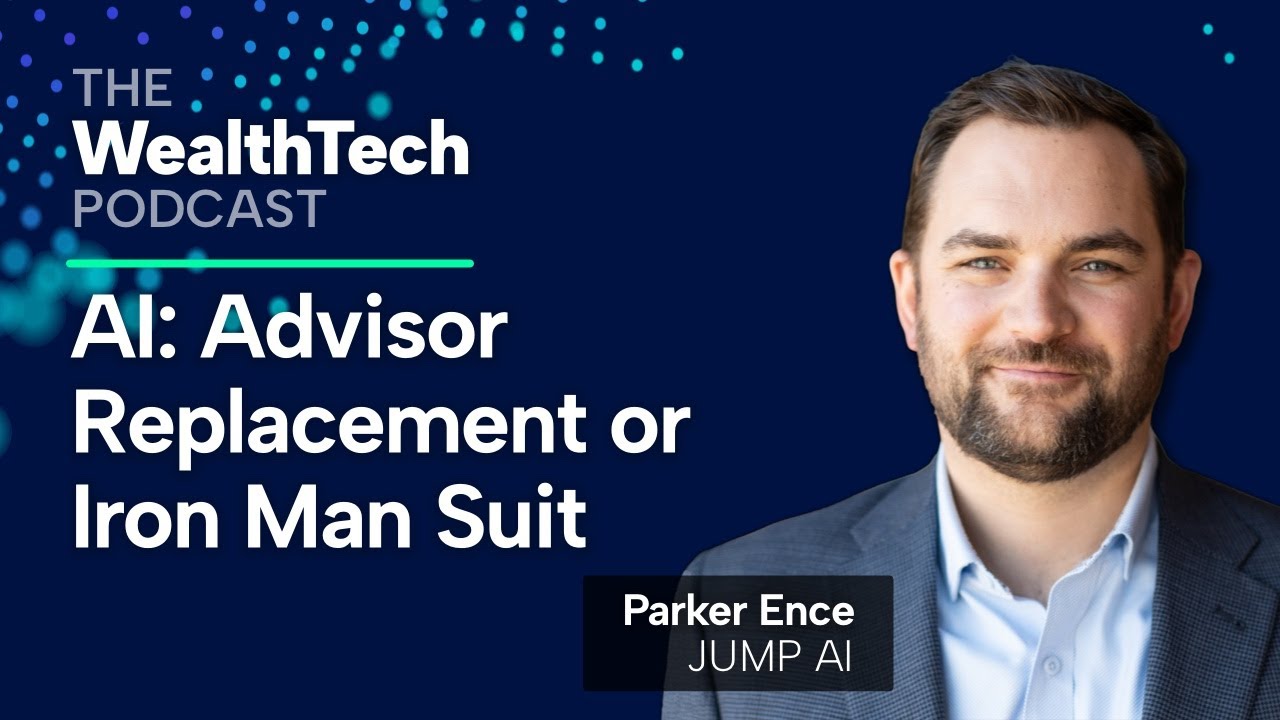
This is why his favored metaphor is an Iron Man suit. The advisor remains inside it. AI retrieves context, catches details and drafts the administrative residue. The professional reviews, decides and relates. Ence is not sentimental about adoption, however. His bluntest line to the industry is that advisors should worry less about being replaced by AI than about being outcompeted by advisors who adopt it faster.
Don't worry so much about getting replaced by AI. Worry about getting outcompeted by other advisors who are adopting AI faster.Parker Ence
The distinction is more than rhetoric. In finance, a useful system must behave inside institutional limits. Ence has emphasized that sensitive client information should not become training material for a general model. The company's pitch combines the enticing part of AI, a draft appearing quickly, with the unexciting architecture of retention rules, firm controls, review and auditability. The compliance layer is not a decorative moat. It is part of the job.
That practical framing helped the company travel quickly. Jump reported about 14,000 advisors using the product as of July 2025. At the announcement of its $80 million Series B in February 2026, it said the number had passed 27,000, with more than 2,000 joining each month. The round, led by Insight Partners, brought reported total funding to $105 million. In July, a return appearance on Jason Pereira's Fintech Impact described roughly 35,000 advisor users.
Builds and sells a small software agency with Tim Chaves.
Leads Dental Warranty Corp, a turnaround apprenticeship in insurtech.
Runs data company Veraset through its spinout and acquisition.
Reunites with Chaves, explores the idea maze and launches advisor-focused Jump.
Jump announces an $80 million Series B and its plan for a broader AI operating system.
After the notes
A wedge eventually becomes either a ceiling or a doorway. Jump is choosing the doorway. The company now describes three connected directions: meeting assistance, growth intelligence drawn from conversation data, and agents that perform work. Newer products cover onboarding and account-opening tasks. Scorecards can help firms study talk time, objections and whether meetings follow a desired standard. Signals may surface assets held elsewhere or another opportunity that appeared in conversation but never became a CRM field.
The ambition is to move from remembering what happened to suggesting what should happen next. Ence calls the destination an AI-native operating system for advisory firms, aimed at operational friction, organic growth and client experience. That is a much larger claim than automatic notes. It also follows the same logic as the original wedge: the conversation contains work, if software can structure it safely.
There is a useful founder lesson in the expansion. Jump did not begin by asking an industry to adopt a theoretical future. It began with a task people already disliked and a result they could inspect before clicking send. Trust accumulated in drafts, integrations and minutes returned. Only then did the roadmap widen toward intelligence and agents.
Ence's own career followed a similar rhythm. The guitar lesson came before the startup. The tiny agency sale came before the turnaround. The turnaround came before Stanford and Google Cloud. The data spinout came before Jump. Each chapter added a different kind of ear: for the student, the customer, the company in trouble, the dataset and finally the advisor trying to be fully present with a client.
AI discussions often drift toward the grandiose. Ence keeps returning to the checklist after a meeting. That may be the more revealing future. A machine does not need to dominate the room to change the work. Sometimes it only has to remember the beneficiary, prepare the recap and give a professional permission to listen.