A hotel can have nearly three thousand rooms and still run out of reasons to keep its owner interested. In June 2023, Park Hotels & Resorts stopped making payments on a $725 million loan secured by the Hilton San Francisco Union Square and Parc 55. Together, the properties contained 2,945 rooms. The remarkable part was the owner’s conclusion: keeping them was no longer worth the continuing burden.
- Park owns hotel real estate behind familiar brands.
- Its advantage depends on choosing where to spend, sell and stop.
- A renovation must repay both its construction bill and its disruption.
The $725 million decision
Thomas Baltimore, Park’s chairman and CEO, described a recovery obstructed by office vacancies, weak return to office and a disappointing convention calendar. His phrase was “clouded and elongated.” A large convention hotel needs people arriving together. Improving the curtains cannot put an absent conference back on the calendar.
What failed first was the demand assumption. In its 2019 results, Park had celebrated strength in Hawaii and San Francisco. By 2023, management judged the burden of the two San Francisco properties too large to keep subsidizing. That was a change in the expected usefulness of the buildings to their owner, driven by the market around them.
The financing mattered. The mortgage was non-recourse, with the two hotels serving as collateral. That structure helped define the decision available to Park. The hotels entered receivership in October 2023, and Park recorded an approximately $202 million impairment related to one of them. The $725 million was the loan balance, not a cash exit fee. Walking away still meant giving up assets and recognizing damage.
“San Francisco’s path to recovery remains clouded and elongated”Thomas J. Baltimore, Jr. · June 2023
The name on the door
To understand this business, follow the hotel sign. A traveler sees Hilton. The building may belong to Park. The brand supplies recognition, distribution and a loyalty system; a hotel manager runs operations. Park supplies ownership capital and scrutinizes what the property earns. These roles can overlap, but their incentives and obligations differ.
Park became independent on January 3, 2017, when Hilton spun off much of its owned real estate. Baltimore arrived with experience at Hilton, Marriott and RLJ. He had co-founded RLJ Development, not Park. His assignment was to turn an inherited collection of buildings into an independently managed investment portfolio.
The approximately $2.5 billion acquisition of Chesapeake Lodging Trust, completed in September 2019, broadened its brands, operators and geography. Today its properties include Hilton, Marriott and Hyatt affiliations, predominantly in luxury and upper upscale lodging. Comparable investment alternatives include Host Hotels & Resorts and Sunstone Hotel Investors. Park competes through the properties it owns, their locations and the work it does on them.
Guests buy rooms, meals and amenities. Meeting planners buy space and the convenience of putting everyone together. Shareholders buy exposure to those economics through Park’s NYSE-listed shares, ticker PK. Travelers usually book through the hotel or its brand. An investor evaluating Park has a different task: judging whether the owner is improving the earning power of its assets.
One useful measure is revenue per available room, or RevPAR: room revenue spread across every available room, including empty ones. Consider an illustrative hundred-room hotel. Selling eighty rooms at $250 produces $20,000 in room revenue and $200 in RevPAR. The empty twenty rooms remain in the denominator. A higher advertised rate alone cannot tell you whether the property is performing better; occupancy belongs in the same calculation. Food, drink and other spending then add another layer to the owner’s analysis.
A ballroom is a revenue engine
At Bonnet Creek in Orlando, the arithmetic becomes architectural. Park invested approximately $220 million across the Signia by Hilton and Waldorf Astoria complex. The program renovated 1,511 guestrooms and added 107,000 square feet of meeting and multifunction space. A bedroom earns from its occupants. A conference can also fill the ballroom, restaurants and neighboring rooms.
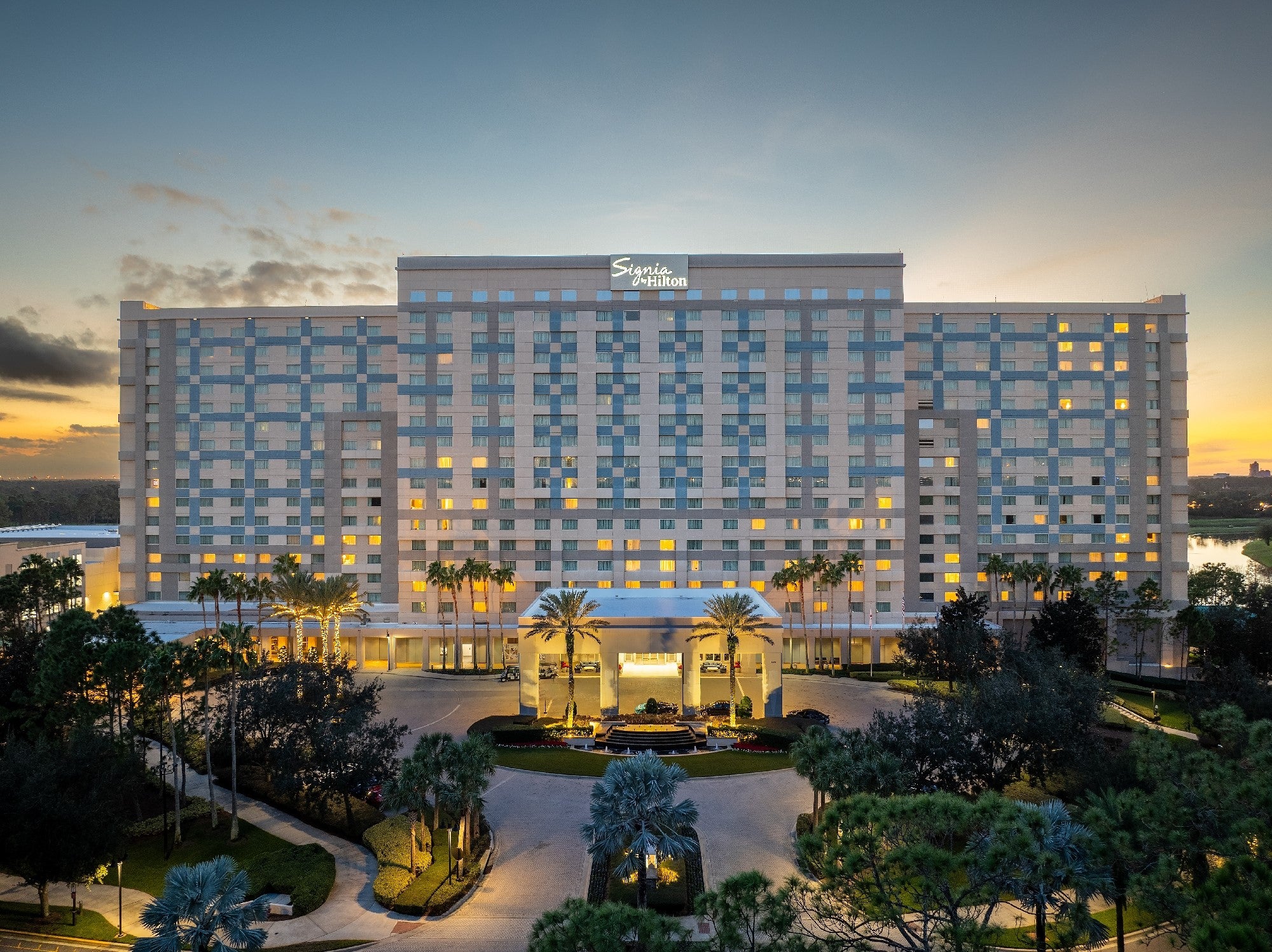
The work was tangible: upgraded bathrooms, new finishes, lighting and a transformed lobby. Project manager H-CPM describes changes extending to 17 sets of public restrooms. Hotel investment contains a surprising amount of plumbing. Guests may remember the arrival; owners must account for the machinery that makes the arrival possible.
For a meeting planner, putting rooms and gathering space together reduces a practical problem: moving hundreds of people between separate venues. For the owner, that same arrangement creates a reason to watch revenue beyond the room rate. A conference booking can bring several kinds of spending into one property. It also creates concentration risk. When a large group cancels, the missing business can reach the banquet kitchen as well as the guestrooms. The connected layout cuts both ways.
A prettier room has a hidden bill
Royal Palm South Beach Miami suspended operations in mid-May 2025 and reopened in July 2026 after a renovation costing more than $100 million. Those dates describe a second expense beyond construction: time without guests. In 2025, Park reported $2.541 billion of revenue, down from $2.599 billion a year earlier. Renovation disruption belongs in the investment calculation.
The reverse calculation appears in Seattle. In April 2026, Park sold Hilton Seattle Airport & Conference Center for $18 million. It had a short remaining ground lease and more than $25 million in anticipated capital expenditures. A sale price alone misses the future checks the seller no longer expects to write.
Some improvements barely appear in a guest photograph. ENERGY STAR’s account of Park’s 2023 work records $5.7 million allocated to eight large efficiency projects, alongside audits at 20 properties. Measuring energy use gives an owner another way to identify where capital can improve a building’s economics. The boiler deserves a place beside the ballroom in the discussion.
The next dollar has to earn its room
The useful lesson is a question an operator in another industry can copy: would you buy this asset today, including its next repair bill? Park’s decisions suggest comparing the cost of holding a property with the likely return from improving it, selling it or directing the money elsewhere. Historic size is a poor substitute for that calculation.
The conditions matter. Park’s financing structure helped make the San Francisco decision possible; another borrower’s guarantees could change the outcome. Renovations require cash, available labor and enough future demand to justify rooms taken out of service. Selling into a weak market can crystallize losses. Better buildings still need willing guests. Park’s work begins where the attractive resort photograph ends: deciding what those guests will pay for next.