A good game idea arrives without an invoice. Everything that follows has a price. Someone must build the thing, persuade people to try it, keep it working, and find a way to pay for tomorrow. Pany Haritatos has spent much of his career moving between those jobs. His latest company, Series Entertainment, rests on a proposition that sounds almost suspiciously considerate: perhaps the person with the idea should get to spend more time making it.
He has occupied enough positions in the business to understand the complications. He founded studios that were acquired by Zynga and Kongregate. He helped establish Kongregate's mobile publishing business, became its chief operating officer and interim chief executive, and later led games at Snap. These are different vantage points on the same awkward encounter between creative ambition and the machinery required to deliver it.
In 2026, his attention is on RUN, Series' platform for making and publishing interactive entertainment. It puts creation, distribution, and ways to earn money into a shared system. That combination matters to his story. A faster art tool might solve Tuesday's problem. A dependable route from an unfinished experiment to an audience could change whether a small studio survives the year.
Haritatos writes about his own beginnings with little romance. He remembers having ambitions and time, but few resources. Independence appealed to him because he wanted to make work with a point of view. Becoming another contributor to an endlessly repeated product held less attraction. Even before the executive titles arrived, the desired reward was a measure of creative control.
An audience before an acquisition
There is an early episode that helps explain the later career. In 2009, while running his own studio, Haritatos faced the problem of getting games discovered. Kongregate helped his games succeed, an experience he later connected to the studio's acquisition by Zynga. The platform had supplied something a developer could not simply code into existence: people willing to play.
By February 2013, he had moved to the other side of that relationship. Kongregate brought him in from Zynga as vice president of mobile to lead its $10 million Mobile Developers program. Backed by GameStop, the initiative offered funding, distribution, consulting, and marketing. The list was revealing. Money alone would leave several of a developer's hardest problems neatly untouched.
His approach was selective. The aim was to work closely with a limited number of developers and find games that suited Kongregate's audience. Early plans called for no more than one release a month. For someone now associated with accelerated production, it is a useful detail: at that moment, he was arguing for careful matching between games and players, rather than sheer release volume.
The first announced slate included Tyrant: Unleashed, BloodRealm, Sheep Happens, Endless Boss Fight, and Cardinal Quest 2. Developers could keep their intellectual property while receiving support in exchange for a share of royalties. It was a practical bargain around a stubborn fact. Finishing a game and building a business around it are separate accomplishments, however often the first is asked to perform both duties.
A game needs more than a game
The chair changes; the problem stays
Haritatos also founded the mobile studio Ultrabit, which became part of Kongregate. Its work included Raid Brigade and Pocket Politics; the studio later made Office Space: Idle Profits. A game based on a film about workplace absurdity makes a rather pleasing entry in the history of someone who would spend years trying to improve how game studios work.
Kongregate itself changed hands in 2017, when MTG agreed to acquire it from GameStop for an enterprise value of $55 million. Haritatos was part of its leadership during that period. The sequence deserves care: the acquisition preceded his turn in the chief executive's chair. When co-founder Emily Greer stepped down in May 2019, the company named its then-COO interim CEO.
The following year brought Snap. There, his remit extended across gaming strategy, content, engineering, product, and external developers. Games embedded inside a social application posed another version of the distribution question. Instead of asking a player to discover a separate destination, a game could appear inside somewhere they already spent time. The surrounding platform became part of the design problem.
Seen together, these moves form a career organized around access. Browser games, mobile publishing, and embedded games each offered a different entrance for developers and players. Haritatos's experience was accumulating at the junction where a new technical possibility meets a business arrangement. That is a useful education for a founder proposing to change both the tools and the route to market.
- 2013Kongregate’s mobile publishing program
- 2019COO to interim CEO at Kongregate
- 2020Head of Games at Snap
- 2023Founds Series Entertainment
- 2026RUN enters public beta
Build the workshop, then make something in it
Series began in 2023. Andreessen Horowitz's games team backed the company at seed stage, with Joshua Lu and Andrew Chen pointing to Haritatos's record across earlier changes in game development. His initial product, Rho Engine, approached generative AI as a collection of connected production capabilities. The ambition extended beyond producing an occasional image or an isolated piece of dialogue.
When Rho was unveiled in March 2024, the plan was to assist experienced developers across assets, scripting, and narrative. It was designed to work with established engines, including Unity and Unreal. Haritatos invoked Pixar as an organizational example: build useful technology, then use it to make the entertainment yourself. Internal production would give the tools an immediate, demanding customer.
That distinction gives Series a particular kind of exposure. A tool company can demonstrate an attractive workflow. A studio must persuade someone to keep playing. Combining the two means the quality of the finished work becomes an argument about the technology underneath it. A polished demonstration may open a conversation; a game has to survive the player's next opportunity to leave.
In July 2024, Series acquired Pixelberry from Nexon. Pixelberry's Choices: Stories You Play brought an established interactive-fiction business into the company. Haritatos described plans for larger books, more interaction, and improvements to story quality. The acquisition gave Series an existing creative operation and a community whose expectations had been formed long before its new owner's arrival.
By the third quarter of 2024, Series had raised a $28 million Series A. Dell Technologies Capital joined investors including Netflix, a16z, BITKRAFT, and F4. The money supported a company attempting to develop technology and entertainment together. It also enlarged the circle of people expecting Haritatos to turn a persuasive production thesis into work that customers actually wanted.
Capital raised by Series Entertainment. Company funding, rather than a measure of personal wealth.
A founder meets his own difficulty settings
His account of building Series is less serene than a funding announcement. During a compressed 60-day stretch in 2024, acquisitions, partnerships, and multiple projects arrived together. The systems and team were not ready for the load, he recalled. He calls the sequence of existential obstacles in a startup “killgates.” The vocabulary suggests a game designer who has inspected the business plan and discovered that the tutorial is missing.
“Starting a company is a full contact sport.”
Pany Haritatos · 2025
“Starting a company is a full contact sport.” It is an unusually physical description of work often conducted through screens. His concern also runs toward the responsibility of leadership: employees commit their time, investors commit capital, and the founder must decide with incomplete information. Confidence in a technology does little to simplify that obligation.
Series operates remotely across countries and time zones. Haritatos has described deliberate investment in onboarding and talent-management systems, alongside caution about hiring for work requiring close collaboration. Remote working, in that account, requires construction. Access to people around the world comes with the duty to make their work together coherent. Geography stops being a hiring boundary and starts becoming an operating responsibility.
There is a harder edge to the story as well. In March 2026, Pixelberry staff publicly reported layoffs, including writers with years at the studio. Those reports establish losses of jobs; they do not establish that a particular AI system caused them. They do place a concrete human consequence beside the promise of more efficient production. A profile of the founder needs room for both.
The next independent developer
RUN entered public beta in August 2026 alongside a $1 million Content Support Fund. The announced support included competitions, marketing, subsidized model use, and education. The resemblance to his earlier publishing work is striking. Thirteen years after Kongregate's mobile fund, Haritatos was again assembling help around the parts of a creative career that a compelling idea does not automatically solve.
The tools have changed. RUN's announced suite spans game, story, video, and adventure creation, with distribution and monetization in the proposition from the outset. The founder's stated ambition is to make independent creative work economically sustainable more quickly. That remains an ambition, rather than a guarantee delivered to every new account. A public beta begins the encounter with creators; it does not settle its outcome.
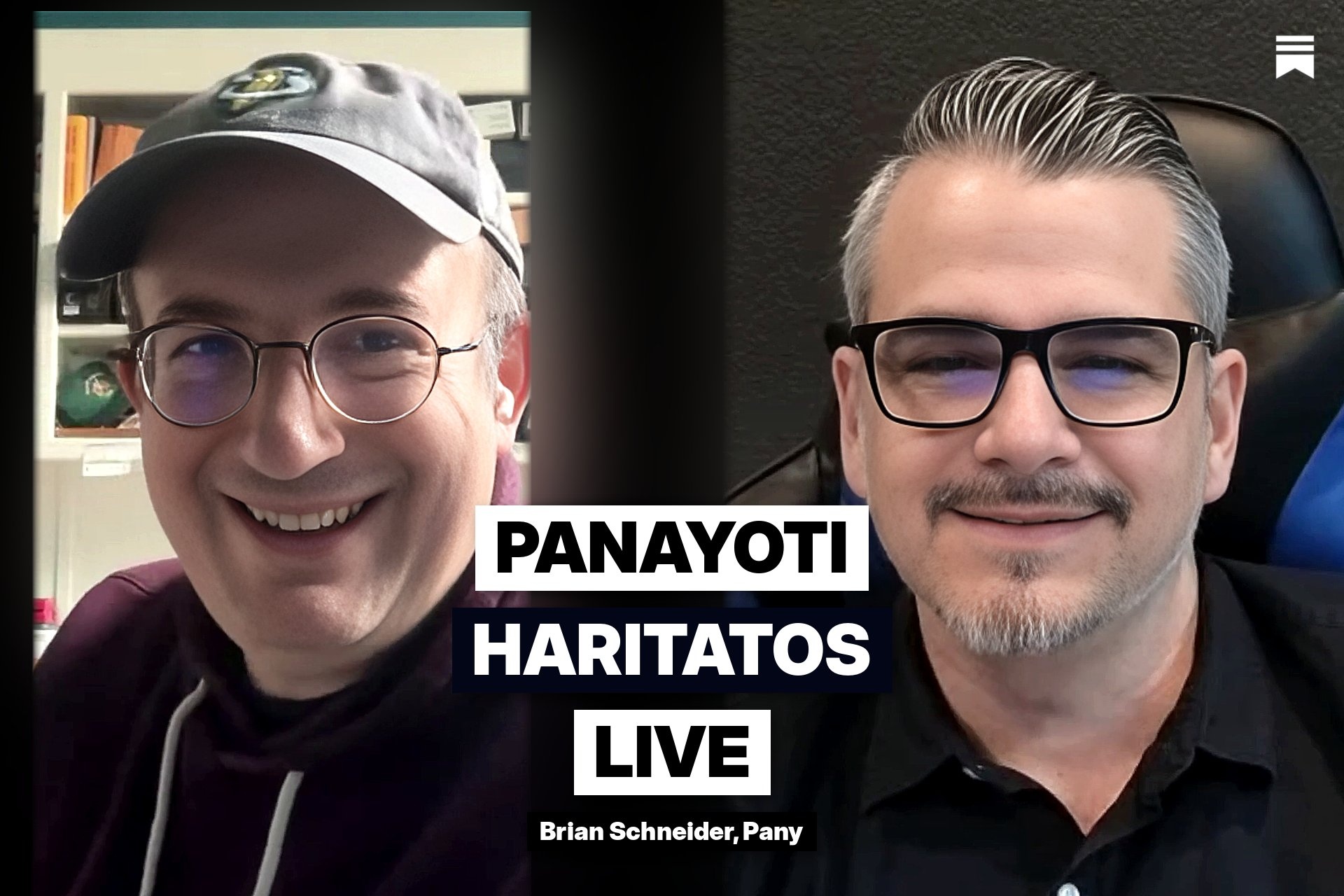
In September 2026, Haritatos appeared on Brian Schneider's Alternate Worlds podcast for a conversation about his career, teams, and family life. Schneider, also part of Series' leadership, knew him from their earlier work in games. It is a reminder that this apparently technical career is also a network of people who have kept making things together through changes in employers and platforms.
The question now is whether Haritatos can give a new creator some of the advantages he acquired over decades: production knowledge, a route to players, and enough room to try an unusual idea. The founder who once needed a platform has built another one. Its value will become visible in the games people finish, the audiences they find, and the next project they can afford to begin.
Keep the conversation going
- Series Entertainment
- Try RUN
- Haritatos on LinkedIn
- Haritatos on X
- Haritatos on Substack
- Why RUN · his own account
- The 2013 mobile publishing interview
- Rho Engine · GamesBeat interview
- BITKRAFT founder conversation
- Alternate Worlds · watch the interview
- Alternate Worlds · YouTube playlist
- Pixelberry acquisition · Game Developer
- Pixelberry staffing report · Game Developer