The red phone on Palmer Luckey's desk once belonged to the American nuclear command system. It is broad, bright and slightly ridiculous, the sort of object that would look at home beside a movie villain's swivel chair. Luckey bought it before founding Anduril, when he was known for virtual reality rather than military technology. Back then, it was Cold War memorabilia. Later it became a proposition. He wanted to build the things that mattered when a consequential call came in.
This is a convenient object with which to understand him. Luckey likes machines that collapse abstractions into something you can touch. A headset turns a rendered world into a place. A sensor tower turns a distant movement into a marked object on a screen. A handheld console turns nostalgia into machined magnesium, sapphire and precisely arranged pixels. Policy papers have never been his preferred medium. He prefers the stubborn eloquence of working hardware.
His public costume reinforces the point. The Hawaiian shirt, cargo shorts and sandals have survived trade shows, boardrooms and defense conferences. It reads as studied informality until you notice he dressed much the same before anyone was watching. Silicon Valley has produced plenty of uniforms. Luckey's is simply louder and better ventilated.
Before the future, a pile of obsolete headsets
Luckey was born in Long Beach, California, in 1992 and homeschooled by his mother. As a teenager he took classes at community colleges, sailed, repaired computers and haunted online forums populated by people whose hobbies required screwdrivers. In 2009 he co-founded ModRetro, a community devoted to “portabilization” - taking old consoles apart and rebuilding them as self-contained portable machines.
Virtual reality was another supposedly obsolete enthusiasm. Existing headsets were heavy, expensive and narrow in view. Luckey began building his own at 16. The first completed prototype, PR1, arrived in his parents' garage at 17. He kept going. By the time the project became a company, he had built more than 50 head-mounted displays, testing wider fields of view, lower latency and lighter parts. He financed the habit by fixing and reselling damaged iPhones and working as a groundskeeper, sailing coach and computer technician.
The breakthrough came through a relationship native to his world: a forum connection. Game programmer John Carmack asked to borrow a prototype and demonstrated Doom 3 on it at E3 in 2012. Attention followed. Luckey left California State University, Long Beach, where he had studied journalism and edited the student newspaper's website. Oculus VR launched a Kickstarter seeking $250,000. It collected $2.4 million.
The sale arrived almost indecently fast. Facebook agreed to acquire Oculus in March 2014 for $2 billion in cash and stock. Luckey was 21. The garage project now had the capital and distribution of a global platform. It also had a new owner, which meant the mythology of the lone tinkerer would meet payroll, law, politics and institutional control.
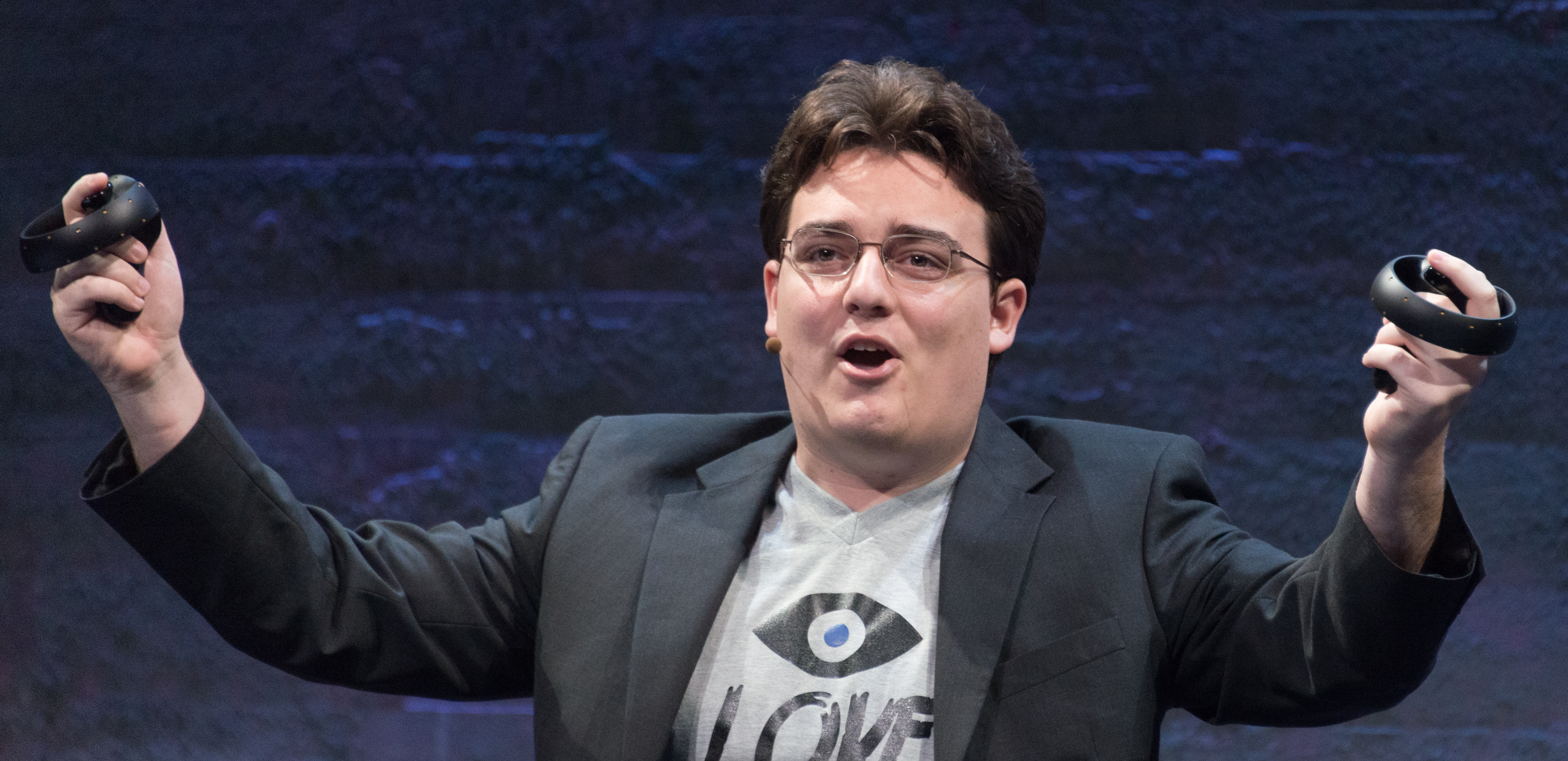
The five-year company
Oculus gave Luckey money, reach and a place in the story of consumer VR. It also supplied the rupture that shaped his second career. In 2016, news of his $10,000 donation to a pro-Donald Trump political group caused an internal and public controversy. He left Facebook in March 2017. Facebook did not give a specific explanation and later denied that politics caused his departure. Luckey has consistently described it as a firing tied to his political activity.
There are two incompatible corporate stories here and little value in sanding them into one. What mattered next was speed. One week after leaving Facebook, Luckey gathered prospective recruits at his Orange County home. They ate Chick-fil-A and heard a pitch for a new defense company. The presentation wanted “crazy mad scientists,” political connections and ample capital. Almost everyone at that first dinner joined.
The eventual founding group joined two networks. Joseph Chen had led hardware work at Oculus. Brian Schimpf, Trae Stephens and Matt Grimm came from Palantir. Founders Fund, an early Oculus investor, led Anduril's seed financing. Schimpf became chief executive; Luckey took the founder-technologist role. The name came from the reforged sword in The Lord of the Rings. A replica hangs on the office wall, because subtlety was never part of the brand guide.
Same loop, different stakes
Anduril's products look far removed from a gaming headset. Its Lattice software combines data from sensors into a common operating picture. Its catalog has expanded through surveillance towers, counter-drone systems, autonomous aircraft, undersea vehicles and rocket motors. Yet the operating instinct resembles early Oculus: spend internal money, build a functioning system and bring it to the user before a conventional procurement process has defined every requirement.
That method was easier to romanticize when the output was a game peripheral. At Anduril, the machines operate at borders and in wars. The company won the U.S. Customs and Border Protection program for autonomous surveillance towers. In 2022, U.S. Special Operations Command selected it to lead counter-unmanned systems work under a ten-year contract with a potential value near $1 billion. Anduril sent systems to Ukraine soon after the Russian invasion and has expanded work with Australia, Taiwan, South Korea and other American allies.
Luckey's argument is that autonomy can make military action more precise, give service members better information and rebuild deterrence by making capable systems in quantity. Critics see harder questions: how algorithmic weapons are governed, how surveillance changes borders and whether venture-backed speed deserves to outrun public oversight. The products refuse the comfort of a purely hypothetical debate. They are already being bought and deployed.
| Era | Object | Constraint | Luckey's answer |
|---|---|---|---|
| Oculus | Rift headset | VR was costly and unconvincing | Cheap components, wide view, rapid prototypes |
| Anduril | Lattice and autonomous systems | Slow procurement and disconnected systems | Build first, integrate software, iterate in the field |
| ModRetro | Chromatic handheld | Old games on compromised modern displays | Purpose-built screen, durable materials, exact behavior |
The reunion and the side quest
The strangest turn is a return to the face. In 2025, Anduril took over leadership of the U.S. Army's Integrated Visual Augmentation System program from Microsoft, subject to government approval, and announced a partnership with Meta on military extended-reality systems. The company that bought Oculus and the founder who left it were again working on headsets, now designed for soldiers rather than gamers.
The proposed EagleEye system ties Luckey's two careers into a near-perfect knot. A headset overlays information from Lattice onto what a service member sees, joining the immersive display work of Oculus to Anduril's sensor network. Luckey has described his mission as turning warfighters into “technomancers.” It is a very Luckey word: half role-playing game, half procurement pitch, delivered without detectable embarrassment.
Meanwhile, ModRetro returned. In 2024 the old forum name became a consumer hardware brand. Its first device, Chromatic, plays Game Boy and Game Boy Color cartridges. The design includes a metal shell, sapphire screen cover and a custom display built to reproduce the original pixel structure and color. Luckey called many of its development choices irrational. To him, that was praise.
The handheld clarifies something the defense story can obscure. Luckey remains a modder. He still likes the detailed argument hidden inside a physical object: this screen in sunlight, this button material, this latency, this battery. Anduril's scale has not removed that instinct. It has attached it to factories, aircraft and government budgets.
What the second life is for
Luckey is now a global defense salesman, a consumer-hardware founder, a political donor and a very online collector of technical enthusiasms. His connections run through John Carmack, Peter Thiel, Palantir alumni, Meta executives, military leaders and the retro-gaming community. They are not a tidy social graph. They are a map of the rooms into which his machines have carried him.
His stated aspiration is industrial as much as technological. He argues that the United States should recover the capacity to manufacture advanced physical systems quickly and at volume. Anduril's planned factories and software-defined products are meant to answer that thesis. ModRetro makes the domestic-hardware impulse playful; Anduril makes it strategic.
The unresolved question is whether the prototype loop that revived virtual reality can bear the weight placed on it in defense. A consumer can return an unsatisfying headset. A deployed military system lives inside chains of command, foreign policy and life-or-death decisions. Speed remains useful, but it is no longer innocent.
That tension gives Luckey's second act its shape. He is still trying to make the future arrive as a piece of hardware. The red phone waits on the desk. The sword hangs on the wall. Somewhere nearby, an engineer is making version 51.