The most important moment in PagerDuty's product is also the least glamorous. A machine notices trouble. A rule figures out who owns the service. A phone rings, then rings someone else if the first person sleeps through it. Somewhere between an angry customer and a blinking server rack, responsibility lands on a name.
That handoff is the business. PagerDuty did not invent software monitoring, and it does not repair every broken database. It makes the machinery around a digital emergency legible: collect the alarms, remove duplicates, find the owner, escalate, open the collaboration channel, run the approved diagnostic, update the people waiting and preserve enough evidence to learn later. In an outage, the product is an organizational chart that moves.
The company now calls this the PagerDuty Operations Cloud. The name is broad because the menu is broad - incident management, AIOps, runbook automation, customer-service operations, status pages and AI agents. But the original insight remains deliciously narrow. Three software engineers hated being on call, so they rebuilt the part that woke them up.
Monitoring sees smoke. PagerDuty connects the smoke detector to ownership, escalation, action and memory.
A business born from a bad night's sleep
Alex Solomon and Andrew Miklas studied at the University of Waterloo. They met Baskar Puvanathasan while working at Amazon, where all three experienced the grubby reality of supporting production software after hours. Existing alerting systems were inefficient enough to disturb both the service and the person responsible for it. In January 2009, they quit and began building in Toronto.
Their ambition was initially modest to the point of comedy: create a bootstrapped software company, reach $20,000 in monthly revenue, retire early and drink from coconuts on a beach. The beach kept moving. PagerDuty found paying customers before entering Y Combinator's Summer 2010 batch. The founders relocated to California and worked from an apartment with desks, beds and a bright pink lamp. Y Combinator mattered less as product school than fundraising school. The engineers already had usage; they needed a larger story.
“We started PagerDuty by solving the hair-on-fire problem of on-call incident response.”Alex Solomon, co-founder
The first thing that failed was not the software. It was the founders' small plan. By the time PagerDuty passed roughly $3 million in annual recurring revenue and 2,000 customers, the evidence argued for a category-sized company. The trio celebrated with a day in Napa while also pitching investors. The celebratory trip and the capital raise occupying the same day feels appropriately PagerDuty: even the milestone had an escalation policy.
Three Amazon engineers begin in Toronto.
Jennifer Tejada takes charge as enterprise demand grows.
PagerDuty lists on the NYSE at $24 a share.
Rundeck joins in a deal worth about $100 million.
John DiLullo becomes CEO as ARR passes $500 million.
The moat is not the ringtone
Paging an engineer can be copied. PagerDuty's sturdier advantage is the connective tissue accumulated around the page. It has more than 700 direct integrations across cloud platforms, observability products, ticketing systems, chat tools and business applications. It stores schedules, escalation policies, service ownership, response history and the sequence of actions people actually took. Those details become more useful as a company gets bigger and its systems stop fitting inside any one person's head.
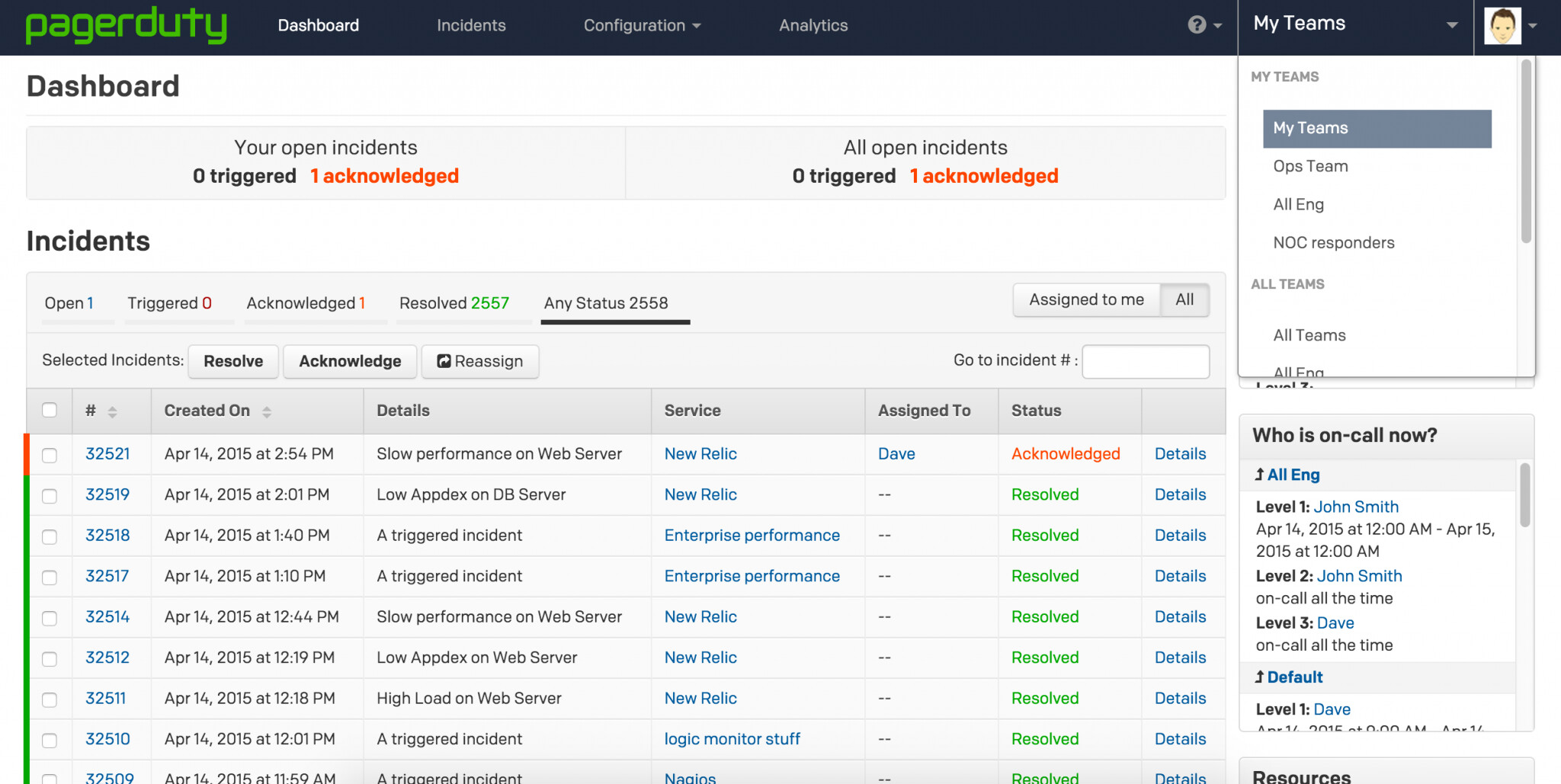
That explains the land-and-expand model. A development team can start with a trial and a schedule. The account grows as more engineers, services and departments join, or as the customer adds AIOps, automation and customer-service workflows. At the fiscal-2026 year-end, PagerDuty had 15,351 paid customers. Eight hundred sixty-one produced more than $100,000 in ARR; 79 produced more than $1 million. The biggest accounts are not buying a louder alarm. They are buying a common way for development, IT, security and support to behave under pressure.
The sticker price starts smaller than the organizational commitment. PagerDuty offers trials and packaged subscriptions, while public add-on pricing currently begins at $699 a month for AIOps and $415 a month for PagerDuty Advance for Incident Management. Large deployments are quoted, and their real cost includes the unbilled work: tuning alerts, mapping services, maintaining schedules, approving runbooks and training responders. That labor is also why a successful rollout becomes sticky.
Subscription revenue reached $492.5 million in the fiscal year ending January 2026, the company's first full year of GAAP profitability. In the July 2026 quarter, revenue was $124 million, up only 1 percent from the prior year, while ARR reached $501 million. That contrast describes the current assignment: protect a durable franchise, make the multiproduct platform credible and recover faster growth without turning every familiar feature into an AI slogan.
The machine takes the first shift
PagerDuty's expansion has followed a practical sequence. Incident management mobilized people. The 2020 acquisition of Rundeck added runbooks and machine actions, allowing a responder to execute a vetted diagnostic or repair without hunting down the expert who wrote it. Customer Service Operations connected support cases to engineering incidents. Jeli, acquired in 2023, deepened post-incident analysis. The platform keeps moving one step earlier and one step later around the original page.
AI agents are the latest move. The company's SRE Agent can join the rotation as a virtual responder, investigate with context from the surrounding stack and recommend a workflow before a person acknowledges the alert. PagerDuty Advance adds generative summaries and assistance inside Slack or Microsoft Teams. Its growing AI ecosystem includes Anthropic, Cursor and LangChain, while model-context integrations can put on-call knowledge inside developer tools.
This is a sensible place for applied AI because incidents contain a pile of expensive reading. Responders must inspect alerts, recent changes, service dependencies, old incidents and runbooks before touching production. A machine that assembles the evidence and proposes the next safe action can save minutes without pretending to be the final authority. The product is most persuasive as a prepared junior responder: quick, tireless, governed and expected to show its work.
Copy this
Start with one critical service. Name its owner, tune its alerts, write one safe runbook, rehearse the escalation and measure acknowledge and resolution time.
Do not copy this
Connect every noisy monitor, grant broad production permissions and call the result autonomous. Automation amplifies whatever operating discipline already exists.
What the brochure leaves out
PagerDuty does not create operational maturity by installation. It exposes the lack of it. If nobody can say who owns a service, an escalation policy merely documents confusion. If alerts fire for harmless fluctuations, faster delivery creates faster fatigue. If a runbook is stale or requires judgment that was never written down, an agent cannot safely improvise its way to reliability.
The market is crowded from several directions. incident.io and Rootly offer chat-native incident coordination. Atlassian can bundle Opsgenie-style alerting into Jira Service Management. ServiceNow owns deep IT workflows. Datadog and other observability vendors want to carry customers from detection toward response. Some experienced teams prefer the homegrown choreography already living in Slack, even when it is held together by memory.
PagerDuty earns its keep under particular conditions: enough services and responders to make routing difficult; enough business cost to make minutes matter; enough clean telemetry to distinguish an incident from a hiccup; and enough institutional discipline to maintain ownership, permissions and runbooks. A five-person team with three services may be perfectly happy with a simpler tool. A bank, retailer or streaming platform operating across time zones is purchasing something closer to air-traffic control.
PagerDuty works best when the emergency process is already worth improving. It is not a substitute for having one.
A playbook worth stealing
Founders can copy the shape of PagerDuty without copying incident management. Begin with a painful moment, not a grand platform. Make the handoff of responsibility unmistakable. Integrate with the tools on both sides of that moment. Record the data created by the workflow. Then expand into adjacent actions only after customers pull the product there.
PagerDuty's founders changed their minds when the little bootstrapped escape plan collided with real demand. They hired salespeople as larger contracts appeared. Solomon recruited Tejada in 2016 and moved from CEO to product strategy rather than treating the founder title as a permanent entitlement. The company raised $90 million at a $1.3 billion valuation in 2018, went public the next year and used acquisitions to move from alerts toward automation.
Now another handoff is underway. John DiLullo became chief executive in May 2026, while Tejada shifted to executive chair. He inherits a recognizable verb - teams casually say they were “paged” - and a company whose mature core grows more slowly than the AI story surrounding it. The test is not whether PagerDuty can put an agent on call. It is whether customers trust that agent with the first consequential minutes of a bad day.
The company built its reputation by knowing exactly when to interrupt a human. Its future depends on learning when not to.
Continue the shift