At two in the morning, a pager performs one useful trick: it ruins the night of precisely the right person. Then the difficult work begins. Which service failed? Who owns it? Has this happened before? Who tells the customer? Which half-remembered runbook still applies? An alarm is merely an invitation to confusion.
- incident.io puts paging, response, status communication and investigation into one operating system for bad days.
- Its wedge was a Slack workflow built at Monzo; its advantage is the context accumulated around every incident.
- Public plans run from free to $25 per user per month for Response, with On-call sold separately or as an add-on.
- The product is strongest for software organizations already living in Slack or Microsoft Teams and tired of tool sprawl.
incident.io was founded by Stephen Whitworth, Pete Hamilton and Christopher Evans, three colleagues who had met while dealing with incidents at Monzo. Banks are excellent laboratories for operational anxiety. Chris built a Slack integration to relieve some of the toil around incidents. Engineers used it. Then people outside engineering used it. The lesson was not that Slack needed another bot. It was that incident response had been designed as a technical alarm when it was really an organizational performance.
In 2021 the trio left to make that performance less amateur. They rented a room in a former London fire station, a detail so exquisitely on-brand that a novelist would have removed it. The company began with Response: declare an incident in Slack, create the channel, appoint the roles, record the actions, prompt the updates and retain the timeline. The novelty was not any single button. It was placing the process where the conversation was already happening.
“Waking someone up is table stakes. What happens next is where the value is.”incident.io’s founding argument
A suite assembled in the order panic occurs
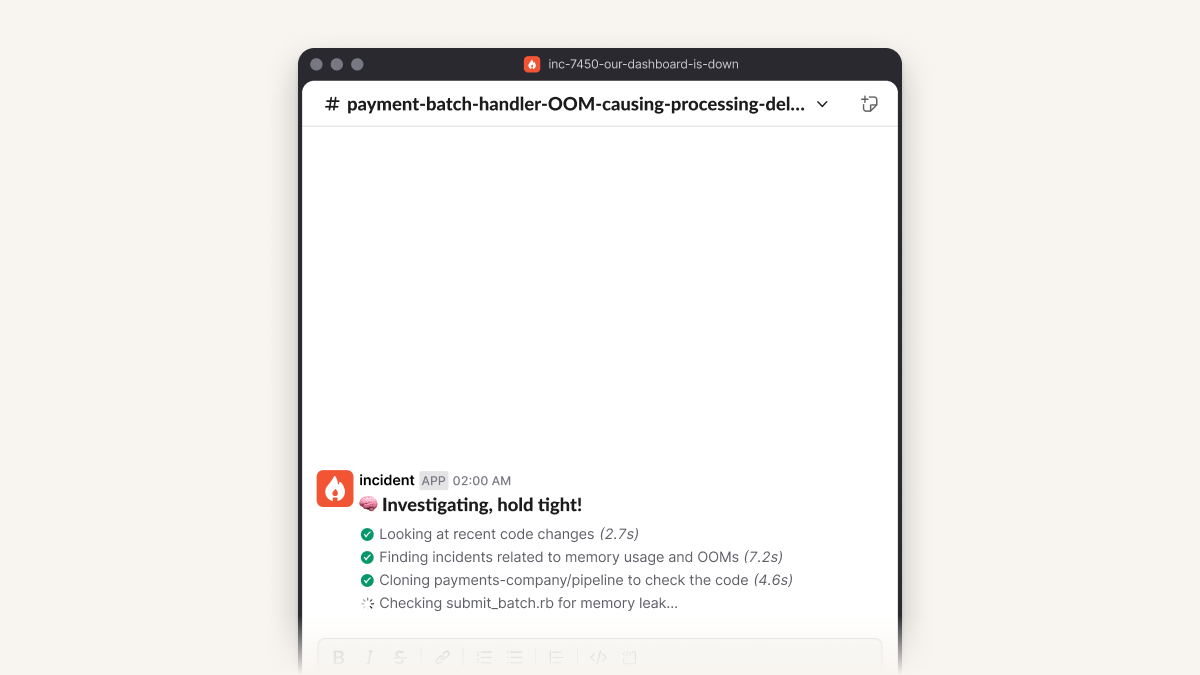
The product expanded with almost suspicious logic. Response arrived first because coordination fails first. Status Pages followed in 2023 because somebody must explain the trouble without distracting the people fixing it. On-call arrived in 2024 because the person must be found before a room can be useful. Investigations followed as an AI SRE: it examines telemetry, recent deploys, code, old incidents and public Slack context, then proposes a cause with evidence attached.
The joining tissue is now called Nexus, a living model of a customer's production environment. In ordinary English, it is the memory the products share: services, owners, dependencies, deploys, dashboards, documents and previous failures. This is incident.io's real competitive claim. PagerDuty can page; Statuspage can publish; Jira can hold a follow-up; Slack can contain the argument. When one system sees all of them, the argument becomes data for the next incident.
The customers bought fewer tabs
Enterprise software is fond of promising transformation when what buyers often want is subtraction. Intercom had Slack, PagerDuty and Atlassian Statuspage. It moved hundreds of engineers to incident.io in weeks and consolidated three tools. Netflix had a mature process conducted through Jira and a single Slack channel, but tacit knowledge does not scale neatly to thousands of engineers. It now runs more than 25 internal status pages and tens of thousands of Catalog entities. Those pages are not for viewers wondering whether a film will load. They are for one engineering team trying to understand another.
Zendesk offers the most legible economic case: more than 800 hours of annual operational work removed and at least $500,000 in first-year savings reported on incident.io's customer pages. Those are vendor case-study figures, but they explain the buying motion. The software is not sold merely against downtime, an expense whose counterfactual is slippery. It is sold against licenses retired, updates automated, post-mortems shortened and senior engineers returned to planned work.
What it costs, and what it asks of you
The Basic plan is free and includes native response in Slack or Teams, single-team on-call and a status page. Team Response is publicly listed at $15 per user each month on an annual contract, or $19 monthly, with On-call available for another $10. Pro Response is $25 per user each month, with the On-call add-on at $20. Standalone On-call is also $20. Enterprise pricing is negotiated.
The larger price was paid by investors. A $4.7 million seed round in 2021 was followed by a $28.7 million Series A in 2022 and a $62 million Series B led by Insight Partners in 2025. The disclosed total is $95.4 million. TechCrunch reported a valuation around $400 million, while noting the company itself did not disclose one. Capital bought the familiar things - engineers, American expansion and sales - but it also financed a move from workflow software toward an agent that interprets production systems.
The first thing that failed was the old idea of failure
The founders did not change their minds because of a grand market report. They watched a small internal tool escape its intended audience. At Monzo, incidents included service outages, security problems and overwhelmed support teams. A process built for engineers became useful across the company. That adoption changed the unit of design: not the responder, but the organization around the responder.
A similar change shaped the AI work. The first production feature, suggested incident summaries, began as a prototype and was built into a working version by an engineer and a data analyst in five days. Yet the team waited for model performance and reliability to improve, kept a human acceptance step and discovered that evaluation was harder than the API call. Half of summary updates were AI-written soon after launch. The useful pattern here is restraint: automate the draft, preserve the review.
The parts worth stealing
- Enter through the workplace where the urgent conversation already occurs.
- Turn good practice into defaults and prompts, not another PDF nobody opens at 2 a.m.
- Keep the exhaust. Today's timeline becomes tomorrow's diagnosis.
- Use design partners for stressful workflows, then test reliability continuously.
- Let AI recommend and draft before allowing it to publish or repair.

A rational buyer’s test
incident.io fits a particular market position. It is broader than a Slack incident bot, more product-minded than a general IT service-management suite, and increasingly willing to confront PagerDuty on paging. Its nearest rivals include Rootly, FireHydrant, ServiceNow, Grafana IRM and specialist AI SRE vendors, while its most persistent competitor is the home-built stack that seems free because nobody invoices the glue.
There is one unavoidable condition: incident.io requires Slack or Microsoft Teams, even for On-call. That is not a footnote. It is the architectural wager. The company believes reliability improves when the system of record and the place people speak are joined. For organizations that dislike that premise, the product will feel oddly dependent. For those already conducting every outage in chat, it feels less like adding software than tidying up the room.
By September 2026, the company said its Investigations product had cut the median time to an accurate in-channel message from 6.7 minutes to three. That metric is more interesting than the standard AI theater. It measures not whether a machine can produce an answer, but whether it can produce a useful answer before a tired engineer has assembled the same context by hand. The pager still ruins the night. incident.io's business is making sure it ruins as little of the night as possible.