Consider a perfectly ordinary software release. The code is ready. Someone must build it, test it, scan it, move it into the right environment and decide whether it is safe to leave there. Now give the company twenty teams. Each has inherited a slightly different way of doing those jobs. The application is new. Much of the ceremony is familiar.
- The product: visual CI/CD workflows built on Tekton for Kubernetes.
- The buyer: platform and DevOps teams trying to share delivery standards.
- The bet: reuse the workflow, then govern the release.
That repetition is Ozone’s opening. The company packages software delivery around reusable tasks and pipelines, with a visual studio for assembling them. Its customer is the organization that wants developers to ship applications without requiring each team to become the resident authority on every deployment tool. The appeal lies in an everyday question: how often should competent people solve the same plumbing problem?
The same job, written again
Ozone builds on Tekton, the open-source framework for cloud-native continuous integration and delivery. A task describes a unit of work, such as building an image or running a security check. A pipeline connects those units. Ozone supplies a catalog and a visual interface around this machinery, letting engineers assemble workflows from existing pieces and add custom logic where necessary.
The distinction matters. A visual editor alone changes how a workflow looks. A reusable catalog changes how knowledge travels. Ozone’s documentation describes platform engineers defining delivery templates that other teams can consume, with controls over which Kubernetes clusters those teams may use. Security checks, performance tests and code-quality checks can become parts of a shared process instead of recurring requests.
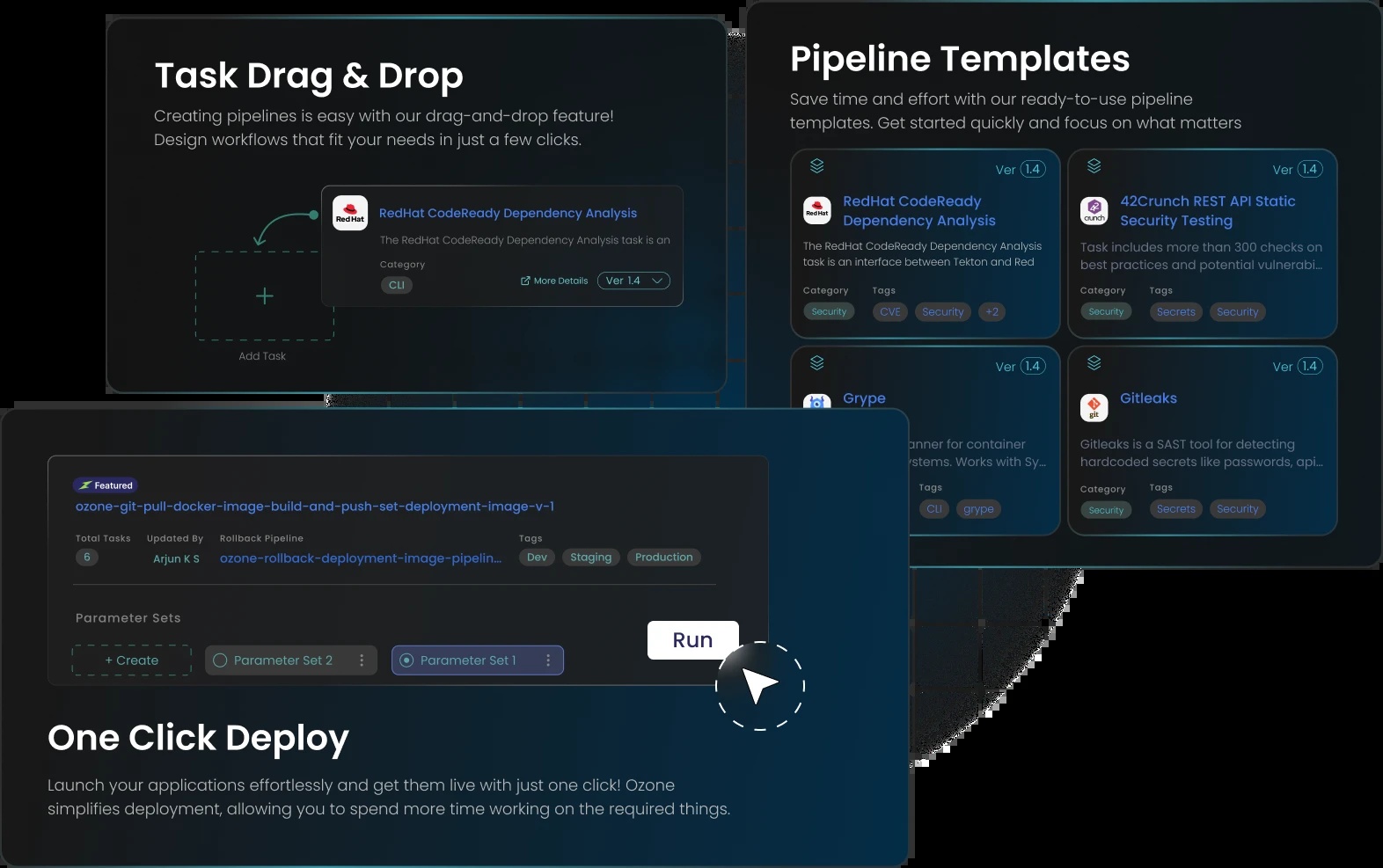
There is room for different tools inside that standard. Ozone documents integrations for source repositories, registries, security scanners and monitoring providers. A team can preserve choices it has already made while connecting their results into a delivery workflow. That is particularly relevant when the platform team owns the process but application teams arrive with different languages, frameworks and preferences.
A catalog with consequences
The release is a separate object in this arrangement. Ozone’s release documentation describes pipelines wrapped with approval stages. A repository event can start a build and automated scans; a human approval can sit between that work and promotion to another environment. Speed and permission become decisions expressed in the workflow.
The platform also reaches beyond the moment of deployment. Its verification setup connects application-performance data with logs, Kubernetes events and metrics. Operators choose an anomaly sensitivity and whether to enable automatic rollback. That setting deserves attention: an automated response inherits the judgment encoded in its thresholds. Someone still has to decide what counts as suspicious behavior.
- 01AssembleTasks + templates
- 02CheckTests + scans
- 03ApproveRelease gates
- 04ObserveVerify + recover
The migration tax
There is an awkward fact about a better delivery system: the old one already works well enough to survive. Its scripts contain decisions, exceptions and accumulated habits. Moving to another framework means carrying that history across. Ozone addresses this with AI-assisted conversion from Jenkins, GitLab and Azure pipelines to Tekton.
The documentation makes the mechanism concrete. Users can synchronize an external integration or import a standalone pipeline, select its type, paste the code and request conversion. A chat interface allows further changes, and a toggle reveals the original pipeline. The sensible evaluation follows from that design: compare behavior, examine the output and test the exceptions before trusting a production migration.
“Our mission is to make every enterprise great at application delivery.”Ozone · About
The details tell on the product
The company lists three co-founders: CEO Ashok Chakravarthi Arulmozhi, president Dilip Kalliyat and CTO Siva Gurunathan. A founder announced Ozone Cloud Edition for CDCon in June 2021. By October 2023, Ozone was presenting a CNCF-hosted webinar about GitOps and Tekton. Its teaching followed its product: explain the workflow, then let developers try the parts.



Its 2024 updates reveal the less glamorous work of enterprise software. June’s Limited Agent feature allowed clusters to connect with specific namespaces and restricted permissions. August brought a centralized approval catalog and custom approval stages. In the same release, “Variables” became “Secrets.” Naming, permissions and approvals are small details until several teams must agree on what they mean.
The October 2024 release notes, published in December, added software bill of materials views, enhanced scanning reports and sidecar logging. Read together, these changes suggest a product expanding around the responsibilities that surround a pipeline. The engineering work continues after someone has successfully dragged the boxes into place.
What the subscription buys
Ozone sells subscriptions, with a free tier and paid plans that add controls, retention, support and deployment options. Its pricing table lists up to five users and 36 vCPU for the free plan. Enterprise includes self-hosting. The page displays a $1,000 Starter figure alongside a separate per-vCPU monthly rate, so an actual budget needs a confirmed quote and infrastructure assumptions.
Jenkins is the comparison Ozone makes explicitly. The broader choice includes existing CI services or assembling a Tekton environment internally. Ozone’s commercial proposition is the surrounding product: shared catalogs, visual authoring, integrations and governance. Its July 2024 notes also announced AWS Marketplace availability, giving enterprise buyers another procurement route.
The operational picture matters as much as authoring. Ozone’s observability documentation describes collecting events, metrics and logs across linked clusters, including retaining Kubernetes events for later analysis. A release problem can outlive the transient event that explained it. Keeping that evidence accessible gives teams a way to investigate the workflow they actually ran.
Borrow the habit
A useful trial would begin with one application and one repeated workflow. Record how much work goes into maintaining it, move the common checks into a template and see whether another team can use it. Reuse becomes valuable when a change to the standard stops requiring a fresh explanation in every team.
That logic fits organizations with Kubernetes workloads, repeated delivery steps and people willing to own the shared templates. A small team with a simple, stable workflow may gain less from another platform. Ozone makes the common process easier to express. The organization supplies the agreement about what that process should be.