There is a small blue storefront on a residential street, and inside it very little is for sale. A counter, a fitting room, shelves for brown parcels. People arrive, show a code on a phone, inspect a pair of shoes or collect cat litter, and leave. It looks like a shop after retail has been removed from it. In Ozon's version of commerce, this is the final screen.
The company began in 1998 as a web bookstore in St. Petersburg, when a Russian online transaction was still an act of optimism. Its founders, Alexander Egorov and Dmitry Rudakov, worked from the software house Reksoft and a science-fiction publishing project. Books became CDs, electronics, clothes and household goods. But expanding the catalog was only the visible work. Russia offered long distances, uneven delivery infrastructure and consumers accustomed to cash. To make the website useful, Ozon had to build what sat behind it.
That decision still defines the company. Ozon is now a multi-category marketplace, but the word “marketplace” is too flat. It is also seller software, ad inventory, warehouses, sorting hubs, couriers, parcel lockers, pickup points, a travel desk and a bank. In 2025, 65.1 million active buyers placed 2.481 billion orders. The average active buyer ordered 38 times, up from 26 a year earlier. Shopping had stopped being an occasional expedition and become a household rhythm.
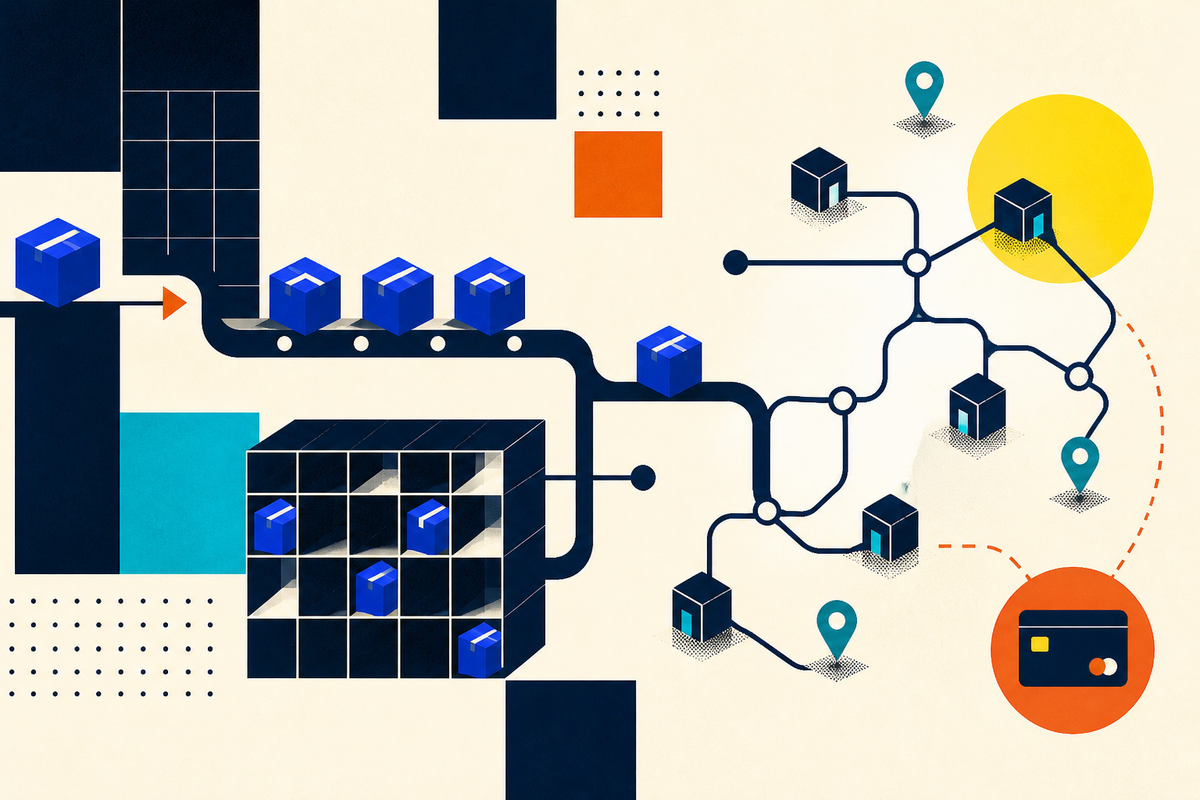
The store is the easy part
Ozon's consumer proposition is familiar: search a large assortment, compare price and reviews, pay in an app and choose where to receive the order. The harder proposition is made to merchants. A seller can list a product, buy promotion, use Ozon's analytics, let Ozon store and pack inventory, or keep stock independently and hand parcels into the network. Settlements, lending and working-capital products sit nearby. For a small manufacturer far from Moscow, the platform compresses a stack of jobs into one relationship.
The shift from retailer to platform is the hinge. Ozon opened its marketplace to third-party sellers in 2018. By 2025, merchants generated about 84 percent of GMV. Ozon still sells some merchandise itself, but the center of gravity is service revenue: commissions, fulfillment, delivery, advertising and other tools. The company earns more ways to participate in a sale without buying every toaster first.
For a merchant, the menu is deliberately modular. One business can send pallets into Ozon fulfillment and hand over storage, picking, packing and delivery. Another can keep goods in its own warehouse and use the marketplace mainly for demand and the last mile. A brand can promote individual listings, study conversion and search data, adjust prices, schedule payments or seek financing against the activity of its store. For a buyer, those operational choices disappear behind a delivery date and a pickup-point map. That separation is the service: Ozon absorbs complexity from both sides, standardizes it, then charges at several points along the transaction. It also gives small businesses access to regions they could not economically serve on their own. The trade-off is dependence. Changes to ranking, commissions, storage rules or promotion can alter a seller's economics quickly, which makes predictable platform governance as important as clever software.
The loop feeds itself. More sellers improve selection and price competition. More buyers attract more sellers. More orders justify denser logistics, which shortens delivery and spreads fixed costs across more parcels. Better convenience raises order frequency. The interesting part is that half this loop is physical. A recommendation engine can be copied more quickly than a regional fulfillment network.
“If there are no suitable solutions on the market, we develop our own.”Ozon Tech, describing its engineering approach
A map made of counters
By the end of 2025, Ozon said its warehouse infrastructure exceeded five million square meters. It counted 50 fulfillment centers, more than 150 delivery hubs and roughly 84,000 pickup points. About half the pickup points were in towns and rural settlements with fewer than 50,000 people. The company estimated that the network put an Ozon counter within walking reach of around 130 million residents.
Pickup points solve several last-mile problems at once. One van can deliver many parcels to a counter instead of visiting many apartment doors. Customers do not need to wait at home. Clothing can be tried on, returns can be handed back, and a proprietor can operate the point as a small local business. The model is not glamorous, which may be its charm. It turns a former phone shop or ground-floor room into a standardized interface between national inventory and a neighborhood.
This is where Ozon differs most usefully from global analogies. Calling it the “Russian Amazon” explains the category but not the adaptation. Amazon optimized around its own markets and delivery habits. Ozon learned in a geography where logistics could not be treated as a utility purchased at the edge. Its closest rival, Wildberries, also built an enormous pickup network; Yandex Market brings its own technology and logistics; Avito dominates a different kind of person-to-person discovery. Competition is less a beauty contest between homepages than a race for sellers, delivery density and daily habit.
GMV including services / RUB trillions
GMV is the value of transactions and services processed, not Ozon's revenue. Group revenue in 2025 was RUB 998 billion.
The bank inside the basket
Commerce gave Ozon a distribution channel for finance. Ozon Bank now offers accounts, cards, savings, payments and credit to consumers, plus acquiring, settlement and financing products for businesses. At the end of 2025, the fintech segment had 41.7 million active clients, up 38 percent in a year. Its revenue more than doubled to RUB 195.2 billion. Around 60 percent of Ozon Card transaction volume occurred outside the marketplace, a sign that the financial product was beginning to stand on its own.
The fit is practical. A marketplace knows when a merchant sells, what moves and when money is due. It can shorten settlement or offer financing around that activity. For buyers, a card or account can reduce payment friction and attach rewards to repeat shopping. Ozon Pay has moved beyond the company's checkout, offering outside online stores a bundle of acquiring, electronic receipts and Ozon delivery. The infrastructure built for an internal problem becomes a product for someone else's website.
Other adjacencies follow the same logic with mixed degrees of closeness. Ozon Travel sells flights, rail tickets, hotels and tours to an audience already comfortable transacting in the app. Ozon Fresh handles groceries and everyday goods on faster delivery cycles. Ozon Global brings overseas sellers into the catalog. Advertising lets merchants pay for attention where purchase intent is already visible. Each service either increases the number of reasons to open Ozon or raises the amount Ozon can earn from traffic it already has.
Growth meets the margin test
Marketplaces have a recurring tension: the things that delight buyers can be the things that irritate sellers or consume cash. Low prices, fast shipping and lenient returns must be funded somewhere. Commissions, storage charges and advertising improve platform economics, but merchants notice every fee. Financial products add earnings and convenience, but also credit and regulatory risk. Dense logistics is an advantage once volume arrives; before then, it is an expensive collection of roofs and conveyor belts.
Ozon's recent numbers show the model maturing. Group revenue reached RUB 998 billion in 2025, up 63 percent, while adjusted EBITDA rose to RUB 156.4 billion. In the second quarter of 2026, GMV increased 37 percent from a year earlier to about RUB 1.3 trillion. Active buyers reached 69.2 million, and the company reported group net profit of RUB 10.1 billion for the quarter. A profitable quarter does not settle the long argument over marketplace economics, but it changes the question from whether scale can produce earnings to whether those earnings can persist.
Books first. Ozon launches online from St. Petersburg.
The platform turn. Third-party sellers become the engine of assortment.
Public debut. A $990 million Nasdaq IPO values Ozon at about $6.2 billion.
Banking arrives. Ozon Bank becomes the regulated center of its fintech push.
Four-trillion-ruble year. GMV reaches RUB 4.16 trillion.
A profitable quarter. Ozon reports RUB 10.1 billion in second-quarter net income.
The company sits at the center of Russian digital retail: between millions of households looking for selection and convenience, and merchants looking for national reach without assembling their own stack. Its expertise is not any single category on the shelf. It is coordinating catalog data, search, demand, money and the motion of physical objects at high frequency. Ozon Tech says more than 8,000 IT specialists work across the system, operating the kind of high-load architecture that makes an ordinary-looking checkout possible.
And that blue pickup room remains the most concise explanation. Twenty-eight years after two programmers put fantasy books on the Russian internet, Ozon's useful invention is a place where the shelves belong to everyone and the inventory belongs somewhere else. The customer sees a code, a counter and a parcel. Behind it is the actual product: a set of roads, digital and physical, that Ozon built around the store.